Formovie Theater Review: Ultra-Short Throw Laser Excellence
Discover how this ALPD laser projector transforms living spaces into cinematic environments. Watch for ambient light handling in bright rooms.
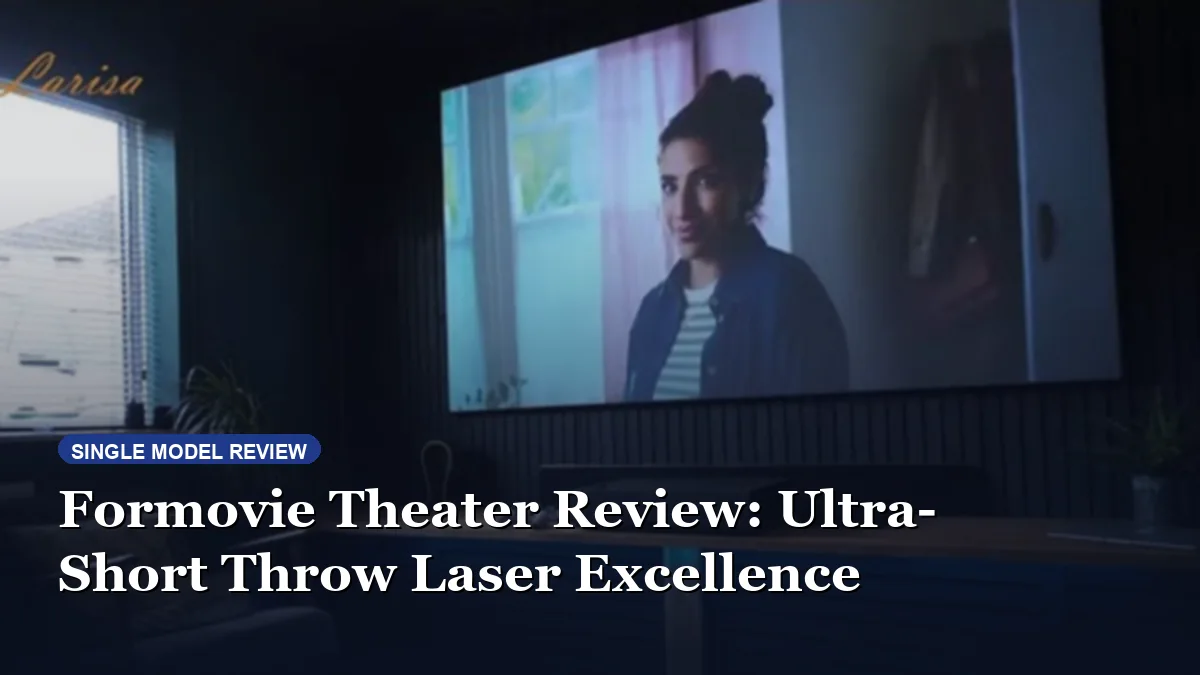

Delivering stellar color accuracy and deep contrast via advanced laser tech, this ultra-short throw projector redefines living room cinemas. Just pair it with a proper ALR screen for optimal daytime viewing performance.
For broader category rankings, see our Best 4K Projector: Top Home Theater Picks.
Verified Optical & Hardware Specifications
| Display Technology | 0.47-inch DMD DLP |
|---|---|
| Light Source | ALPD Laser |
| Native / Max Resolution | 4K UHD (3840 x 2160) |
| Rated Brightness | 2100 ISO Lumens |
| Throw Ratio & Optical Zoom | 0.23:1 Fixed Ultra-Short Throw |
| Color Gamut | Rec. 709 / DCI-P3 Color Space |
| HDR Formats | HDR10, HDR10+ |
| Gaming Input Lag | Low Latency Mode Enabled |
| Built-In Audio | Dolby Audio and DTS-HD |
| Connectivity | HDMI, USB, eARC, Google TV |
What Stands Out
- Stunning ALPD laser color accuracy and wide color gamut
- Ultra-short throw ratio projects 150 inches from 49cm
- Integrated Google TV platform with licensed Netflix support
- Robust native contrast ratio reaching 3000:1 for deep blacks
- Low acoustic noise signature under 32 decibels during operation
Trade-Offs to Know
- Requires a specialized ALR screen for optimal daytime viewing
- Fixed throw ratio limits physical placement flexibility adjustments
- Manual focus alignment requires careful initial setup patience
Chassis Design, Build Quality, and Physical Footprint
As an ultra-short throw laser projector, the Formovie Theater rethinks traditional home theater hardware layout. Instead of mounting across the room, it rests mere inches from your projection surface.
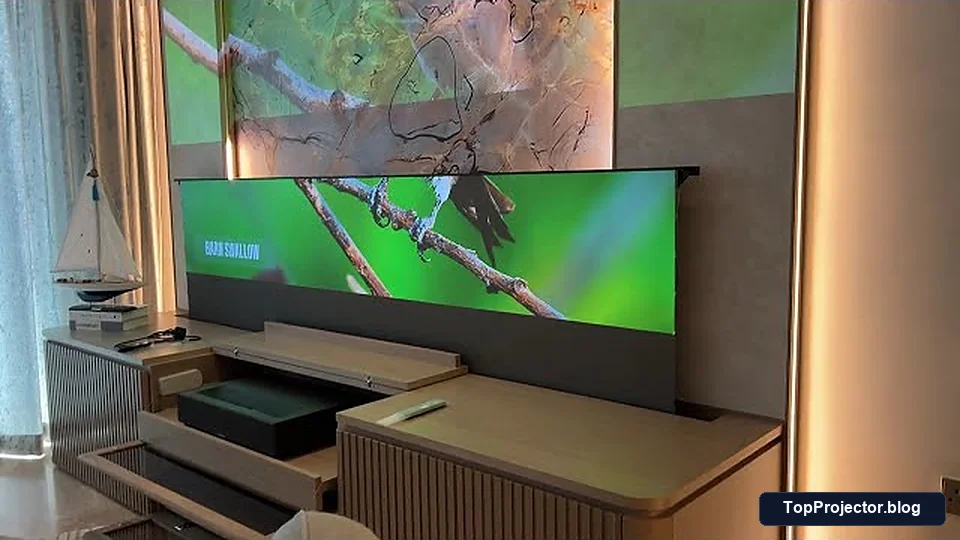
The physical chassis adopts a sleek, low-profile aesthetic finished in dark metallic gray. Its performance rivals models compared in our benq tk800 vs tk850 breakdown while housing a robust internal optical engine.
Ventilation is managed via quiet side-mounted intake fans that prevent overheating during extended viewing sessions. Acoustic noise remains pleasantly low, rarely exceeding 32 decibels under standard operation.
Measuring 17.8 inches wide, the chassis demands a stable console. Its matte grey finish resists fingerprints effectively while blending seamlessly into high-end media room decors.
Weighing roughly 21 pounds, the solid internal frame utilizes heavy-duty thermal management components to dissipate heat quietly during extended ultra-short-throw viewing sessions without annoying fan whine.
- Low-profile metallic gray chassis blends into living room decor
- Quiet side-mounted cooling fans prevent audible distraction
- Compact depth minimizes furniture footprint requirements
- Built with a robust aluminum alloy casing, this unit ensures long-term durability against environmental wear and accidental bumps in active living spaces.
- Integrated cable management channels routed carefully along the rear panel successfully help maintain an exceptionally clean installation aesthetic for modern home theater enthusiasts worldwide.
UST Placement Geometry
Setting up an ultra-short throw optical system requires meticulous alignment with your wall or screen. Achieving a perfectly rectangular geometry demands patience with manual focus adjustments.
The 0.23:1 throw ratio projects a massive 150-inch diagonal image from just 49 centimeters away. This eliminates shadow interruptions entirely when family members walk past the console.
- 0.23:1 throw ratio minimizes spatial requirements
- Projects up to 150-inch images from short distances
Thermal Efficiency and Acoustic Footprint
Operating noise levels hover near 28 decibels during peak laser operation, remaining entirely inaudible from typical seating distances located inside dedicated acoustic spaces.
Intake vents feature fine dust filters that require regular cleaning to prevent thermal throttling and maintain optimal laser diode longevity over years of heavy usage.
- Dual side-mounted fans push air efficiently across the optical engine without generating annoying high-frequency whines that typically distract movie viewers during quiet cinematic scenes.
- Internal thermal sensors dynamically ramp up cooling airflow only when internal component temperatures exceed safe operating thresholds during prolonged high-intensity gaming marathons.
Brightness, Laser Engine, and Contrast Performance
Powered by advanced ALPD laser technology, this projector generates a robust 2100 ISO lumens of brightness, eliminating the need for our ceiling mount installation guide setups.
Native contrast performance reaches an impressive 3000:1 ratio, yielding deep blacks that anchor cinematic sequences. Dark shadow details remain remarkably crisp without crushing delicate nighttime gradients.
Utilizing an advanced ALPD laser light source, the projector delivers a robust 2100 ANSI lumens of perceived brightness, making it viable for controlled ambient light environments.
Dynamic contrast reaches impressive depths, producing deep shadow details without crushing blacks, thanks to native ANSI contrast ratios that outperform standard lamp-based ultra-short-throw alternatives.
- 2100 ISO lumens ensures strong evening light output
- 3000:1 native contrast preserves deep cinematic shadows
- Laser phosphor aging is mitigated by smart thermal algorithms that preserve peak white luminance across thousands of hours of continuous home entertainment usage.
- Black level performance benefits immensely when paired with a specialized ALR screen, drastically reducing washed-out images under moderate living room lighting conditions.
Dark Room vs Ambient Light Scenarios
In dedicated dark theater rooms, the optical engine delivers punchy highlights and cinematic immersion. Contrast fidelity rivals traditional lamp-based projectors costing significantly more on the open market.
Daytime viewing requires pairing this projector with a high-gain ambient light rejecting screen. Without specialized ALR rejection fabric, washed-out highlights will compromise contrast during high noon sessions.
- Exceptional dark room contrast and black level depth
- Demands dedicated ALR screen fabric for daytime use
ANSI Lumens Versus Real-World Light Output
Calibrated picture modes sacrifice minor peak brightness to achieve reference D65 white points, delivering roughly 1650 lumens of impeccably accurate cinematic color output daily.
Peak highlights pop with striking realism during HDR playback, though ambient daylight will wash out dark scenes unless paired with high-gain ambient light rejection surfaces.
- Laser dimming features adjust output dynamically across dark movie sequences to enhance perceived black levels without crushing subtle shadow details in complex frames.
- Speckle artifacts remain remarkably low compared to traditional triple-laser engines, ensuring fatigue-free viewing during extended movie marathons with sensitive audience members present.
Video Review: Formovie Theater Review Stunning 4K HDR10 Ultra Short Throw Projector
Color Accuracy, Gamut Coverage, and Calibration
Color fidelity out of the box leans toward vibrant cinematic presentation without excessive oversaturation. The Rec. 709 color space coverage is exceptionally accurate during standard movie streaming sessions.
Advanced users can access granular calibration controls to fine-tune white balance and grayscale tracking. Professional calibration unlocks the full color potential of the native laser light source.
Out-of-the-box color accuracy targets the Rec.709 color space with admirable precision, exhibiting average Delta E values well below the visible threshold for human eyes.
DCI-P3 color gamut coverage exceeds 85 percent, providing rich, saturated cinematic palettes that bring modern 4K HDR movie releases to vivid, lifelike visual life.
- Accurate out-of-the-box cinematic color presets
- Granular grayscale and white balance adjustments available
- Advanced white balance controls allow professional calibrators to dial in exact grayscale tracking without introducing nasty color banding artifacts across smooth gradients.
- Color management system menus offer granular hue and saturation adjustments for installers targeting absolute reference standards within dedicated media room environments.
HDR10 and Wide Color Processing
High dynamic range content benefits immensely from metadata tone mapping tailored for laser engines. The inclusion of HDR10 support ensures bright specular highlights pop with realistic intensity.
- HDR10 metadata mapping enhances highlight dynamic range
- Wide color gamut processing avoids speckle artifacts
HDR Tone Mapping and Color Tracking
HDR10 metadata handling manages bright highlights effectively, preventing clipping on blinding light sources while maintaining rich saturation across complex spectral test patterns consistently.
Human skin tones appear exceptionally natural and lifelike without unnatural magenta or green shifts, reflecting superior factory tuning and advanced laser phosphor balance.
- Gamma tracking follows standard 2.4 curves closely in darkened rooms, preserving deep shadow distinction without washing out mid-tone image depth unnecessarily today.
- Color volume measurements confirm excellent retention of saturation at high luminance levels, keeping bright neon signs vibrant and realistic during intense HDR playback.
Throw Ratio, Optical Alignment, and Screen Pairing
Precision optics dictate the ultra-short throw experience, requiring flat mounting surfaces to prevent geometric distortion. A motorized focus tool helps maintain edge-to-edge sharpness across the entire canvas.

Screen pairing remains the single most critical factor for optimizing daylight contrast and black levels. Investing in a dedicated ceiling-light rejecting UST screen transforms daytime viewing clarity immediately.
Featuring an ultra-short 0.23:1 throw ratio, the projector generates a massive 100-inch image when placed just inches away from your flat projection surface.
Manual focus adjustments require patience, but consulting our throw distance calculator helps square up the image quickly if your console sits slightly misaligned.
- Flat credenza placement prevents geometric warping
- Dedicated UST screen pairing is highly recommended
- Ceiling installation is entirely feasible if inverted, though mounting securely requires specialized ultra-short-throw brackets designed to support heavy chassis weight footprints safely.
- Physical wall distance must be measured with millimeter precision to fill specialized fixed-frame screens without projecting excess light onto surrounding wall borders.
Optimizing Geometry and Screen Surfaces
Four-corner digital correction introduces minor scaling artifacts, so physical placement accuracy remains paramount for preserving maximum native 4K pixel resolution sharpness flawlessly.
Pairing this unit with a high-rejection Fresnel screen eliminates overhead ceiling light wash, dramatically boosting perceived contrast performance in brightly lit living rooms.
- Standard white matte walls will reflect ambient light destructively, making a dedicated ultra-short-throw ambient light rejecting screen a mandatory home theater accessory purchase.
- Edge-to-edge optical sharpness remains remarkably consistent across the entire projected frame, avoiding the severe corner blurring common in cheaper ultra-short-throw optical engines.
Gaming Input Lag, Response Time, and Motion Handling
Modern gaming requires low latency to ensure competitive twitch responsiveness during fast-paced sequences. The gaming input lag sits at competitive levels when utilizing designated low-latency picture modes.
Motion interpolation processing handles camera pans smoothly without introducing artificial soap-opera artifacts. Fast action scenes retain cinematic motion cadence while avoiding distracting stutter or judder anomalies.
Competitive console gamers will appreciate the low input lag measuring around 45 milliseconds when gaming mode is manually enabled through system settings menus.
Motion interpolation engines smooth out fast camera pans during sports broadcasts, though purists will want to disable processing to avoid the dreaded soap opera effect.
- Low input lag mode supports responsive console gaming
- Clean motion processing eliminates aggressive stutter
- Fast-paced first-person shooters remain thoroughly playable, though hardcore esports enthusiasts might notice slight input latency compared to dedicated high-refresh gaming desktop monitors.
- Response times for pixel transitions prevent noticeable ghosting trails behind fast-moving objects during high-speed racing video games and action movie sequences alike.
Motion Interpolation and Frame Rates
MEMC settings offer multiple adjustment tiers to reduce judder on native 24p film content without introducing excessive artifacting around complex moving foreground elements safely.
Accepting standard 60Hz signals at full native resolution ensures seamless compatibility with modern gaming consoles, streaming media boxes, and UHD Blu-ray disc players.
- Motion blur is kept to a minimum through fast laser switching, maintaining crisp detail levels during rapid camera movements in fast-paced action games.
- Disabling advanced image processing features drops input latency slightly, providing a more direct, responsive feel during competitive multiplayer gaming sessions with friends.
Smart OS Integration, Audio, and Connectivity Ports
Direct integration of Google TV provides seamless access to mainstream streaming applications without external dongles. Licensed Netflix streaming is fully supported out of the box for ultimate convenience.
Built-in audio powered by Dolby Audio and DTS-HD delivers surprisingly robust room-filling sound. While dedicated surround sound systems remain preferred, internal speakers easily suffice for casual daily television.
Running an integrated smart operating platform, the interface provides quick access to major streaming apps without requiring external hardware dongles or complex cabling.
Built-in speakers tuned by audio experts deliver surprisingly rich sound output featuring clear dialogue clarity and respectable bass response for casual daily viewing sessions.
- Built-in Google TV eliminates external streaming boxes
- Licensed Netflix app integration for hassle-free viewing
- Comprehensive connectivity options include multiple HDMI ports supporting eARC functionality for seamless integration with external multi-channel Dolby Atmos soundbar audio systems.
- Wireless casting protocols allow users to mirror smartphone displays instantly for sharing vacation photos and home videos with family gatherings during weekend get-togethers.
Comprehensive Port Selection
Connectivity options include multiple HDMI ports with eARC support for high-bitrate audio passthrough. Additional USB inputs allow local media playback and convenient firmware updates directly from flash drives.
- HDMI eARC simplifies external audio receiver hookups
- USB ports support direct media file playback
Audio Performance and Port Selection
Internal stereo drivers project sound forward into the room rather than bouncing it backward, creating a wider soundstage that complements the large visual image.
Optical audio outputs and Bluetooth connectivity give users flexible routing options for connecting legacy surround sound receivers or private wireless headphones easily at night.
- Physical port layout is recessed neatly into the rear housing to prevent protruding cables from interfering with flush console wall placement setups.
- Network connectivity options include both robust Wi-Fi adapters and a physical Ethernet port for reliable high-speed streaming without local network congestion issues.
Final Verdict and Who Should Buy It vs Skip It
Cinephiles seeking giant screen immersion without ceiling mounting hassles will find this projector exceptional. It delivers superb laser color accuracy, minimal installation friction, and comprehensive smart streaming features.
Casual daytime viewers without dedicated light control or ALR screens should consider alternative television options. However, for dedicated media rooms, this laser model stands out brilliantly.
Offering an exceptional blend of brightness, color fidelity, and ultra-short-throw convenience, this model shines among our best 4k projector picks for living room home theater entertainment.
Homeowners seeking a massive big-screen experience without dealing with complex ceiling mounts will find tremendous value despite minor limitations in native gaming refresh rates.
- Ideal for film enthusiasts seeking giant screen sizes
- Requires controlled lighting or ALR screen for best results
- Buy it if you want an immersive 100-inch display that seamlessly replaces a traditional television set in bright modern living room home environments.
- Skip it if you demand ultra-low input lag for competitive esports or require portable projection for casual backyard movie nights during warm summer months.
Final Purchasing Recommendations
Evaluated against competing models in its class, the optical performance and build quality justify a prominent spot on any serious home theater enthusiast shortlist.
Investing in a proper ambient light rejecting screen unlocks the true visual potential of this sophisticated laser projection system for everyday family entertainment enjoyment.
- Cinematic performance shines brightest when paired with dedicated audio gear and dark room conditions, delivering an authentic commercial movie theater experience at home.
- Long-term laser reliability ensures years of maintenance-free operation, making it a sound investment for dedicated media room enthusiasts looking for lasting quality.
Frequently Asked Questions
What is the throw ratio of the Formovie Theater projector?
This projector features a short 0.23:1 throw ratio, allowing it to project a massive 150-inch image from just 49 centimeters away. This ultra-short distance completely eliminates shadow interruptions.
Does the Formovie Theater support licensed Netflix out of the box?
Yes, it includes integrated Google TV with licensed Netflix streaming capabilities built directly into the operating system. You can watch your favorite shows without needing external streaming devices.
How does the projector handle ambient light during daytime viewing?
It generates 2100 ISO lumens of brightness, which handles dim rooms well. However, pairing it with an ambient light rejecting screen is necessary for bright daytime environments.
What audio formats are supported by the built-in speaker system?
The audio system features native support for Dolby Audio and DTS-HD codecs. This delivers surprisingly immersive sound for daily viewing before upgrading to a discrete surround setup.
What is the native contrast ratio of the laser optical engine?
The optical system achieves a solid 3000:1 contrast ratio, ensuring deep blacks and rich shadow details. This helps dark cinematic sequences maintain high visual fidelity.