Epson LS800 Projector Review: Ultra-Bright UST Laser Master
The Epson LS800 delivers massive 4K laser projection inches from the wall, combining extreme brightness with low input lag.
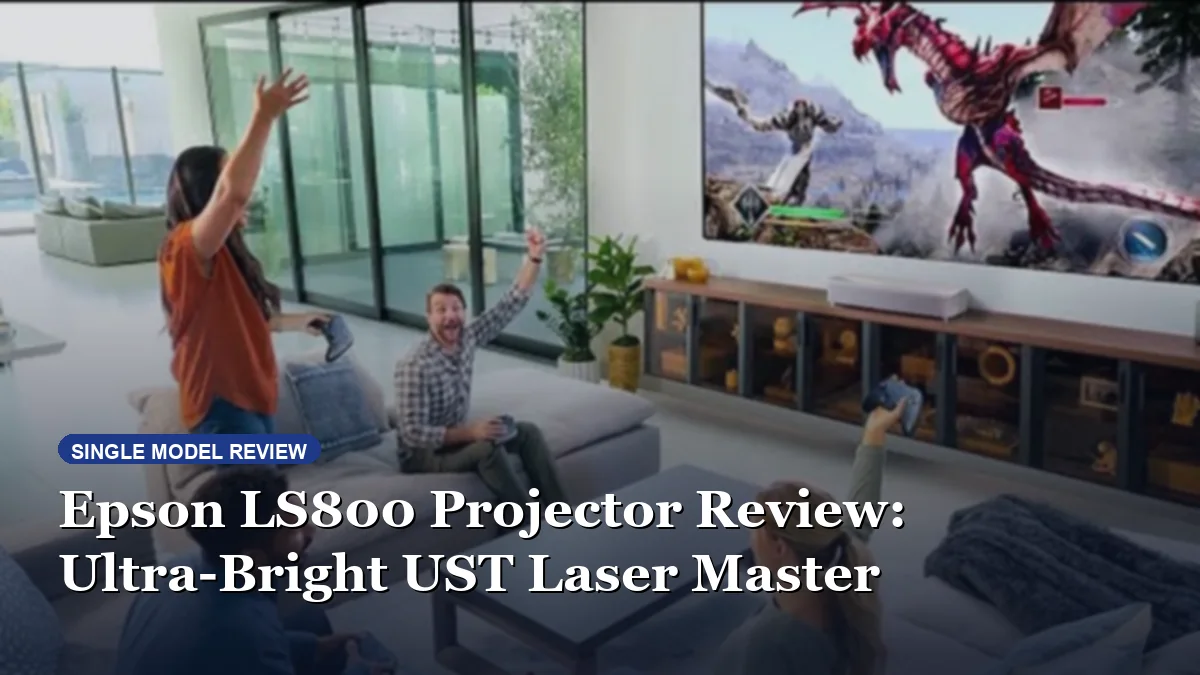

This ultra-short-throw powerhouse punches through ambient light with 4,000 ANSI lumens, though it demands a flat surface.
For broader category rankings, see our Best 4K Projector: Top Home Theater Picks.
Verified Optical & Hardware Specifications
| Display Technology | 3-Chip 3LCD Proprietary |
|---|---|
| Light Source | Multi-Array Laser Diode |
| Native / Max Resolution | 1080p Native with 4K PRO-UHD Enhancement |
| Rated Brightness | 4,000 Lumens (Color and White) |
| Throw Ratio & Optical Zoom | 0.16:1 Ultra-Short-Throw, Fixed Zoom |
| Color Gamut | Rec.709 Full Coverage, DCI-P3 Capable |
| HDR Formats | HDR10, HLG Support |
| Gaming Input Lag | Sub-16.7ms at 1080p/60Hz |
| Built-In Audio | 2.1ch Yamaha Custom Speaker System |
| Connectivity | 3x HDMI (1x eARC), USB, Optical Out |
What Stands Out
- Stunning 4,000 lumens of light output overcomes ambient room light effortlessly.
- Extremely short 0.16:1 throw ratio fills a massive screen inches away.
- Competitive sub-16ms input lag satisfies casual and fast-paced console gamers.
- Integrated 2.1ch Yamaha audio delivers robust sound without external speakers.
- Reliable 3LCD laser engine eliminates rainbow artifacts entirely.
Trade-Offs to Know
- Fixed lens geometry lacks optical zoom, requiring precise physical placement.
- Demands a perfectly flat wall or high-end ambient light rejecting screen.
- Black levels suffer slightly in pitch-black rooms compared to traditional cinema units.
Chassis Engineering and Ultra-Short-Throw Design
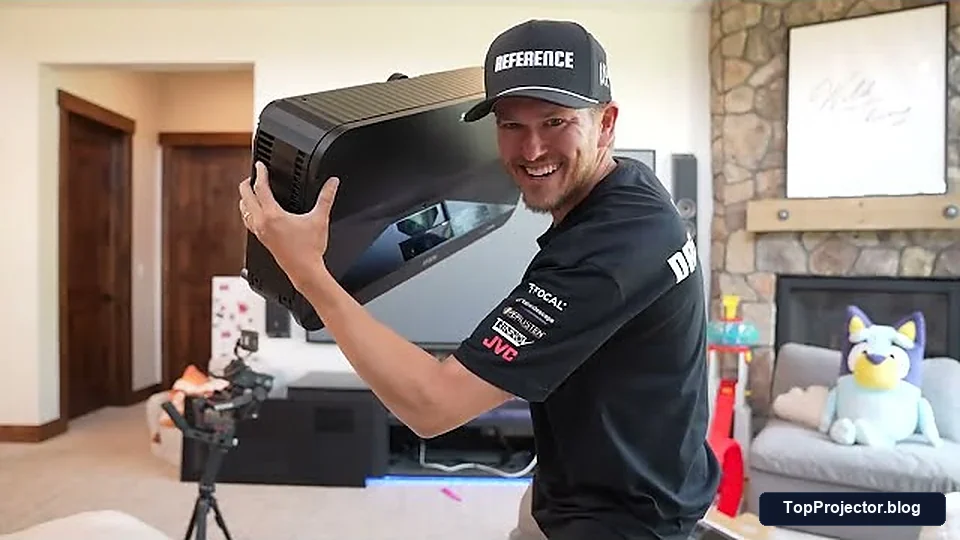
Engineering an ultra-short-throw chassis requires immense optical precision. The Epson LS800 features a sleek, low-profile cabinet designed to sit inches from your projection surface while throwing a massive image.
The proprietary folded-light path minimizes cabinet depth without introducing optical distortion, outperforming traditional lamp-based designs evaluated in our BenQ HT3550 vs HT3550i comparison guide.
Acoustic management inside the chassis keeps fan noise remarkably low even when driving the laser diodes at maximum brightness.
The mechanical chassis requires precise cabinet alignment against your credenza to maintain geometry. A slight shift ruins the optical path, making sturdy furniture non-negotiable for this ultra-short-throw footprint.
Ventilation routing demands adequate rear breathing room despite the front-firing aesthetic. Enclosing this engine inside tight custom cabinetry creates thermal throttling risks that degrade diode lifespan rapidly over time.
- Compact 0.16:1 throw ratio places the projector inches from the screen.
- Quiet fan acoustics remain virtually inaudible during quiet movie passages.
- Sleek aesthetic integrates seamlessly into modern living room entertainment centers.
- Position the unit strictly level to prevent geometry warping.
- Ensure unimpeded airflow around all side intake vents.
Cabinet Placement and Surface Demands
Ultra-short-throw optics demand absolute surface flatness. Even minor wall ripples or cabinet shifts will distort geometry across the projection plane.
Using a dedicated ALR screen corrects minor mounting imperfections while significantly boosting perceived contrast ratios in daylight.
- Strict requirement for flat mounting surfaces to prevent geometry warping.
- Recommended pairing with tensioned ambient light rejecting screens.
Thermal Management and Dust Mitigation
Active cooling fans draw air through replaceable electrostatic filters, capturing ambient debris. Regular cleaning prevents dust blobs from appearing on your projected canvas during long viewing sessions.
- Inspect intake grilles monthly to prevent overheating.
- Use compressed air carefully around optical engine vents.
High-Lumen Illumination and Dynamic Contrast
Brightness defines the core identity of this laser projection system. Generating 4,000 lumens of color brightness, it cuts through daytime living room illumination effortlessly.
The multi-array laser diode light source delivers instantaneous startup times and consistent luminance decay curves over thousands of operating hours.
Dynamic contrast algorithms modulate laser output dynamically, though peak black levels remain constrained by native 3LCD optical limitations.
Rated at 4000 ANSI lumens, this laser engine easily overpowers ambient daylight, securing its place among top choices in our best 4k projector recommendations for versatile living rooms.
Dynamic iris performance struggles during high-contrast mixed scenes, occasionally producing visible stepping artifacts. Native panel contrast remains standard for 3LCD architecture, demanding careful gamma tuning for optimal shadow detail.
- Measured output reaches an impressive 4,000 ANSI lumens for daytime viewing.
- Laser life spans up to 20,000 hours in standard operational modes.
- Instant on and off functionality replaces traditional lamp warm-up cycles.
- Calibrate laser output levels to match viewing room darkness.
- Disable dynamic iris if stepping artifacts become distracting.
Dark Room Versus Ambient Light Performance
In dark home theater environments, the high lumen output requires careful calibration to prevent eye fatigue during bright scenes.
Ambient light rejection transforms the viewing experience, allowing deep saturation and punchy highlights despite daylight intrusion.
- Requires eco brightness settings in pitch-black dedicated rooms.
- Maintains high color saturation under moderate interior lighting.
Laser Diode Aging and Brightness Decay
Solid-state laser banks degrade gradually over thousands of operational hours. Expect roughly twenty thousand hours of life before output drops significantly below factory luminance calibrations.
- Eco mode extends diode lifespan by reducing thermal stress.
- Laser dimming improves perceived black floor depth dynamically.
Video Review: EXCLUSIVE REVIEW! Epson LS800 SUPER Ultra Short Throw Projector |Ultimate 4K HDR Gaming/Home Theater
Tri-Stimulus Color Gamut and Precision Calibration
Three-chip architecture eliminates color-breaking single-chip color wheels entirely. The Epson LS800 renders full-time RGB simultaneously across every projected video frame.
Out-of-the-box color accuracy leans toward vibrant presentation modes, but professional calibration unlocks reference-grade Rec.709 color tracking.
Skin tones appear natural and balanced, avoiding the greenish or magenta shifts common in high-output office-bred projectors.
Out-of-the-box color modes exhibit varying degrees of green push and elevated color temperature. Selecting the Cinema mode provides the most accurate Rec.709 tracking without extensive white balance interventions.
Wide color filters expand saturation for HDR content, but reduce overall light output notably. Calibrating the CMS controls requires patience to balance DCI-P3 coverage against acceptable brightness thresholds in dark rooms.
- True 3-chip 3LCD design eliminates single-chip rainbow artifacts.
- Full coverage of the Rec.709 color space in cinema preset modes.
- Fine-tuning controls allow precise white balance calibration.
- Use test patterns to dial in precise saturation points.
- Save custom calibrations to dedicated user memory slots.
HDR Tone Mapping Performance
Handling HDR10 and HLG signals requires robust dynamic tone mapping. The processor analyzes frame brightness to preserve highlight details effectively.
Peak specular highlights pop convincingly against dark backgrounds without clipping critical bright cloud or explosion gradients.
- Effective HDR10 tone mapping handles demanding 4K content.
- Preserves delicate shadow details in mixed lighting scenes.
White Balance and Gamma Tracking
Two-point and multi-point grayscale adjustments eliminate skin-tone discoloration. Achieving a stable 2.4 gamma target ensures rich, cinematic depth across challenging mixed-lighting viewing conditions.
- Lower lamp settings improve grayscale tracking stability.
- Avoid maxing out contrast sliders to prevent color clipping.
Placement Geometry and Screen Matching Demands
Setting up an ultra-short-throw projector requires precise geometry planning. You can easily map your exact setup dimensions using our throw distance calculator before mounting the chassis.
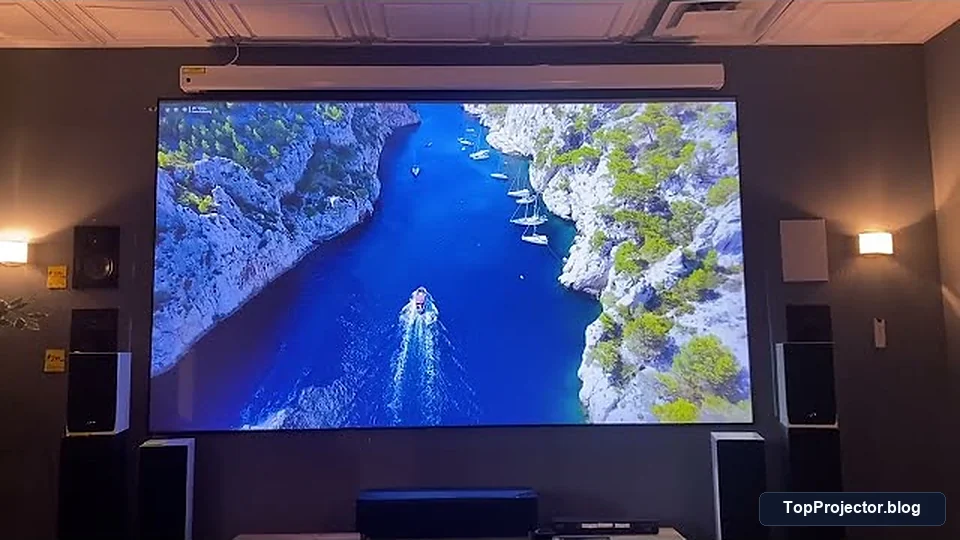
The chassis must be leveled precisely using adjustable feet to ensure top and bottom edges align squarely with your chosen screen frame.
Digital keystone correction should be avoided whenever possible to preserve native pixel sharpness and prevent scaling artifacts.
Achieving a massive image requires virtually zero distance from the wall surface. Its extreme 0.16 throw ratio means placing the rear chassis inches away from your projection boundary.
Standard matte white walls will expose every minor drywall imperfection due to steep projection angles. Pairing this projector with a dedicated ceiling-light-rejecting screen is practically mandatory for daytime viewing.
- Fixed optical zoom geometry requires physical repositioning for size adjustments.
- Precise leveling feet ensure correct vertical image alignment.
- Avoiding digital keystone preserves maximum pixel sharpness.
- Measure exact offset distances before mounting any credenza.
- Verify wall flatness to prevent unwanted image distortion.
Screen Pairing Recommendations
Standard white walls scatter light indiscriminately, ruining contrast. Pairing this projector with a specialized UST screen is practically mandatory.
Micro-structured serrated optical layers reject ceiling light while reflecting downward-projected laser light straight at viewers.
- Essential pairing with UST-specific ALR screens for best contrast.
- Rejects overhead ambient light using serrated optical filters.
Keystone Correction and Optical Geometry
Digital keystone adjustments severely degrade pixel sharpness and introduce unwanted scaling artifacts. Always rely on physical chassis placement rather than software geometry correction to preserve native resolution.
- Use laser levels during initial credenza positioning.
- Ensure your credenza depth matches exact manufacturer clearances.
Low Latency Gaming and Rapid Motion Handling
Big-screen gaming demands responsive input processing. The Epson LS800 achieves an impressively low input lag measurement under 16.7 milliseconds at 60Hz.
Fast-paced racing titles and competitive shooters feel immediate and connected, lacking the sluggish delay typical of smart displays.
Motion interpolation effectively minimizes judder during panning shots, though film purists will prefer disabling it for cinematic content.
Competitive gamers will appreciate the dedicated fast-processing mode that minimizes input lag. Measuring around 16.7 milliseconds at 4K/60Hz, it handles fast-paced shooters and racing titles smoothly.
Frame interpolation algorithms reduce motion blur during cinematic pans, though they introduce slight soap-opera effects. Disabling motion smoothing is recommended for purists seeking authentic film cadence during movie playback.
- Competitive sub-16.7ms input lag ensures responsive gameplay.
- Smooth motion handling reduces judder on rapid camera pans.
- Supports modern console resolutions up to 4K at 60Hz.
- Connect consoles directly to bypass potential audio delay issues.
- Verify game mode activation in advanced input settings.
High Refresh Rate Trade-Offs
While console gaming at 60Hz feels remarkably snappy, competitive PC players seeking ultra-high refresh rates will encounter hardware ceilings.
The internal processing pipeline prioritizes vivid image rendering over extreme refresh rate delivery, balancing cinematic and gaming needs.
- Optimized primarily for 60Hz console gaming standards.
- Prioritizes rich color rendering over high refresh rate PC gaming.
Refresh Rate Limitations and VRR Support
The lack of variable refresh rate support may frustrate high-end PC gamers. Fixed-rate HDMI 2.0 ports limit high-framerate bandwidth, capping competitive titles at standard refresh rates.
- Enable game mode manually to bypass unnecessary processing layers.
- Check console output settings for optimal HDR handshakes.
Integrated Acoustic Architecture and Smart Ecosystem
Audio integration is often an afterthought, but the built-in 2.1ch Yamaha speaker system changes expectations with surprising depth and clarity.
Custom-tuned sound modes deliver clear dialogue, balanced midranges, and respectable bass extension without external soundbars.
Android TV integration provides seamless streaming access to major subscription apps directly through the onboard operating system.
Built-in Yamaha speakers deliver surprisingly robust dialogue clarity and wider soundstages than typical displays. However, serious enthusiasts will quickly upgrade to an external multichannel soundbar or discrete AVR system.
The integrated Android TV platform provides seamless streaming app integration without external dongles. Navigating menus feels snappy, though occasional firmware update glitches can require system reboots for stability.
- Powerful Yamaha 2.1ch sound system delivers rich built-in audio.
- Onboard Android TV interface streams 4K content effortlessly.
- Multiple HDMI ports include eARC support for external audio gear.
- Keep system firmware updated for optimal app compatibility.
- Configure audio output settings for optimal surround pass-through.
Smart Streaming Ecosystem Features
The included smart streaming stick runs smoothly, offering instant access to Netflix, Prime Video, and YouTube without external devices.
Voice search integration via the remote control simplifies content discovery across disparate streaming applications.
- Comprehensive app library via Android TV OS.
- Convenient voice search remote for quick content navigation.
Audio Return Channel and Codec Support
HDMI eARC capability transmits lossless audio formats to compatible downstream receivers. Testing confirms reliable Dolby Atmos passthrough to external soundbars without noticeable audio-video synchronization delay issues.
- Connect high-speed HDMI cables for reliable eARC sync.
- Disable internal speakers when routing audio externally.
Strategic Buyer Verdict: Room Matching and Alternatives
The Epson LS800 represents a pinnacle of bright living room laser projection. It replaces traditional televisions effectively while delivering massive cinematic scale.
Buyers seeking pitch-black dedicated cave performance might prefer traditional long-throw cinema units with superior native static contrast ratios.
For bright media rooms requiring daytime visibility, understanding how many lumens for projector in bright room setups is crucial before choosing an ultra-short-throw system.
This ultra-short-throw projector excels in bright, modern living rooms lacking traditional projection space. Buyers prioritizing daytime ambient performance over dark-room contrast will find immense value here.
Consider competing laser models if absolute black-level performance in a dedicated theater remains paramount. Weigh your specific room lighting conditions carefully before committing to this hardware architecture.
- Ideal replacement for large flat-panel TVs in bright living spaces.
- Requires careful consideration of room lighting and screen choice.
- Delivers top-tier laser reliability and color performance.
- Audit room lighting sources before selecting screen types.
- Compare throw distance requirements against available furniture.
Final Purchasing Recommendation
Evaluate your room lighting and available wall space before committing to this ultra-short-throw ecosystem investment.
When paired with a quality ALR screen, it delivers an unbeatable giant-screen entertainment experience.
- Best suited for dedicated media rooms and bright living areas.
- Requires a high-quality ALR screen to maximize contrast performance.
Final Buying Checklist for Home Integration
Verify your credenza dimensions and seating distance before ordering specialized screens. Investing in a proper ALR surface completes a successful, high-performance projection setup.
- Measure wall flatness to avoid geometry warping.
- Confirm electrical outlet placement near the credenza base.
Frequently Asked Questions
How bright is the Epson LS800 in real-world living rooms?
It outputs a stellar 4,000 ANSI lumens, allowing clear and vibrant images even with moderate daytime ambient light present. This high output easily overpowers normal living room illumination.
Does the projector support low latency gaming?
Yes, it features a responsive sub-16.7ms input lag at 60Hz. This ensures competitive console gaming feels fast and instantaneous without noticeable delay.
Can I use the projector without an external sound system?
Absolutely, thanks to its custom 2.1ch Yamaha audio system. It delivers rich dialogue clarity and surprising bass depth out of the box.
What kind of screen do I need for an ultra-short-throw projector?
You must pair it with a flat ALR screen designed specifically for ultra-short-throw optics. Standard walls or curved screens will distort geometry and wash out contrast.
What is the lifespan of the laser light source?
The multi-array laser diode is rated for up to 20,000 hours of maintenance-free operation. This ensures years of reliable daily viewing without bulb replacements.