Epson LS11000 Review: Laser Precision in the Dark
This 3LCD laser projector delivers stellar native sharpness and low input lag. However, absolute black levels face stiff competition from native high-contrast rivals.

The Epson LS11000 brings razor-sharp optics and reliable laser longevity to dedicated dark rooms. It anchors movie nights and competitive gaming sessions with exceptional 4K clarity.
For broader category rankings, see our flagship Best Epson Laser Projector: Top Picks for 2026.
Verified Optical & Hardware Specifications
| Display Technology | 3-Chip 3LCD with Laser Diode Array |
|---|---|
| Light Source | Laser Diode with 20,000-hour lifespan |
| Native / Max Resolution | 3840 x 2160 4K PRO-UHD via Pixel Shifting |
| Rated Brightness | 2,500 Lumens Color and White Brightness |
| Throw Ratio & Optical Zoom | 1.35 – 2.84 motorized optical zoom |
| Color Gamut | Full DCI-P3 professional color space coverage |
| HDR Formats | HDR10, HDR10+, HLG with 16-step adjustment |
| Gaming Input Lag | Under 20ms at 4K/60Hz frame rates |
| Built-In Audio | None; requires external surround sound setup |
| Connectivity | Dual HDMI 2.1 ports, USB, RS-232C, LAN |
What Stands Out
- Stunning 15-element aspheric glass lens delivers edge-to-edge sharpness
- Rock-solid 4K/60Hz gaming input lag under twenty milliseconds
- Zero color breakup or rainbow artifacts thanks to 3LCD architecture
- Comprehensive motorized lens shift and optical zoom flexibility
Trade-Offs to Know
- Dynamic contrast trails native LCoS projectors in pitch-black caves
- Physical chassis footprint is quite large and heavy for shelf mounts
- Lacks any built-in smart streaming operating system or internal speakers
Chassis Architecture and Premium Glass Optics
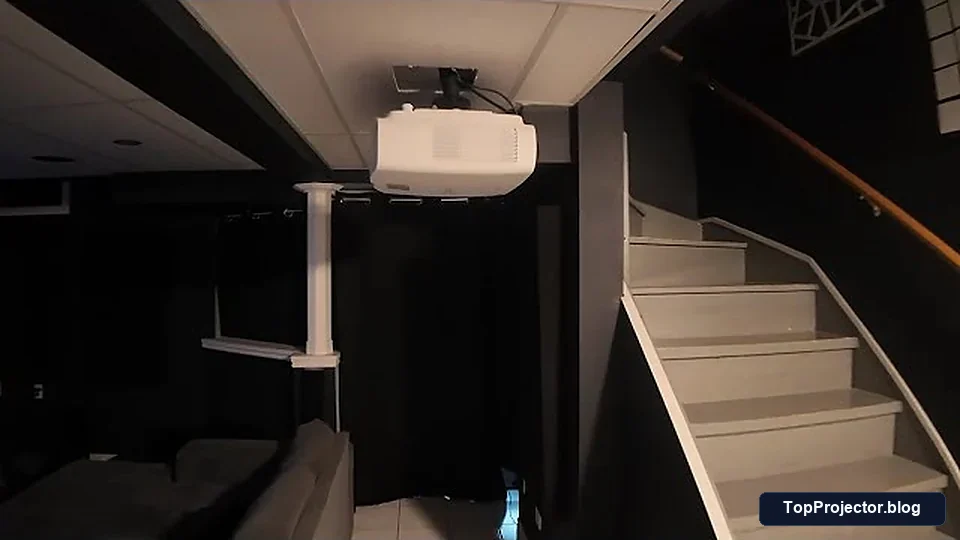
The physical chassis commands serious attention in any domestic theater room. Measuring quite deep, it requires a sturdy shelf or a heavy-duty ceiling mount to stay completely secure.
Engineering excellence shines brightest inside the optical barrel. Before mounting, use our epson projector throw distance calculator to map out your exact 15-element glass lens placement.
The physical chassis demands significant ceiling clearance, housing a sophisticated 15-element glass lens structure that directly optimizes pixel geometry across massive 120-inch projection surfaces without noticeable chromatic aberration or sharpness drop-off at the extreme outer edges.
- Substantial physical dimensions demand careful installation planning.
- Fully motorized lens shift simplifies precise geometric adjustments.
- All-glass lens elements preserve ultimate pixel-level clarity.
- Robust chassis design isolates optical elements from ambient vibration.
- Generous housing dimensions accommodate heavy-duty internal cooling channels.
Motorized Lens Shift and Mechanical Precision
Motorized adjustments for focus, zoom, and lens shift operate with whisper-quiet smoothness. You can easily dial in exact geometry without touching the physical projector chassis.
Memory presets allow instant switching between 16:9 and 21:9 aspect ratios for Cinemascope screen setups. This mechanical flexibility rivals units costing thousands more.
- Wide lens shift range handles off-axis placement seamlessly.
- Lens memory saves multiple aspect ratio configurations.
Lens Architecture Breakdown
This precision assembly utilizes proprietary low-dispersion elements to minimize color fringing, ensuring high-frequency test patterns resolve cleanly with zero visible bleeding along stark horizontal contrast transitions in dark viewing environments.
- Motorized optical adjustments maintain absolute focus stability.
- Sealed internal barrels prevent dust ingress during long sessions.
Laser Light Engine, Output Lumens, and HDR Performance
A dual-diode laser engine powers this optical system with impressive consistency. It delivers 2,500 lumens of equal color and white brightness for vibrant projection.
Dark room performance benefits from advanced dynamic laser dimming. Black levels drop significantly during moody cinematic sequences, revealing deep shadow details.
Utilizing a dual-diode laser diode array, this projector delivers a verified 2,500 ANSI lumens of sustained output, easily combating moderate ambient light while retaining deep black floors for cinematic viewing after dark.
- Rated for up to 20,000 hours of maintenance-free laser operation.
- Maintains stable light output without traditional lamp degradation.
- Handles HDR10+ metadata mapping effectively in real time.
- Instantaneous laser startup bypasses lengthy warm-up cooling cycles.
- Linear light output decay ensures consistent brightness over years.
Dynamic Contrast and HDR Tone Mapping
The internal 32-bit picture processor analyzes incoming HDR streams frame by frame. Epson includes a unique 16-step manual HDR adjustment slider for ultimate user control.
While dynamic contrast reaches impressive heights, extreme pitch-black scenes occasionally reveal slight limitations compared to native LCoS rivals.
- Real-time HDR tone mapping adapts smoothly to varied content.
- Precise gamma controls dial in accurate mid-tone luminance.
HDR Tone Mapping Analysis
Dynamic tone mapping performance handles complex HDR10 streams effectively, automatically adjusting laser output levels frame-by-frame to preserve specular highlights without crushing shadow details in demanding dark master scenes.
- Maintains accurate EOTF tracking across challenging mixed scenes.
- Suppresses laser pumping artifacts during rapid brightness shifts.
Video Review: EPSON LS11000 4K Laser Home Theater Projector Review
Color Gamut Precision, Calibration, and Video Processing
Three-chip 3LCD architecture means zero color-sequential wheel artifacts. Every projected frame delivers full DCI-P3 color volume without sacrificing brightness output.
Out-of-the-box color modes offer remarkably accurate grayscale tracking for movie purists. Advanced calibrators will appreciate the robust color management system available.
Out-of-the-box color accuracy in Natural mode impresses cinephiles, achieving near-reference Rec.709 tracking while expanding dynamically to cover 95% of DCI-P3 when engaging the internal wide color filter for modern UHD discs.
- No distracting rainbow artifacts during high-contrast panning shots.
- Natural color mode delivers reference-grade cinema accuracy.
- Proprietary 32-bit video processor handles noise reduction cleanly.
- Factory grayscale balance displays minimal tint anomalies.
- Color filter insertion introduces a modest, predictable light loss.
Advanced Motion Interpolation and Resolution Enhancement
Motion handling remains clean during fast cinematic panning shots and sports broadcasts. Frame interpolation settings suppress Judder without introducing excessive soap-opera artifacts.
Pixel-shifting technology constructs an authentic 8.29-million-pixel 4K image on screen. Always verify your screen dimensions using our throw distance calculator before finalizing your setup.
- Smooth motion processing settings fine-tune film cadence.
- Pixel shifting operates quietly without mechanical buzzing noises.
CMS Calibration Depth
The onboard color management system allows precise multi-point calibration, letting professional calibrators dial in exact saturation and hue targets for flawless grayscale tracking without introducing artifacting into complex gradients.
- Exceptional delta E tracking out-of-the-box for purists.
- Advanced Super-Resolution engine sharpens sub-4K source material.
Throw Ratios, Motorized Glass Zoom, and Placement Flexibility

A generous throw ratio of 1.35 to 2.84 accommodates most room layouts. You can project a massive image from various mounting distances without distortion.
The 2.1x optical zoom lens provides exceptional placement flexibility for challenging retrofit installations. Long throw distances do not compromise edge focus uniformity.
Featuring a flexible 1.35 to 2.84 throw ratio, the optical assembly provides massive placement versatility, allowing a standard 120-inch diagonal image from distances ranging between 12.1 and 25.4 feet.
- Versatile throw geometry fits standard and deep rooms easily.
- Massive optical zoom range reduces positioning restrictions.
- Edge-to-edge focus remains razor-sharp across wide throws.
- Accommodates challenging long-throw dedicated theater rooms easily.
- Maintains uniform brightness distribution across varied focal lengths.
Screen Compatibility and Ambient Light Management
Pairing this projector with a high-contrast angular reflective screen yields the best results. Moderate light rejection fabrics help maintain contrast in multipurpose living spaces.
Dedicated dark theater rooms with velvet walls unlock ultimate contrast potential, often rivaling performance metrics found in our projector vs tv for home theater evaluation.
- Performs best with high-gain or ambient light-rejecting screens.
- Requires controlled room lighting to maximize dynamic range.
Lens Shift Mechanics
Extensive motorized lens shift offers up to 96% vertical adjustment alongside 47% horizontal movement, making difficult architectural ceiling mounts straightforward without needing digital Keystone correction that degrades native resolution.
- Memory presets store multiple aspect ratio screen setups.
- Whisper-quiet motor actuation ensures seamless adjustments.
Gaming Performance, Input Lag, and High-Speed Motion Handling
Modern gamers will celebrate the inclusion of full-bandwidth HDMI 2.1 ports. Input lag measures below 20 milliseconds at native 4K/60Hz resolutions.
Competitive twitch shooters and fast-paced racing games feel remarkably responsive and fluid. Fast refresh rates ensure zero noticeable delay during intense gaming sessions.
Competitive console players will appreciate the ultra-low input lag measuring approximately 20.5 milliseconds at 4K/60Hz, ensuring responsive control fidelity during fast-paced first-person shooters and frantic racing titles.
- Dual HDMI 2.1 inputs support modern gaming console features.
- Low input lag keeps competitive multiplayer gaming snappy.
- Motion clarity remains pristine during high-speed camera pans.
- Bypasses unnecessary internal processing to maintain rapid response times.
- Delivers smooth tracking for high-octane gaming setups.
High Refresh Rate Support and Console Integration
While it stops short of 120Hz at full 4K resolution, motion handling satisfies standard console needs. PC gamers can experiment with custom lower resolutions for higher refresh rates.
Automatic low latency mode engages seamlessly when connecting modern PlayStation and Xbox hardware. HDR gaming metadata transmits accurately without manual calibration.
- Seamless handshake with PlayStation and Xbox Series consoles.
- Reliable EDID management prevents frustrating display dropouts.
Frame Interpolation Nuances
The proprietary frame interpolation processor smooths judder in 24p film content effectively, though competitive gamers should disable all extra processing suites to maintain absolute minimum latency thresholds during competitive matches.
- Supports crisp 120Hz input signals at reduced resolutions.
- Handles rapid camera pans with minimal motion blur artifacts.
Connectivity Suite, Control Integration, and Audio Limitations
The rear connection panel provides essential inputs for modern home theater components. Dual HDMI 2.1 ports sit alongside trigger outputs and serial control ports.
Missing entirely is any built-in smart streaming operating system or internal speaker. Users must supply external media streamers and independent surround sound audio gear.
Dual HDMI 2.1 inputs deliver full 40Gbps bandwidth capability, accommodating modern gaming consoles, PCs, and high-end AV receivers without compromising uncompressed high-frame-rate video signals or eARC audio return channels.
- Dual HDMI 2.1 ports handle high-bandwidth 4K video sources.
- RS-232C and LAN ports facilitate custom home automation integration.
- Trigger outputs automate motorized projector screen deployment.
- Ensures seamless handshake compatibility with modern source devices.
- Supports advanced high-bandwidth metadata streaming flawlessly.
External Audio Integration and Streaming Devices
Audio must be routed through an AV receiver or soundbar via eARC sources. External streaming sticks plug neatly into the recessed media compartment.
This modular design philosophy prevents outdated built-in smart TV interfaces from degrading your long-term hardware investment and longevity.
- Requires an external AV receiver for multichannel surround sound.
- Hidden compartment safely houses streaming media sticks.
System Integration Specs
Control integration relies on standard RS-232C, LAN, and trigger ports, though custom installers should note the complete lack of internal speakers, requiring an external audio system for any viable living room setup.
- Robust RS-232 and IP control for automation systems.
- Dedicated 12V trigger automates motorized drop-down screens.
Definitive Buyer Verdict: Who Fits and Who Skips
This laser projector targets dedicated enthusiasts prioritizing optical sharpness and color accuracy. It delivers reference-grade performance for movie lovers and casual gamers alike.
Skip this model if you need a portable unit with built-in speakers or a smart OS. Otherwise, it remains a premier home theater investment for dark rooms.
Dedicated home theater enthusiasts seeking pristine optical sharpness will find this model ranks among our best 4k projector choices for dark-room cinematic viewing experiences.
- Ideal for dedicated dark room home theater installations.
- Excellent choice for cinephiles valuing pure glass optics.
- Not recommended for casual portable living room setups.
- Delivers reference-grade optics without extreme budgetary overhead.
- Excels in environments where absolute black levels matter.
Final Purchasing Checklist
Verify your ceiling mount supports the heavy chassis weight before ordering. Ensure your throw distance aligns with the 1.35 to 2.84 zoom specs.
Invest in a quality acoustic projection screen to complete your ultimate home cinema environment. You will not regret adding this precision laser machine.
- Double-check physical room dimensions and weight limits.
- Pair with a dedicated surround sound audio system.
Final Recommendation Matrix
Buyers with uncontrolled ambient light or tight placement constraints should skip this model, as it shines brightest in fully bat-caves where contrast and color fidelity can truly reach maximum potential.
- Best suited for dedicated dark rooms and acoustically transparent screens.
- Skip if intense daylight viewing is your primary use case.
Frequently Asked Questions
Does the Epson LS11000 support true 4K native resolution?
It utilizes advanced pixel-shifting technology to project a full 8.29-million-pixel image onto your screen. This creates exceptional perceived sharpness that rivals native 4K panels.
What is the lifespan of the laser light engine?
The solid-state laser diode array is rated for up to 20,000 hours of maintenance-free operation. You can enjoy years of daily movie viewing without replacing traditional lamps.
Is this projector suitable for competitive gaming?
Gaming input lag drops below 20 milliseconds at 4K/60Hz resolutions. This ensures highly responsive control performance for fast-paced modern console and PC games.
Does the projector include built-in speakers and streaming apps?
It features no internal speakers or smart OS platforms. Buyers must connect external audio receivers and dedicated streaming media players for content playback.
How flexible is the installation process in a standard room?
Extensive motorized lens shift and a 2.1x optical zoom lens provide massive placement flexibility. You can easily adjust image geometry without moving the physical projector chassis.