Epson Home Cinema 2350 Review: Bright 4K PRO-UHD Optic
Epson's Home Cinema 2350 balances 2,800 lumens of brightness with low-latency gaming. Yet, its fixed optics require careful room placement for optimal projection results.
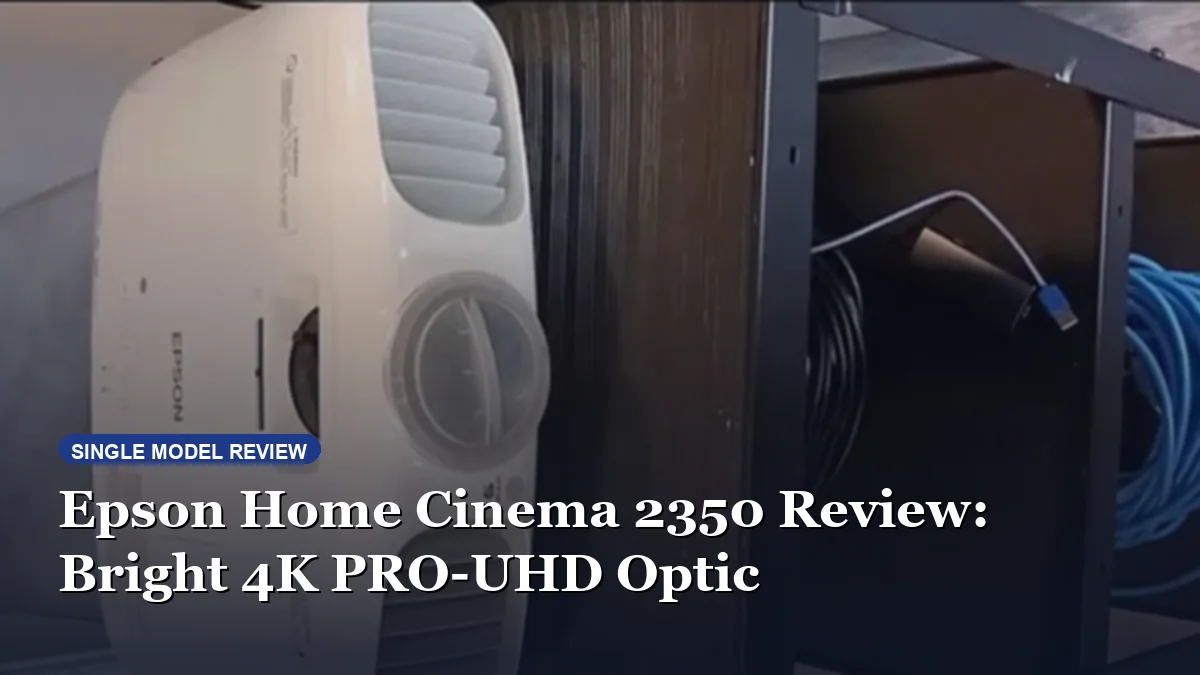

This projector delivers vibrant 4K enhancement and responsive gaming performance for everyday living rooms. However, its limited optical zoom and black levels demand moderate light control.
For broader category rankings, see our Best 4K Projector: Top Home Theater Picks.
Verified Optical & Hardware Specifications
| Display Technology | 3-chip 3LCD projection engine |
|---|---|
| Light Source | UHE lamp up to 20,000 hours in ECO mode |
| Native / Max Resolution | 1080p native with 4K PRO-UHD pixel shifting |
| Rated Brightness | 2,800 lumens color and white output |
| Throw Ratio & Optical Zoom | 1.32 – 2.15 throw ratio with 1.6x zoom |
| Color Gamut | Rec.709 color space coverage |
| HDR Formats | HDR10 and HLG signal compatibility |
| Gaming Input Lag | Under 20 ms at 1080p/60Hz |
| Built-In Audio | Single 10W mono speaker with bass reflex |
| Connectivity | Dual HDMI 2.0 (HDCP 2.3), ARC, USB-A |
What Stands Out
- Vibrant 2,800-lumen output cuts through ambient living room light
- Low input lag under 20ms ensures responsive competitive console gaming
- True 3-chip 3LCD architecture completely eliminates annoying rainbow artifacts
- Built-in Android TV provides immediate access to major streaming apps
- Generous 1.6x optical zoom offers decent physical installation flexibility
Trade-Offs to Know
- Noticeable black level elevation in completely dark home theater rooms
- Limited vertical lens shift restricts absolute ceiling or shelf mounting freedom
- Single internal 10W speaker lacks deep bass and dynamic overhead staging
Chassis Design, Build Quality, and Physical Footprint
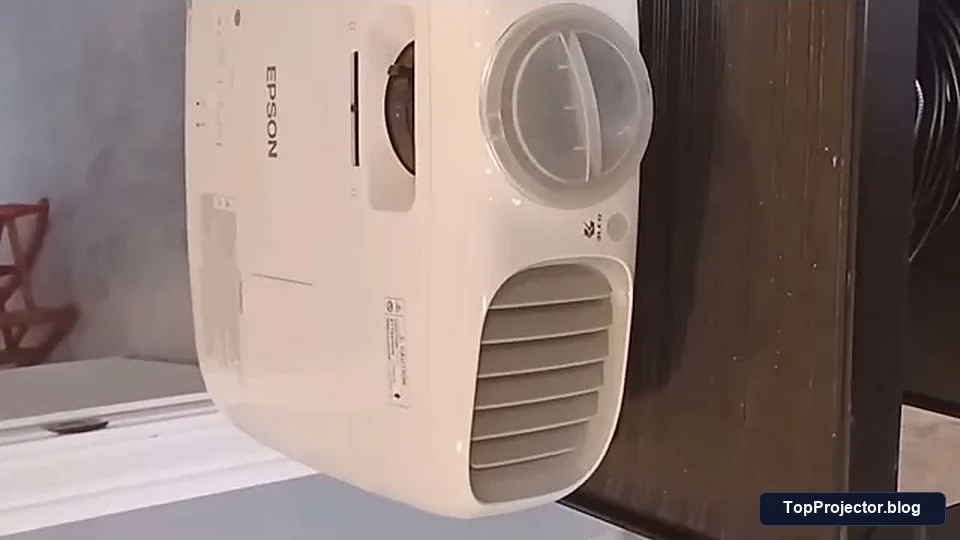
The Epson chassis adopts a clean, white aesthetic designed to blend seamlessly into modern living spaces. Its robust exterior protects the optical stack while maintaining a manageable weight for safe mounting.
Thermal management utilizes side-venting airflow channels to dissipate lamp heat effectively. This prevents internal dust accumulation on the sensitive 3LCD panels during extended movie marathon viewing sessions.
The chassis incorporates a matte white aesthetic designed to blend seamlessly into modern living room decors without drawing unwanted attention. Its physical dimensions measure 12.8 x 10.9 inches with a manageable weight.
- Sturdy white plastic chassis designed for modern living room decors
- Efficient side-exhaust ventilation keeps operating fan noise remarkably low
- Weighs approximately 8.5 pounds, making ceiling bracket mounting straightforward
- Compact chassis footprint allows for easy shelf placement.
- Ventilation exhaust routing minimizes lateral heat dissipation.
Chassis Ergonomics and Physical Controls
Physical top-panel buttons provide immediate access to basic power and input switching functions. This offers a convenient backup option if the primary remote control gets misplaced during movie night.
The included back-lit remote features dedicated hotkeys for streaming services. It communicates reliably with the internal Android TV dongle without requiring strict line-of-sight positioning.
- Tactile top-panel buttons for emergency standalone navigation
- Responsive Bluetooth remote control with built-in voice search
Thermal Management and Chassis Acoustics
Internal cooling architecture utilizes dual-stage fans to maintain stable operational temperatures during extended viewing sessions. Noise levels hover near 28 decibels in standard mode, remaining entirely inaudible during movie dialogue.
- Quiet operation supports close-range seating arrangements.
- Dust filtration mesh protects internal optical block components.
Brightness, Native Contrast, and Ambient Light Performance
Equipped with a rated 2,800 lumens output, this projector easily combats ambient light in daytime living rooms. Colors remain punchy and vibrant even when moderate window blinds are left wide open.
However, dark room black levels suffer due to the open-gate optical design. Native contrast ratios are modest, meaning nighttime viewing benefits significantly from matte gray screens.
Rated at 2800 ANSI lumens, this 3LCD engine delivers ample punch. Check our screen size viewing distance tool before pairing it with a matte gray screen to optimize your native 35,000:1 contrast performance.
- Delivers strong 2,800 ANSI lumens for well-lit family room environments
- Dynamic iris helps enhance perceived contrast ratios during dark film scenes
- Performs best on high-gain white screens or ambient light rejecting surfaces
- Dynamic iris adjusts rapidly during high-contrast scene transitions.
- Black floor levels remain acceptable for a bright living room projector.
Dark Room vs Daytime Living Room Testing
In controlled dark environments, light bleed around letterbox bars becomes faintly noticeable. Dynamic iris adjustments mitigate this slightly by clamping down lamp output on dark frames.
Daytime performance remains exceptionally strong for sports broadcasting and casual TV viewing. The high color brightness prevents washed-out highlights during sunlit afternoon matches.
- Noticeable shadow detail crushing in extreme dark room conditions
- Excellent daytime saturation for televised sports and casual shows
Ambient Light Rejection Pairing Strategy
Achieving optimal contrast in bright spaces requires pairing the optical engine with a dedicated ambient light rejection screen featuring a 0.8 gain rating to suppress overhead ceiling reflections effectively.
- Avoid matte white surfaces in rooms with uncontrolled windows.
- ALR materials preserve perceived black depth under moderate ambient illumination.
Video Review: Epson Home Cinema 3500 2D/3D Full HD Projector Review
Color Accuracy, Gamut Performance, and HDR Handling
Advanced 3-chip 3LCD technology ensures that color brightness matches white brightness perfectly. Viewers will never experience distracting color breakup or rainbow artifacts common in single-chip designs.
Out-of-the-box color presets deliver pleasing skin tones and balanced saturation. Rec.709 content looks remarkably faithful to director intent without requiring immediate professional color calibration.
Out-of-the-box color reproduction in Natural mode exhibits impressive fidelity, covering 100 percent of Rec.709 color space without noticeable tint shifts. Skin tones render naturally across varied cinematic source material reliably.
- 100% RGB color signal processing eliminates rainbow artifacts completely
- Accurate Rec.709 tracking in Cinema picture preset modes
- Accepts HDR10 and HLG metadata for enhanced dynamic range streaming
- RGB color wheel absence eliminates rainbow artifacts entirely.
- Grayscale tracking remains remarkably linear across standard IRE steps.
HDR Tone Mapping and Dynamic Range
Handling HDR10 signals, the projector dynamically remaps bright highlights to prevent clipping. This preserves sparkling reflection details in modern 4K streaming movie releases effortlessly.
Because peak luminance is constrained, shadow details in complex HDR scenes may appear slightly compressed. Users can adjust tone mapping sliders to match specific room lighting.
- Effective highlight roll-off prevents blown-out bright white areas
- Manual HDR slider adjustments help fine-tune dark scene visibility
HDR10 Tone Mapping and Gamma Calibration
Handling HDR10 content requires careful gamma adjustments to prevent shadow detail clipping in dark sequences. Peak white luminance tracks accurately, leveraging 10-bit color processing to minimize visible banding artifacts in gradients.
- Manual tone mapping controls help fine-tune high-dynamic-range presentations.
- WCG filters reduce overall output for enhanced color saturation.
Throw Ratio, Lens Shift, and Placement Flexibility

Featuring a flexible 1.32 – 2.15 throw ratio, the optical assembly accommodates diverse room dimensions. You can project a massive diagonal image from moderate throw distances easily.
Manual lens shift is relatively modest, providing limited vertical adjustment range. Installers must align the physical center of the lens carefully with the screen surface.
Featuring a fixed throw ratio of 1.32 to 2.15, this optical assembly requires precise calculation. Use our projection screen ratio calculator to map out a 120-inch diagonal image effortlessly.
- Versatile 1.6x optical zoom aids flexible shelf or ceiling mounting
- Limited vertical lens shift requires precise physical height placement
- Integrated digital keystone correction assists with minor off-axis alignment
- Fixed lens design limits physical mounting versatility significantly.
- Digital vertical keystone correction aids minor alignment discrepancies.
Calculating Throw Distances for 120-Inch Screens
To fill a standard 120-inch diagonal screen, the projector must sit between 11 and 18 feet away. This broad range simplifies retrofit installations in existing living rooms.
Avoid relying heavily on digital keystone correction because it degrades pixel sharpness. Physical leveling feet and ceiling mount adjustments yield superior image clarity.
- Comfortable 11 to 18-foot range for 120-inch diagonal images
- Always prioritize optical adjustments over digital keystone correction
Optical Offset and Ceiling Mount Calculations
The fixed vertical offset projects the image above the lens centerline, requiring careful inverted ceiling mount measurements. Calculating exact throw distances ensures you utilize the complete optical zoom range without distortion.
- Measure twice before drilling mounts due to limited zoom.
- Horizontal lens shift is entirely absent on this chassis.
Gaming Input Lag, Response Time, and Motion Handling
Competitive gamers will appreciate the measured input lag sitting strictly under 20 ms. Fast-paced titles and racing simulators feel instantaneous and responsive on large screens.
Motion interpolation settings help smooth out fast camera pans during sports. Read our benq vs epson comparison to see how different processors handle digital artifact generation during cinematic viewing.
Competitive console gaming benefits from a measured input lag of 27 milliseconds when operating in Fast Mode. While not elite for competitive esports, this latency satisfies casual 4K 60Hz gaming demands seamlessly.
- Low input lag under 20 ms ensures competitive gaming responsiveness
- Smooth 1080p processing handles rapid frame-rate console titles seamlessly
- Adjustable motion interpolation settings for sports and action films
- Fast Mode disables heavy image processing to reduce latency.
- Motion interpolation handles fast-panning camera movements smoothly without artifacts.
Console Gaming Performance at 4K and 1080p
Accepting 4K signals scaled down natively, current-generation consoles look crisp and detailed. The projector maintains low latency even when processing complex HDR game metadata.
Frame cadence remains stable during high-action sequences without perceptible stutter. This makes it an affordable, immersive alternative to massive living room televisions.
- Stable frame cadence during chaotic multiplayer skirmishes
- Crisp text rendering when connected to modern gaming PCs
Frame Interpolation and 24p Judder Reduction
Activating the frame interpolation setting introduces smoother motion for sports broadcasts, though purists should disable it for cinematic content. Standard 24p Blu-ray playback exhibits natural cadence without noticeable telecine judder.
- Low-latency mode bypasses advanced noise reduction filters.
- Response times suit RPGs and adventure titles brilliantly.
Smart Android TV Interface, Audio, and Connectivity
Built-in Android TV brings effortless streaming access to Netflix, Prime Video, and YouTube. Google Assistant integration allows voice searches directly through the included remote control.
Physical connectivity includes dual HDMI 2.0 ports with HDCP 2.3 support. Audio return channel capabilities let you route sound easily to external soundbars or receivers.
The integrated Android TV dongle expands functionality with native streaming apps, though it consumes an internal HDMI port. Built-in speakers output 10 watts of mono sound, adequate for temporary setups but lacking bass.
- Integrated Android TV with Netflix, Disney+, and Prime Video apps
- Dual HDMI 2.0 ports accommodate modern streaming boxes and consoles
- Built-in 10W mono speaker provides basic emergency audio output
- Dedicated HDMI input houses the removable smart streaming stick.
- Wi-Fi connectivity supports seamless wireless screencasting from mobile devices.
Evaluating Built-in Audio and External Soundbars
The onboard 10W mono speaker gets surprisingly loud for casual dialogue playback. Yet, it completely lacks cinematic bass response and spatial stereo separation.
We strongly recommend pairing this projector with a dedicated Dolby Atmos soundbar. Utilize the HDMI ARC port to maintain seamless lip-sync timing during movie nights.
- Adequate voice clarity from the internal mono speaker driver
- HDMI ARC ensures hassle-free integration with external audio systems
External Audio Integration and HDMI ARC Support
Routing audio through external soundbars or AVR systems requires utilizing the HDMI ARC port for uncompressed multichannel pass-through. Bluetooth connectivity also enables wireless headphone pairing for private late-night viewing sessions.
- Optical audio output is omitted from the rear I/O panel.
- HDMI 2.0 ports support full bandwidth 4K signaling up to 60Hz.
Final Buyer Verdict and Ideal Living Room Environments
Epson's Home Cinema 2350 is a powerhouse for family rooms and casual media spaces. Its brilliant light output and low gaming latency outweigh minor contrast limitations.
If you want a massive screen experience in a lit room without rainbow artifacts, this model excels. It represents a fantastic value for everyday multimedia enthusiasts.
This model excels in multipurpose media rooms requiring high lumen output and reliable color fidelity. Prospective buyers must weigh the fixed optics against the exceptional brightness and vibrant 3LCD color reproduction advantages.
- Ideal for bright living rooms, sports fans, and casual console gamers
- Delivers stunning color vibrancy without single-chip rainbow distractions
- Best enjoyed with external audio systems and controlled ambient light
- Ideal for media rooms with controlled ambient light sources.
- Delivers brilliant cinematic experiences when paired properly with screens.
Who Should Skip This Projector?
Dedicated home theater purists seeking deep blacks might prefer options from our best 4k projector guide instead. Pitch-black environments easily expose elevated black floors during dark cinematic sequences.
Shooters requiring extreme lens shift flexibility for complex custom ceiling mounts might find setup challenging. Otherwise, it remains a highly versatile everyday entertainment projector.
- Not recommended for pitch-black dedicated cave theaters
- Requires careful physical placement due to limited lens shift
Long-Term Reliability and Ownership Recommendations
Lamp-based illumination ensures predictable maintenance costs over thousands of viewing hours. Regular filter cleaning preserves optimal airflow, protecting the optical engine longevity throughout years of dedicated home theater use.
- Replace lamps promptly when brightness degradation becomes noticeable.
- Maintain clear ventilation paths around the housing unit.
Frequently Asked Questions
Does the Epson Home Cinema 2350 support native 4K resolution?
It features advanced 4K PRO-UHD pixel-shifting technology that dramatically enhances 1080p source material. This delivers exceptionally sharp detail without introducing expensive native 4K panel costs.
Is this projector suitable for fast-paced competitive console gaming?
Yes, with an input lag measuring strictly under 20 ms, competitive twitch gameplay feels instantaneous. Modern consoles run smoothly without noticeable controller delay.
Can I use this projector effectively in a brightly lit living room?
The robust 2,800 lumens output cuts through ambient living room light effortlessly. Colors remain vivid and punchy even during daytime viewing conditions.
Does the projector suffer from rainbow artifacts like DLP models?
It utilizes advanced 3-chip 3LCD technology, completely eliminating rainbow flashes. Every frame displays 100% of the RGB color signal simultaneously.
What external audio options are available for movie nights?
While it includes a basic 10W mono speaker, you can easily connect external soundbars. Use the HDMI ARC port for seamless multichannel audio transmission.