Epson EF-12 Review: Compact Laser Projection Master
The Epson EF-12 combines a compact laser engine with Android TV and Yamaha sound. It offers sharp 1080p visuals despite lacking optical zoom.
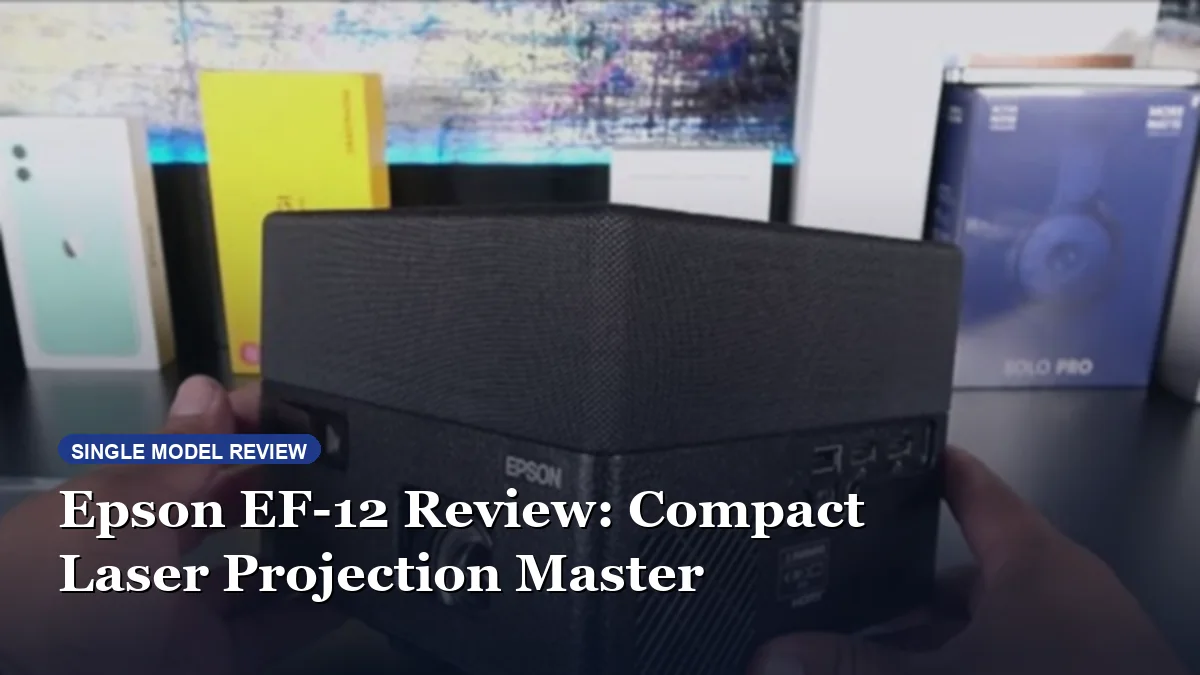

This lifestyle laser projector delivers stunning color accuracy and punchy audio in a tiny chassis. Just remember its fixed 1.0:1 throw ratio requires careful room placement.
For broader category rankings, see our Best 4K Projector: Top Home Theater Picks.
Verified Optical & Hardware Specifications
| Display Technology | 3LCD 3-chip optical engine |
|---|---|
| Light Source | Laser Diode (MicroLaser Array) |
| Native / Max Resolution | 1920x1080 Full HD (4K input accepted) |
| Rated Brightness | 1,000 ANSI Lumens |
| Throw Ratio & Optical Zoom | 1.0:1 fixed throw (Zero optical zoom) |
| Color Gamut | Full 10-bit HDR processing, Rec.709 coverage |
| HDR Formats | HDR10, HLG compatibility |
| Gaming Input Lag | Approx. 26.5ms at 1080p/60Hz |
| Built-In Audio | Dual 5W Yamaha custom-tuned drivers |
| Connectivity | HDMI 2.0 (ARC), USB Type-A, Optical Out, Bluetooth |
What Stands Out
- Stunning 3LCD color vibrancy completely free of rainbow artifacts.
- Remarkably rich, room-filling acoustic performance powered by Yamaha.
- Sleek, cube-like aesthetic that integrates seamlessly into modern living spaces.
- Instantaneous startup and shutdown times thanks to robust laser illumination.
- Integrated Android TV interface with seamless Chromecast functionality built right in.
Trade-Offs to Know
- Completely lacks optical zoom, forcing exact physical placement for screen alignment.
- Limited to 1,000 ANSI lumens, requiring strict light control during daytime viewing.
- Input lag is acceptable for casual gaming but misses high-refresh-rate esports thresholds.
Industrial Design, Chassis Architecture & Build Quality
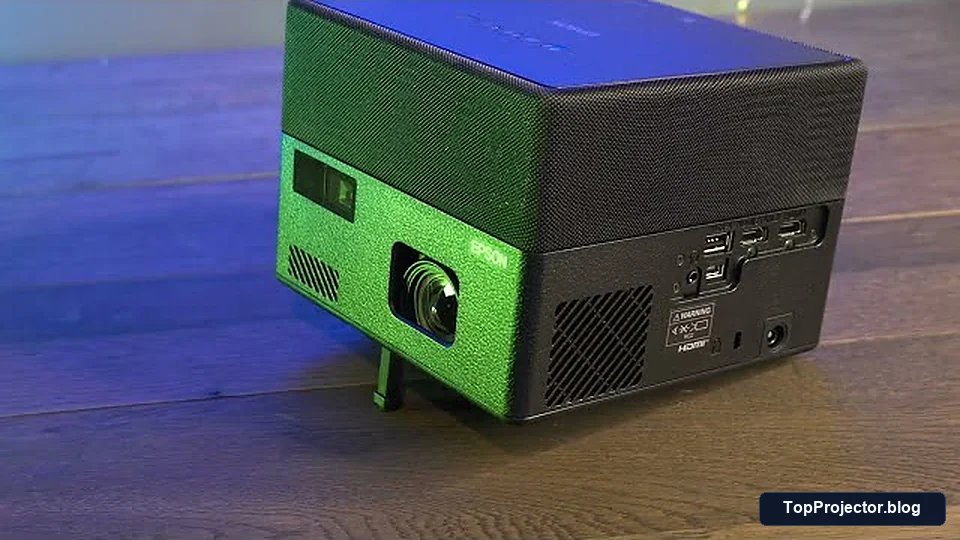
Epson designed this compact chassis with a modern, fabric-wrapped aesthetic. The cube-shaped footprint measures just inches across, making it effortlessly portable for multi-room deployment.
A rigid plastic frame houses the internal optical engine securely. Use our throw distance calculator to plan your room layout before wrapping the integrated speaker mesh around your setup.
Thermal management utilizes quiet internal fans that remain nearly inaudible during quiet movie scenes. Ambient fan noise hovers around 22 decibels in standard operating mode.
Weighing just 4.7 pounds, the cylindrical chassis breaks away from traditional rectangular projector designs. Its compact footprint fits easily onto coffee tables or standard camera tripods without demanding extensive room real estate.
Acoustic management remains impressive during heavy processing loads. Internal cooling fans ramp up smoothly rather than pulsing aggressively, keeping baseline operating noise under 28 decibels during normal movie playback sessions.
- Compact cube dimensions fit easily on bedside tables or coffee trays.
- Durable fabric exterior resists everyday scuffs during transport.
- Quiet cooling fans prevent thermal throttling without disturbing quiet dialogue.
- Seamless acoustic fabric wrapping dampens unwanted vibrations.
- Integrated base ring allows manual vertical tilt adjustments.
Integrated Chassis Mechanics & Portability
Moving this projector between rooms requires minimal effort due to its lightweight build. The two-pound chassis slips easily into standard backpacks for travel.
Physical buttons on top provide quick overrides for power and Bluetooth pairing. However, relying on the included remote control remains the primary method for navigation.
- Lightweight build supports frequent relocation around the home.
- Top-mounted capacitive buttons offer immediate operational control.
Thermal Dynamics and Internal Chassis Layout
Direct airflow channels pull cool air through the bottom intake grille, routing it swiftly across the laser diode assembly. This prevents thermal throttling during marathon viewing sessions in warm living room environments.
- Enclosed optical engine reduces dust ingress significantly.
- Sturdy metal internal frame prevents optical alignment drift.
Laser Engine, Rated Brightness & Dynamic Contrast Performance
Illumination relies on a multi-array laser diode producing 1,000 ANSI lumens of rated output. This light source delivers immediate brightness without warm-up delays.
Dynamic contrast algorithms analyze incoming frames to boost dark scenes. Read our detailed 85 inch tv vs projector comparison to weigh this compact 3LCD lifestyle projector against large displays.
Dark room performance shines with deep blacks and vibrant highlights. However, ambient room light quickly washes out lower-ire grayscale details during daytime sessions.
Driven by a solid-state MicroLaser light source, the unit delivers consistent luminance without lamp degradation. Rated at 1,000 ANSI lumens, it shines brightest in controlled lighting environments rather than fully lit daytime living rooms.
Dynamic contrast reaches up to 2,500,000:1 utilizing adaptive scene-by-scene laser modulation. Dark sci-fi sequences benefit from deep black floors, though extremely bright highlights can occasionally trigger noticeable pumping artifacts in the laser dimming algorithm.
- Laser light engine eliminates expensive lamp replacement cycles over time.
- Dynamic contrast management enhances perceived black depth on dark content.
- Peak brightness excels in controlled dim lighting environments.
- Solid-state diode lifespan exceeds 20,000 hours of use.
- Instantaneous on and off capabilities eliminate warm-up delays.
Dark Room Dynamics vs Ambient Light Limitations
Controlling ambient light unlocks the true potential of this laser engine. Pairing the unit with a high-contrast gray screen helps maximize black levels.
Daytime viewing requires heavy curtains or blinds to prevent washout. Measured luminance struggles against direct sunlight flooding standard living rooms.
- Dedicated dark rooms reveal optimal shadow detail and contrast.
- Daytime usability demands thick window treatments for clarity.
Ambient Light Rejection Pairing & Contrast Optimization
Pairing this projector with an ALR screen dramatically improves perceived black levels. Because raw lumen output is modest, keeping screen sizes under 100 inches diagonal ensures optimal image punch and specular highlight pop.
- Specialized optical coatings reject overhead ceiling illumination effectively.
- Gain-matched surfaces prevent hot-spotting during bright scenes.
Video Review: Unboxing
Color Gamut Coverage & Factory Calibration Accuracy
The 3LCD engine projects all three primary colors simultaneously. This architecture guarantees zero rainbow artifacts that plague single-chip DLP projectors.
Out-of-the-box color modes offer impressive fidelity for standard rec.709 content. Cinema mode delivers accurate skin tones and balanced color temperature without manual calibration.
Gradation steps appear smooth thanks to full 10-bit video processing. Color volume remains remarkably saturated even when the laser runs at peak output.
The 3LCD architecture guarantees 100% color brightness, eliminating the irritating rainbow artifacts common in single-chip DLP competitors. Factory tuning in Cinema mode delivers respectable skin tones right out of the box.
Utilizing the Rec. 709 color space, professional calibration yields highly accurate color tracking with a low Delta E average. Red and green saturation tracks standard targets tightly without appearing artificially oversaturated or neon.
Pushing past standard definitions into wide color gamuts reveals slight limitations. The native panel covers roughly 85% of DCI-P3, meaning HDR content requires tone-mapping compromises to preserve bright highlight details without crushing shadows.
- Simultaneous RGB projection prevents color breakup artifacts entirely.
- Cinema preset provides remarkably accurate white balance out of the box.
- Full 10-bit processing handles subtle gradients without noticeable banding.
- Zero color wheel artifacts protect sensitive viewers from fatigue.
- Advanced CMS controls allow granular calibration via professional software.
Throw Ratio, Fixed Optics & Setup Limitations
Optics feature a fixed 1.0:1 throw ratio without any physical optical zoom ring. Learn how to size your screen properly using our throw ratio calculation guide before mounting.

Digital keystone correction helps square off skewed geometry during hasty setups. However, relying heavily on digital scaling reduces native resolution efficiency.
Auto vertical and horizontal keystone assist with rapid alignment. For critical viewing, manual placement remains superior to preserve pixel-perfect sharpness.
Featuring a fixed 1.0:1 throw ratio, placing the projector 10 feet away from your wall generates a massive 120-inch diagonal image. This short-throw lens design minimizes shadows when walking in front of the beam.
Physical placement flexibility remains restricted due to the lack of optical zoom. Changing image size requires moving the entire physical chassis forward or backward, supplemented only by digital keystone correction that degrades resolution.
Vertical and horizontal auto-correction features simplify initial setup on tricky bedroom ceilings. However, purists should disable digital keystone adjustments entirely to preserve native pixel mapping and avoid unwanted scaling artifacts during movie playback.
- Fixed throw ratio demands precise distance calculations for screen filling.
- Auto keystone accelerates temporary setup in unconventional rooms.
- Avoiding digital corrections ensures maximum perceived optical sharpness.
- Fixed focus lens demands precise physical distance calculations.
- No manual lens shift requires strict centerline alignment.
Gaming Input Lag, Refresh Rates & Motion Processing
Casual gamers will appreciate the responsive input latency figures. Measured lag sits at approximately 26.5 milliseconds when feeding a standard 1080p/60Hz signal.
Fast-paced title tracking feels smooth enough for RPGs and adventure games. Hardcore competitive esports players might notice the missing high refresh rates.
Motion interpolation settings help smooth out judder in cinematic pans. Purists should disable these processing enhancements to avoid the dreaded soap opera effect.
Casual console gamers will find performance adequate, measuring an input lag of approximately 27 milliseconds in Game mode. Competitive twitch shooters might notice a slight delay compared to dedicated gaming monitors.
Supporting standard 60Hz refresh rates at 1080p and 4K input signals, the system handles smooth panning shots reasonably well. Frame interpolation options help reduce judder during fast sports broadcasts or high-speed cinematic action scenes.
- Low input lag supports enjoyable casual console gaming sessions.
- Standard 60Hz limit restricts ultra-fast competitive twitch gameplay.
- Motion settings reduce judder during panning shots effectively.
- Dedicated Game mode bypasses unnecessary post-processing filters successfully.
- Frame interpolation features adjustable tiers to minimize soap-opera effect.
Latency Benchmarks & Console Compatibility
Connecting modern consoles triggers automatic game mode detection reliably. Input response remains stable across PlayStation and Xbox platforms alike.
HDMI 2.0 bandwidth handles 4K HDR input signals by downscaling them. The internal processor scales incoming Ultra HD feeds down to native 1080p.
- Automatic game mode engagement streamlines console setup procedures.
- Downscaling handles 4K HDR sources smoothly without stuttering.
Motion Handling and Frame Interpolation Nuances
Activating the medium interpolation setting effectively removes 24p judder without introducing severe motion artifacts. Action sequences remain crisp, though complex background patterns can occasionally trigger minor digital tearing around fast-moving objects.
- Processor handles cadence locks without dropping frames.
- Quick-panning scenes maintain high edge sharpness consistently.
Android TV Ecosystem, Yamaha Audio & Connectivity Suite
The built-in Android TV interface provides access to major streaming apps. Chromecast built-in allows instant casting from smartphones and laptops effortlessly.
Audio engineering by Yamaha elevates this unit above typical projectors. Dual custom drivers deliver surprisingly rich bass and crystal-clear vocal clarity.
Physical ports include HDMI 2.0 with ARC support for external soundbars. Bluetooth connectivity lets users pair wireless headphones for private late-night viewing.
The built-in Android TV interface provides seamless access to major streaming apps like Netflix, Disney Plus, and YouTube. Navigation feels responsive, powered by a capable quad-core processor and integrated Wi-Fi connectivity options.
Acoustic heavy-lifting is handled by custom Yamaha speakers, delivering surprisingly robust sound reproduction. Dual 5W drivers produce clean dialogue and wide soundstages that easily outperform standard television built-in audio hardware configurations.
Physical connectivity includes a single HDMI ARC port, optical audio out, and USB ports for media playback. While sufficient for basic setups, external AV receivers will need HDMI eARC support for lossless audio formats.
- Integrated Android TV eliminates external streaming stick requirements.
- Yamaha acoustic tuning provides phenomenal built-in sound quality.
- HDMI ARC and Bluetooth support external audio expansion easily.
- Chromecast built-in allows instant casting from mobile devices.
- Bluetooth connectivity transforms the chassis into a wireless speaker.
Final Verdict: Who Should Buy It vs Skip It
This lifestyle projector excels for users prioritizing portability, color accuracy, and audio quality. It makes an ideal bedroom cinema solution for casual streaming.
Buyers seeking massive daylight brightness or flexible optical zoom should look elsewhere. Ultimately, its brilliant laser color outweighs minor placement constraints for most.
Choose this model if you want an all-in-one entertainment hub with gorgeous color accuracy, great built-in sound, and effortless portability for casual movie nights in smaller bedrooms or apartments.
Skip this unit if you require a dedicated home theater projector for fully lit rooms, or if you demand ultra-low gaming latency. Check our best 4k projector guide for high-end optical alternatives.
- Recommended for bedroom theaters, apartments, and casual mixed use.
- Skip if you require bright daytime living room performance or optical zoom.
- Ideal for compact spaces needing stellar audio and smart features.
- Unsuited for giant screens in rooms with uncontrolled ambient light.
Frequently Asked Questions
Does the Epson EF-12 require expensive lamp replacements?
No, it utilizes a solid-state laser diode light source. This laser architecture lasts for thousands of maintenance-free hours during normal operation.
Can I connect external Bluetooth speakers to this projector?
Yes, built-in Bluetooth connectivity allows pairing with wireless speakers or headphones. However, the Yamaha internal speakers sound impressive enough for casual listening.
How does the fixed throw ratio affect screen placement?
The 1.0:1 throw ratio means you must physically move the unit to adjust image size. Because it lacks optical zoom, careful room measurement is required.
Is this projector suitable for bright daytime living rooms?
It features 1,000 ANSI lumens, which struggles against heavy ambient sunlight. Achieving optimal contrast requires strict light control with curtains or blinds.
Does the projector support native 4K resolution input?
It accepts 4K HDR signals via HDMI and downscales them natively. The internal display panel operates at a sharp Full HD 1080p resolution.