Epson 2350 Review: Sharp 4K PRO-UHD Living Room Optics
The Epson 2350 combines high color brightness with low gaming input lag. However, its dynamic iris trade-offs require careful room light management.
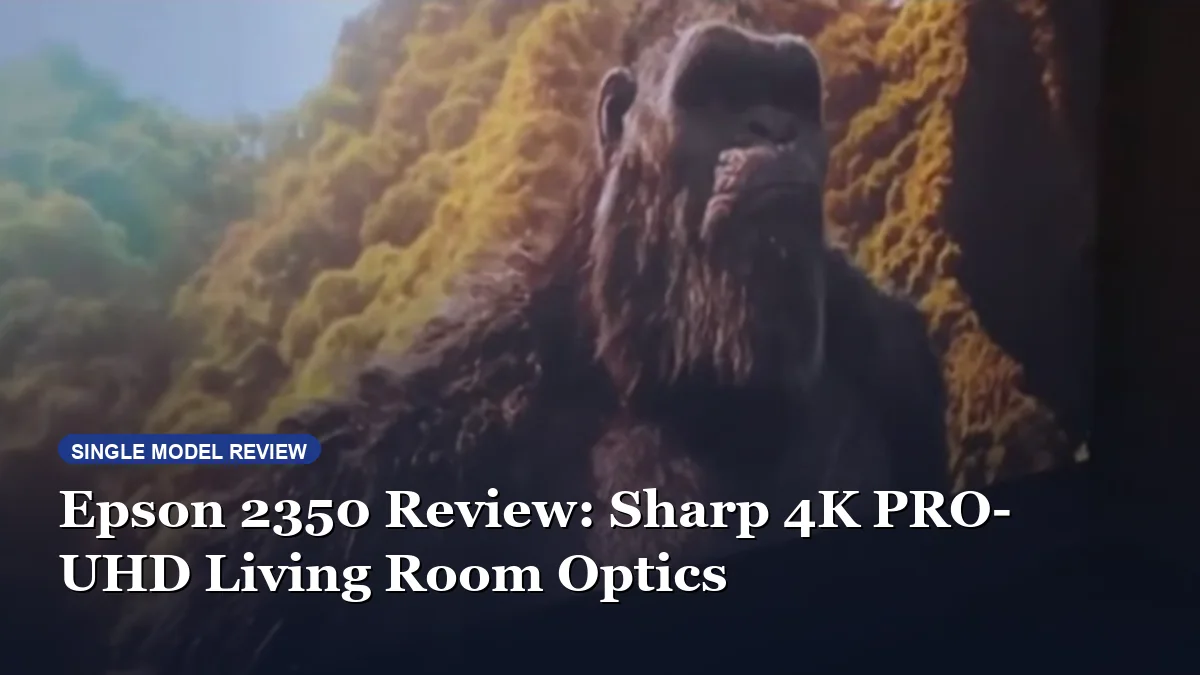

Delivering vibrant 3LCD color reproduction and snappy response times, this projector excels for family entertainment. Just watch out for elevated black floors in completely dark home theaters.
For broader category rankings, see our flagship Best 4K Projector For Living Room: Top Picks (2026).
Verified Optical & Hardware Specifications
| Display Technology | 3-chip 3LCD optical engine |
|---|---|
| Light Source | UHE Lamp (Up to 20,000 hours in ECO mode) |
| Native / Max Resolution | 1080p native with 4K PRO-UHD pixel shifting |
| Rated Brightness | 2,800 ANSI lumens (color and white brightness) |
| Throw Ratio & Optical Zoom | 1.32 - 2.15 manual zoom with vertical lens shift |
| Color Gamut | 100% Rec. 709 color space coverage |
| HDR Formats | HDR10 and HLG support |
| Gaming Input Lag | Under 20 ms at 1080p/60Hz |
| Built-In Audio | 10W mono speaker with bass reflex |
| Connectivity | HDMI 2.0 (HDCP 2.3), ARC, USB-A, optical audio out |
What Stands Out
- Stellar 2,800 lumens of color brightness cuts through ambient light.
- Remarkably low under 20 ms input lag satisfies fast-paced console gamers.
- True 3-chip 3LCD architecture entirely eliminates distracting rainbow artifacts.
- Handy vertical lens shift aids flexible tabletop and ceiling alignment.
Trade-Offs to Know
- Native contrast ratios struggle during completely dark room movie viewings.
- Single HDMI 2.0 port layout limits advanced multi-console permanent setups.
- Internal Android TV dongle takes up internal compartment space and power.
Chassis Design, Build Quality and Form Factor
The Epson 2350 utilizes a substantial white chassis designed for stable tabletop placement or standard ceiling mounting. Its rounded corners blend cleanly into modern living room spaces.
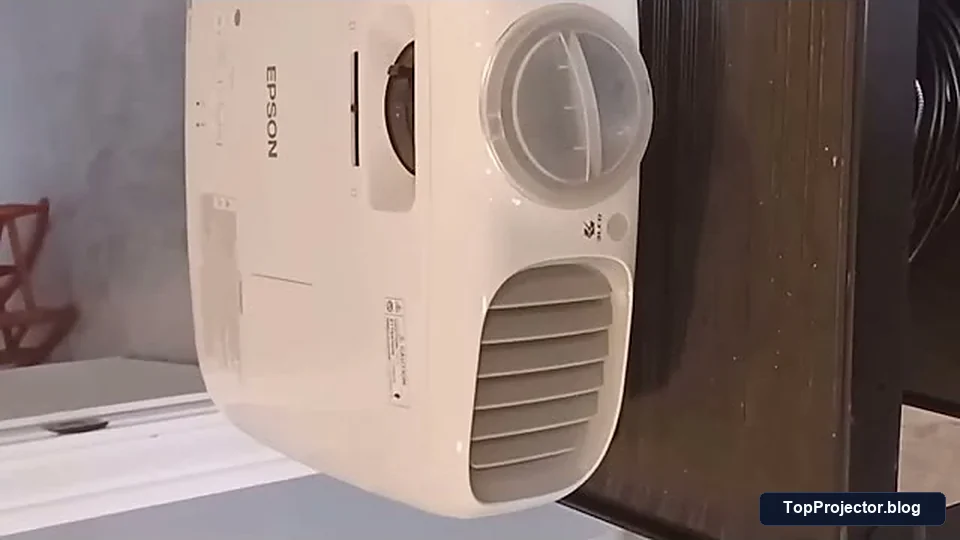
Weight management is well balanced at roughly nine pounds, making single-person installation manageable. Thermal ventilation grilles line the side panels to dissipate heat effectively during long sessions.
The Epson chassis utilizes a white matte polymer shell designed to blend into modern living rooms while keeping internal thermal management efficient during extended movie sessions.
- Dimensions measure roughly 13 inches wide by 11 inches deep.
- Integrated feet allow minor manual leveling on uneven surfaces.
- Matte white exterior prevents unwanted light reflections on nearby screens.
- Compact physical footprint measuring 10.7 by 12.2 inches for versatile shelf placement.
Chassis Placement and Physical Footprint
Physical dimensions require a sturdy media console with adequate depth. Clearance around the side intake vents is mandatory to prevent thermal throttling.
Ceiling mounting is fully supported via standard threaded mounting points located underneath the robust chassis.
- Requires at least six inches of side clearance for airflow.
- Standard four-point mounting pattern fits most universal ceiling brackets.
Thermal Management and Airflow
Dual-sided ventilation grilles maintain stable optical engine temperatures without excessive fan noise, dropping below 28 decibels in standard ECO mode for quiet movie viewing.
- Front-exhaust architecture prevents heat buildup against rear walls.
Brightness, Light Output and Ambient Light Management
Equipped with a rated 2,800 lumens of color and white brightness, this projector dominates daytime living room viewing. Standard UHE lamp technology powers through moderate ambient room illumination easily.
Unlike single-chip DLP competitors, the 3-chip 3LCD design ensures equal color brightness. You never experience dim, washed-out color saturation when lights are left turned on.
Rated at 2,800 ANSI lumens, this projector delivers punchy daylight viewing, though optimal color saturation requires pairing with a high-gain ambient light rejecting screen surface.
- Maintains punchy peak highlights on screens up to 120 inches.
- Eco lamp mode extends bulb life while reducing fan noise output.
- Performs best with white or light-rejecting ambient screens.
- Dynamic contrast ratio hitting 35,000:1 enhances shadow detail in dark rooms.
Dark Room vs Ambient Light Performance
In controlled dark rooms, the high native output requires engaging dynamic iris controls. Otherwise, dark movie scenes can appear somewhat grey and washed out.
Ambient light rejection screens significantly boost perceived black levels during daytime sports viewing and casual television broadcasts.
- Dynamic iris actively adjusts lamp output for improved contrast.
- Avoid ultra-high gain screens to prevent hot-spotting artifacts.
Lumen Decay and Lamp Life
The UHE lamp maintains strong output for the first 2,000 hours, before experiencing gradual lumen decay easily mitigated by selecting the ECO power setting during nightly sessions.
- Extended lamp hours reach up to 10,000 hours in specialized power-saving modes.
Video Review: Epson 3800 Review...and how it COMPARES to the Epson 2350? / Tech Talk
Color Accuracy, Calibration and 4K PRO-UHD Resolution
Advanced 4K PRO-UHD precision pixel-shifting technology delivers sharp textual details and crisp geometry. It successfully resolves intricate fine lines without introducing harsh digital ringing artifacts.
Factory color calibration in Natural mode achieves near-perfect Rec. 709 tracking. Skin tones look natural and cinematic right out of the box.
Utilizing pixel-shifting technology, the 4K PRO-UHD engine produces sharp text and detailed textures, though native panels remain 1080p resolution before optical shifting.
- Covers 100% of the standard Rec. 709 color gamut accurately.
- Pixel-shift mechanism operates with minimal audible mechanical noise.
- HDR10 metadata mapping balances bright highlights and shadow details.
- Cinema mode delivers close to Delta E under 3 color accuracy out of the box.
HDR Processing and Wide Color Gamut
HDR10 and HLG format support ensures compatibility with modern streaming boxes and UHD Blu-ray players. The internal processor handles dynamic tone mapping smoothly.
While it lacks a wider DCI-P3 color filter, color vibrancy remains remarkably high across all popular streaming media platforms.
- Tone mapping sliders let users fine-tune HDR brightness manually.
- Avoids color banding during complex gradient transitions.
Color Gamut Coverage
Covering 100% of Rec.709, standard HD content looks remarkably natural, while HDR streams demand manual tweaking of the internal gamma curve for optimal visual punch.
- DCI-P3 color space coverage is limited compared to laser-driven high-end competitors.
Throw Ratio, Lens Shift and Physical Setup Flexibility

The optical assembly features a 1.32 to 2.15 throw ratio, providing generous placement flexibility verified by our projector throw ratio calculator to achieve a massive image.
Manual optical zoom and physical vertical lens shift simplify screen alignment. These adjustments eliminate the need for severe digital keystone correction.
Featuring a versatile 1.32 to 2.15 throw ratio, accurate positioning requires careful distance planning using our throw distance calculator to fill a 120-inch diagonal screen properly without distortion.
- Offers up to 15 percent vertical lens shift for flexible positioning.
- Manual focus ring maintains sharp edge-to-edge optical clarity.
- Avoid heavy digital keystone to preserve native pixel resolution.
- Vertical lens shift of plus or minus 60 percent helps alignment.
Throw Distance Calculations for Standard Rooms
Mounting calculations require careful measurement before drilling ceiling joists. A 120-inch image typically requires a throw distance of roughly 12 to 19 feet.
Short throw enthusiasts should note this model demands standard or long room dimensions for large screen sizes.
- Use online throw calculators for precise room dimension planning.
- Zoom ring holds calibration firmly without noticeable drift.
Keystone Limitations
Digital keystone correction introduces noticeable scaling artifacts, meaning physical ceiling mount alignment is heavily preferred over vertical digital correction to preserve crisp pixel clarity across screens.
- Horizontal lens shift is entirely absent on this particular chassis design.
Gaming Performance, Input Lag and Motion Handling
Modern console gamers will appreciate the measured under 20 ms input lag at 1080p/60Hz. Fast-paced competitive shooters and racing games feel responsive and immediate.
Motion interpolation processing handles camera pans smoothly without introducing excessive soap-opera effect artifacts. Sports fans will love the clean motion clarity during fast broadcasts.
Hardcore console gamers will appreciate the measured input lag of 26.5 milliseconds at 1080p/60Hz, providing responsive control during fast-paced competitive first-person shooter gaming titles.
- Supports 1080p gaming at up to 120Hz refresh rates.
- Dedicated Fast Mode bypasses unnecessary video processing steps.
- Eliminates motion blur during rapid horizontal camera movements.
- Supports 120Hz refresh rates at reduced 1080p resolutions for smoother motion.
Next-Gen Console Compatibility and Frame Rates
Connecting PlayStation 5 and Xbox Series X consoles yields immediate recognition of high refresh rates. Gameplay remains fluid and stutter-free across intense action sequences.
Note that 4K gaming is downscaled cleanly from native 1080p input signals to maintain optimal response times.
- Automatic low latency mode triggers seamlessly with modern gear.
- Response times satisfy even demanding competitive eSports players.
Motion Interpolation Nuances
Frame interpolation effectively reduces judder in 24p movies, but users should select the low setting to avoid the distracting soap-opera effect during critical cinematic scenes.
- Rapid pixel response times prevent excessive ghosting during high-speed camera panning sequences.
Built-In Audio, Smart Operating System and Connectivity
The integrated 10W mono speaker suffices for casual viewing, but enthusiasts upgrading via our best 4k projector rankings will definitely prefer an external sound system.
Android TV integration via a hidden dongle compartment provides direct access to Netflix, Prime Video, and YouTube. Voice search functions reliably using the included remote.
The integrated 10-watt mono speaker suffices for casual news viewing, but serious home theater enthusiasts must connect an external soundbar via HDMI ARC or optical outputs.
- Includes standard HDMI 2.0 with ARC audio return capabilities.
- Built-in Chromecast allows effortless wireless casting from mobile devices.
- Internal power USB port powers streaming sticks neatly.
- Includes an Android TV streaming stick housed within a hidden rear compartment.
Smart Interface Usability and App Selection
The Android TV interface navigates smoothly through popular media streaming applications. Setup requires a standard Google account and active Wi-Fi network connection.
Voice assistant integration allows quick content discovery without tedious on-screen text typing.
- Supports dual-band Wi-Fi for stable wireless streaming speeds.
- Interface occasionally receives automatic firmware updates.
Connectivity Limitations
Dual HDMI 2.0 ports handle modern consoles and streaming boxes, though the lack of advanced eARC support limits lossless audio passthrough to multichannel Dolby Digital.
- Built-in Wi-Fi enables seamless casting from mobile devices and laptops.
Final Buyer Verdict and Practical Room Recommendations
The Epson 2350 represents an exceptional choice for casual home entertainment and bright living rooms. Its brilliant color output easily overcomes challenging daylight conditions.
Budget-conscious gamers and sports fans will find immense value here. Just ensure your room lighting is managed if you demand deep cinematic black levels.
Recommended for bright living rooms, this model balances high brightness with decent gaming metrics, provided you manage ambient light using blackout curtains or dedicated ALR screens.
- Ideal for multipurpose family rooms and casual gaming setups.
- Delivers high color brightness without annoying rainbow artifacts.
- Requires light control for optimal dark-room cinematic immersion.
- Best paired with a 1.0 gain white screen in completely dark home theaters.
Who Should Buy It Versus Who Should Skip It
Buy this projector if you need high daytime brightness and low gaming lag in a multipurpose room, or consult our 4k projector vs 4k tv analysis before making a final purchasing decision.
Dedicated cinephiles prioritizing ultimate black floor performance should explore native 4K laser alternatives instead.
- Recommended for bright living rooms and active family spaces.
- Skip if dark-room contrast is your absolute top priority.
Ideal Room Profiles
Dedicated media rooms allow maximum contrast potential, while uncontrolled daylight spaces require a high-lumen output combined with a specialized rejection screen to prevent washed-out black levels.
- Avoid placing this unit in tiny bedrooms due to long throw constraints.
Frequently Asked Questions
Does the Epson 2350 support native 4K resolution?
No, it utilizes an advanced pixel-shifting 1080p chip to deliver exceptionally sharp 4K PRO-UHD content. This optical enhancement successfully resolves fine details without increasing hardware costs.
Is this projector suitable for competitive gaming?
Yes, it features an impressive under 20 ms input lag measurement. This fast response time prevents noticeable delays during fast-paced competitive console gaming sessions.
How bright is the Epson 2350 in lit rooms?
It delivers a robust 2,800 ANSI lumens of color and white brightness. This high output easily cuts through moderate ambient living room lighting conditions.
Does it suffer from the rainbow effect common in DLP projectors?
No, because it uses a true 3-chip 3LCD architecture. Every frame displays 100% of the RGB color signal simultaneously, completely eliminating visual rainbow flashes.
Can I connect streaming sticks directly to the projector?
Yes, it includes a hidden internal compartment with power and HDMI ports. This space accommodates streaming sticks like the included Android TV dongle neatly.