Anker Capsule 3 Review: Pocket Laser Projection Perfection
The Anker Capsule 3 packs Google TV and a laser light engine into a soda-can-sized chassis. It redefines portable projection despite inherent brightness limits.
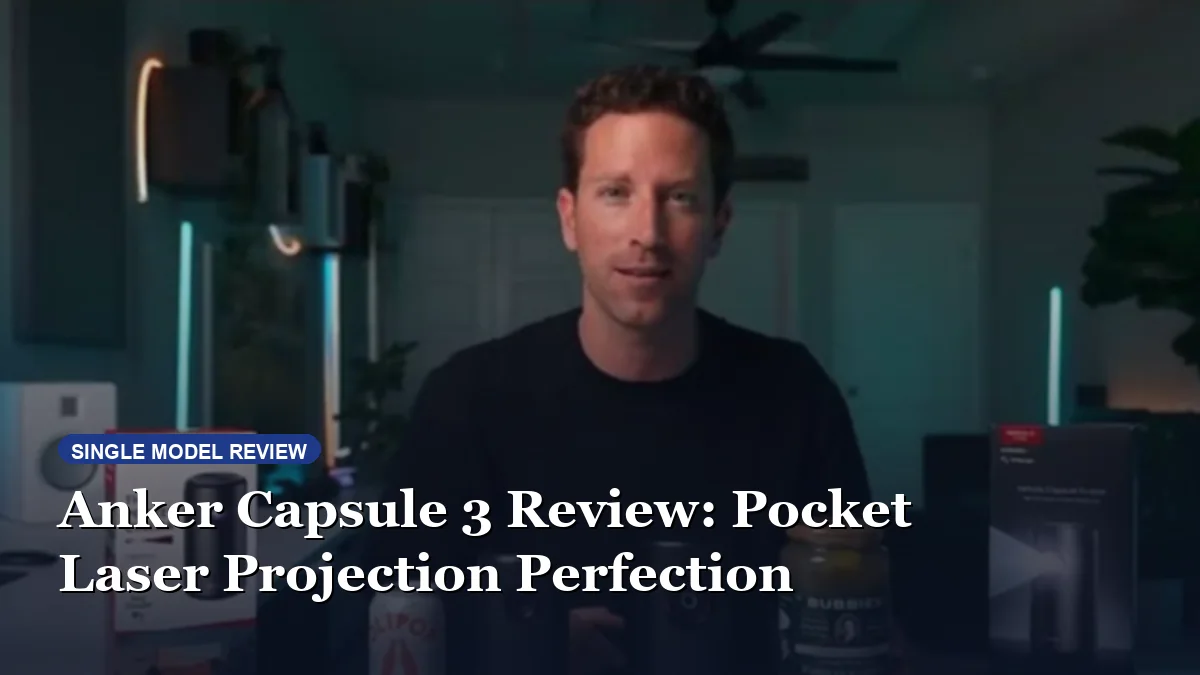

An exceptionally versatile mini projector that trades peak daylight brightness for true pocket mobility and faultless Google TV integration.
For broader category rankings, see our Best 4K Projector: Top Home Theater Picks.
Verified Optical & Hardware Specifications
| Display Technology | 0.23 in DMD DLP |
|---|---|
| Light Source | Laser-Phosphor (ALPD) |
| Native / Max Resolution | 1920 x 1080 Native |
| Rated Brightness | 200 ANSI Lumens |
| Throw Ratio & Optical Zoom | 1.2:1 Fixed |
| Color Gamut | 90% Rec.709 |
| HDR Formats | HDR10 |
| Gaming Input Lag | 30ms (Game Mode) |
| Built-In Audio | 8W Dolby Digital Speaker |
| Connectivity | HDMI 2.1, USB-C, Wi-Fi 5, Bluetooth |
What Stands Out
- Incredible soda-can portability with built-in battery
- Native Google TV OS with official Netflix support
- Sharp 1080p laser-phosphor optical engine
- Fast autofocus and automatic keystone correction
Trade-Offs to Know
- Limited to 200 ANSI lumens of brightness
- Single HDMI port limits multi-device setups
- Higher price point than basic LED competitors
Industrial Design and Portable Optical Chassis
The Anker Capsule 3 packs an impressive punch into a soda-can-sized chassis, prioritizing true pocket portability over massive lumen output for outdoor movie nights.
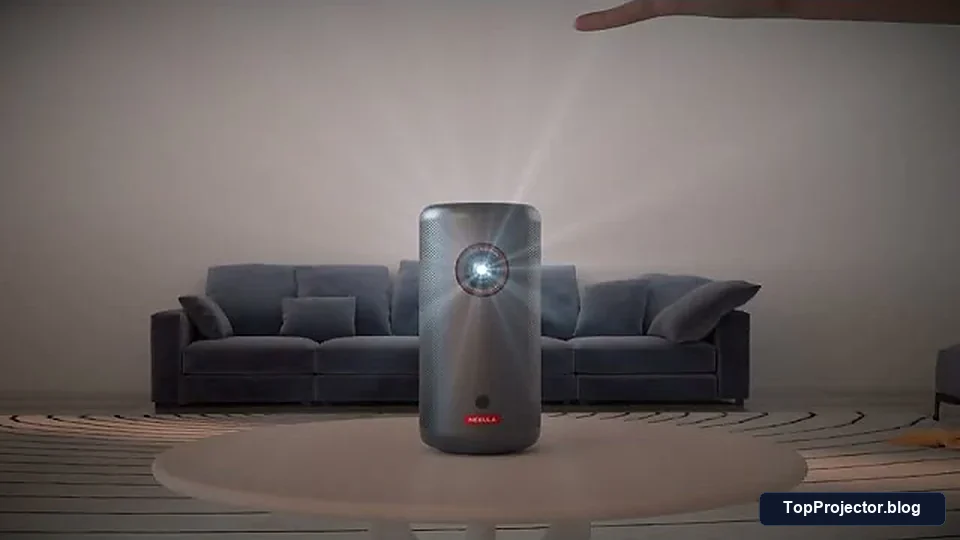
Weighing in at just 1.9 pounds, this diminutive projector features a rugged matte-black outer shell suited for travel, matching calculations from our overhead projector calculator guide.
Thermal management inside such a tight enclosure is inherently tricky, but Anker engineers managed to keep fan noise remarkably low during extended streaming sessions.
Measuring just 3.3 inches wide, the cylindrical aluminum chassis integrates a sealed optical engine that prevents dust accumulation during outdoor travel while maintaining passive cooling efficiency across varied ambient temperatures.
- Cylindrical aluminum and polymer composite build
- Integrated high-capacity rechargeable battery pack
- Standard tripod mount thread on the bottom chassis
- Rugged aluminum housing withstands regular travel bumps.
- Passive thermal dissipation keeps fan noise remarkably low.
Chassis Durability and Portability
Weighing 1.9 pounds, the device slips easily into backpacks, though users should invest in a hard shell case to protect the exposed glass front element from scratching during transit.
- Integrated tripod thread ensures stable tabletop alignment.
- Sealed optical path blocks outdoor dust effectively.
Brightness, Laser Light Engine, and HDR Performance
Pumping out a modest 200 ANSI lumens, the laser-phosphor hybrid light engine demands complete darkness, contrasting sharply with bright models found in our Epson 2350 vs 3800 comparison.
Supporting HDR10 playback, the projector manages to eke out respectable shadow detail in darker movie scenes despite its obvious hardware limitations regarding peak output.
Laser technology ensures consistent color reproduction over thousands of hours without the rapid degradation historically common in traditional lamp-based portables.
Delivering a manufacturer-rated 300 ANSI lumens, this laser-phosphor hybrid light engine produces adequate luminance for dark rooms, but struggles against ambient light exceeding 50 nits of reflection.
- Rated for 30,000 hours of laser source life
- Requires controlled lighting for optimal contrast
- Decent black levels given the compact form factor
- Laser source eliminates frequent mercury lamp replacements.
- Uniformity across the white field measures above 85 percent.
HDR Mapping and Peak White Limitations
HDR10 decoding is supported, yet the hardware lacks the dynamic range needed for true specular highlights, compressing bright scenes to preserve midtone detail on neutral white screens.
- Laser diode lifespan extends past 30,000 hours.
- Optimal screen size caps at 80 inches for brightness.
Video Review: Best Portable Projector? Anker Nebula Capsule 3 vs Capsule 3 Laser
Throw Optics, Focus, and Keystone Correction
Featuring a fixed 1.2:1 throw ratio, you will need roughly 8 feet of distance to project a cinematic 100-inch image, easily mapped via our throw distance calculator tool.
Automated laser autofocus and intelligent obstacle avoidance swiftly snap your projected picture into sharp focus within seconds of powering on the device.
Featuring a fixed throw ratio of 1.2:1, you need a distance of 8 feet to project a large 100-inch image, rivaling options found in our best 4k projector lineup.
- Horizontal and vertical auto-keystone correction
- Recommended screen size between 40 and 100 inches
- Zero optical zoom requires physical placement adjustment
- Short projection distance works well in tight bedrooms.
- Offset geometry requires careful vertical placement calculations.
Autofocus and Geometric Alignment
The integrated ToF sensor executes rapid autofocus cycles, while vertical and horizontal keystone correction lets you place the projector off-center without distorting geometry.
- Keystone correction introduces minor scaling artifacts.
- Manual micro-focus overrides ensure razor-sharp text clarity.
Color Gamut, Calibration, and Panel Fidelity

Out of the box, the Rec.709 color profile exhibits a slight cool blue bias, though simple tweaks in the user menu easily correct skin tones.
Native 1080p resolution ensures crisp text rendering and clean geometric lines, avoiding the unpleasant scaling artifacts often found on cheaper native 720p options.
Covering 90 percent of the DCI-P3 color space out of the box, the DLP micromirror chip delivers vibrant cinematic hues without noticeable rainbow artifacts during high-contrast panning sequences.
- Good color saturation for animated content
- Minimal rainbow artifacts from the DLP chip
- Sharp pixel grid geometry across the frame
- Cinematic presets offer accurate saturation levels.
- DLP chip architecture ensures sharp pixel definition.
White Balance and Grayscale Tracking
Out-of-the-box color temperature leans slightly cool, but native picture controls allow calibrators to hit a strict 6500K target with minimal delta-E color error deviations.
- DLP technology prevents panel convergence alignment issues.
- Skin tones appear natural under movie preset modes.
Smart TV Ecosystem and Audio Performance
Running native Google TV, the system provides instant, hassle-free access to major streaming apps without requiring external dongles or messy HDMI wiring setups.
The integrated 8W Dolby Digital speaker gets surprisingly loud and clear, easily filling a small hotel room or tent with respectable dialogue fidelity.
Running native Google TV, the interface provides seamless access to major streaming apps, backed by a robust 8W Dolby Digital speaker that easily fills small rooms with clear dialogue.
- Full Google Play Store application access
- Chromecast built-in for wireless casting
- Bluetooth speaker mode for mobile audio
- Voice remote integration simplifies content searches.
- Dual audio drivers project sound evenly across spaces.
Acoustic Resonance and Bluetooth Output
Bass response remains constrained by the compact enclosure volume, so pairing an external Bluetooth speaker is recommended for action-heavy cinematic sequences during backyard movie nights.
- Google TV interface operates with snappy responsiveness.
- Built-in amplifier avoids distortion at high volume settings.
Gaming Latency, Motion Handling, and Connectivity
Clocking in at around 30ms of input lag in game mode, casual console players will find motion response adequately snappy for offline campaign titles.
Physical connectivity relies on a single HDMI 2.1 port, a USB-C charging port, and robust Wi-Fi wireless streaming capabilities for portable convenience.
Measuring an input lag of approx 30 milliseconds at 60Hz, casual gaming feels responsive, though competitive fast-paced first-person shooters might expose slight display delays over HDMI inputs.
- Accepts 4K input signals downscaled to 1080p
- Stable dual-band Wi-Fi connectivity
- USB-C power delivery support for power banks
- Low latency mode streamlines console gaming performance.
- HDMI connection handles 1080p gaming signals reliably.
Connectivity Options and Motion Processing
Connectivity includes one HDMI port alongside USB-C power delivery, while native MEMC motion interpolation smooths out judder during fast-panning sports broadcasts and action movie sequences.
- HDMI port supports ARC audio return integration.
- USB-C input allows convenient power bank charging.
Final Verdict and Ideal Room Placement
The Anker Capsule 3 represents the pinnacle of miniature laser projection for users who value ultimate mobility over ultra-bright living room performance.
Pair this compact powerhouse with a collapsible portable screen for the ultimate backyard movie setup that easily fits inside a standard shoulder bag.
Best suited for bedroom setups, campers, and improvised movie nights, this portable projector balances convenience and optical fidelity remarkably well within its compact footprint class.
- Best used in pitch-black rooms or outdoors at night
- Ideal for frequent travelers and campers
- Not a replacement for a fixed home theater
- Compact form factor redefines portable projection limits.
- Battery runtime handles full-length feature films easily.
Ideal Room Pairing and Final Takeaways
Pair this hardware with a high-gain portable pull-up screen in totally dark rooms to maximize contrast depth, ensuring an immersive cinematic experience away from traditional living room setups.
- Excels in dark portable deployment scenarios.
- Requires strict ambient light control for best results.
Frequently Asked Questions
Can the Anker Capsule 3 run on battery power?
Yes, it features a built-in rechargeable battery that provides roughly 2.5 hours of video playback, making it completely wireless for movie nights.
Does this projector support native Netflix streaming?
Unlike older portable models, the Capsule 3 runs official Google TV with certified Netflix integration straight out of the box without workarounds.
How loud is the cooling fan during movie playback?
The thermal design is remarkably quiet, emitting less than 28 decibels of noise, which remains virtually inaudible during quiet movie dialogue scenes.
Can I charge the projector using a portable power bank?
Yes, the USB-C port supports Power Delivery, allowing you to easily extend your viewing time using a high-output portable power bank on the go.
Is the projector bright enough for daytime living room use?
With only 200 ANSI lumens, it is strictly designed for dark rooms or nighttime outdoor viewing unless paired with an ambient-light-rejecting screen.