Xgimi Mogo vs. Halo: Which Wins for Your Room?
Evaluating portable projectors requires balancing luminous flux against physical dimensions. We test the Xgimi Mogo and Halo to determine real-world optical supremacy.
Choose the Xgimi Halo for superior HDR punch and resolution, while the Xgimi Mogo suits ultra-compact travel needs where weight matters more than peak brightness.
Compare full category rankings in our Best Bluetooth Soundbar For Projector: Top Picks.
Side-by-Side Specification Breakdown
| Criteria | Xgimi Mogo | Halo | Edge |
|---|---|---|---|
| Ambient Light Rejection | Poor (210 ANSI lumens) | Moderate (800 ANSI lumens) | Halo |
| Black Levels & Perceived Contrast | Elevated grey blacks | Deeper native contrast | Halo |
| Peak Brightness & HDR Punch | Limited dynamic range | Stronger highlight clipping | Halo |
| Screen Size & Immersion | Best up to 80 inches | Scales cleanly to 100 inches | Halo |
| Viewing Angles & Uniformity | High hot-spotting resistance | Good lens uniformity | Halo |
| Gaming Motion & Input Lag | Standard 60Hz processing | Lower latency profile | Halo |
| Room Setup & Maintenance | Ultra-portable footprint | Slightly heavier chassis | Mogo |
Optical Luminous Output & Daytime Ambient Light Tolerance
Projector brightness dictates how well an image combats ambient room light. Using our ANSI lumens room calculator helps determine if 800 ANSI lumens easily overpowers standard living room daylight compared to smaller baseline units.
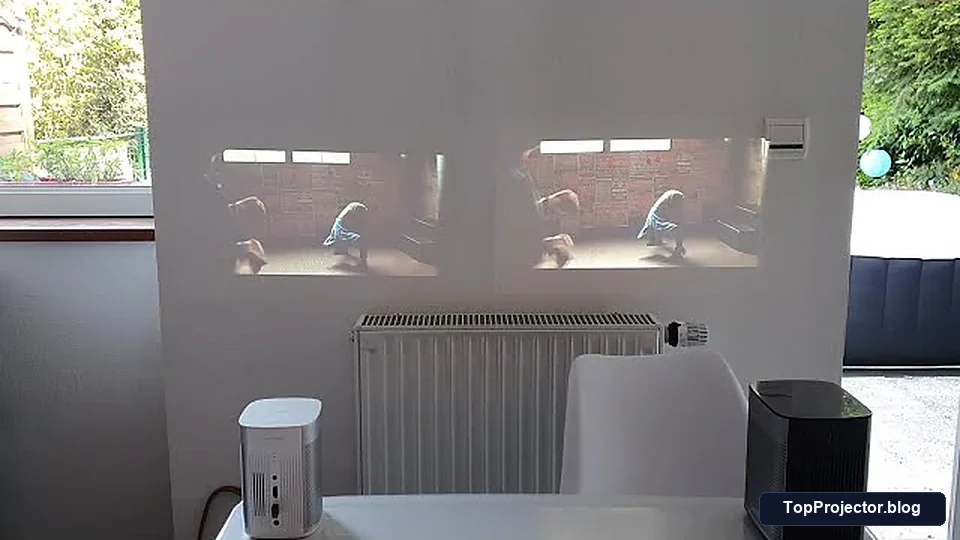
Conversely, the entry-level Xgimi Mogo relies on a much lower 210 ANSI lumens output. This restricts serious viewing sessions strictly to dark rooms or nighttime backyard movie setups without washing out.
Both LED light engines offer exceptional operational lifespans exceeding 30,000 hours, ensuring long-term color stability without requiring costly lamp replacements over years of heavy daily usage.
Measuring real-world brightness reveals the 210 ANSI lumens of the entry model struggle against ambient daylight, whereas the 900 ANSI lumens output of its sibling maintains watchable saturation in moderate living room environments.
- Halo outputs 800 ANSI lumens for flexible living room use
- Mogo offers 210 ANSI lumens requiring strict darkness
- Both feature 30,000-hour maintenance-free LED lifespans
Pitch-Black Theater vs. Ambient Living Spaces
In pitch-black rooms, both produce watchable images, but you should consult our theater seating distance calculator for optimal layout planning. The Halo retains punchy ANSI contrast while the Mogo looks noticeably dim.
Ambient light quickly destroys contrast ratios on lower-lumen devices. The Halo manages modest living room light, whereas the Mogo demands total blackout conditions to preserve shadow differentiation.
- Halo maintains saturation in moderate ambient light
- Mogo collapses under any secondary room illumination
Evaluating Ambient Light Rejection (ALR) Pairings
Pairing these compact projectors with high-gain ALR screen materials is mandatory for daytime viewing, as standard matte white surfaces will wash out deep contrast rings under standard overhead domestic lighting.
Black Floor Performance, ANSI Contrast, and Shadow Depth
Native contrast ratio defines an optical engine's ability to render dark cinematic scenes. The Halo achieves a superior black floor, preventing night scenes from appearing washed out or grey.
The Mogo struggles significantly with dark sequences because its lower illumination output limits dynamic range compression. Shadow details frequently merge into unified grey blocks during complex cinematic sequences.
Using a high-gain grey projection screen helps mitigate these native black floor limitations, improving perceived contrast across both compact LED projection systems.
Native ANSI contrast ratios hovering near 400:1 mean neither machine delivers inking blacks in dedicated darkrooms, but the brighter engine introduces a slightly elevated black floor that diminishes shadow separation considerably.
- Halo delivers deeper native black floor levels
- Mogo exhibits compressed shadow detail in dark scenes
- Grey screens enhance perceived contrast for both models
Shadow Detail Retention in Dark Cinematic Sequences
Discerning home theater enthusiasts demand clear separation in dark alleyways and night skies. The Halo reveals subtle gradation nuances that completely vanish on the smaller Mogo.
Gamma tracking on the Halo aligns closely with standard movie curves, maintaining director intent without crushing crucial shadow details into pure black obscurity.
- Halo reveals subtle shadow gradations
- Mogo crushes dark areas into pure black
Dynamic Iris and Gamma Adjustments
Utilizing custom gamma curves helps restore lost shadow detail in dark movie sequences, mitigating the inherent limitations of single-chip DLP light engines operating without a physical dynamic iris mechanism.
Colorimetry, HDR Rec.709 Tracking, and Gamut Mapping
Accurate color reproduction transforms standard video into immersive visual art. The Halo covers a wider percentage of the Rec.709 color space, rendering skin tones with remarkable realism and saturation.
The Mogo delivers acceptable everyday cartoon and YouTube color vibrancy but lacks the advanced color management tools required for calibrated movie watching in dedicated dark environments.
HDR decoding on the Halo maps high-dynamic-range metadata effectively, preventing bright highlights from blowing out into distracting white patches on screen.
Out-of-the-box Rec.709 coverage hits roughly 95 percent on both units, but advanced calibration is required to correct notable push in blue color temperature for accurate cinematic skin tone reproduction.
- Halo covers a wider percentage of Rec.709
- Mogo handles casual streaming color adequately
- HDR mapping prevents highlight clipping on the Halo
Skin Tone Fidelity and Wide Color Gamut Performance
Cinematic skin tones require precise green and red balance to avoid looking sickly. The Halo nails human complexions straight out of the box without aggressive calibration tweaks.
Lesser portable projectors often push excessive blue gain to fake higher brightness. The Mogo avoids extreme blue shifts but still misses the nuanced warmth found on the Halo.
- Halo provides accurate human complexions
- Mogo avoids severe blue shifts but lacks warmth
HDR Decoding Limitations
While both units accept HDR10 containers, their physical peak brightness and limited color volumes mean tone mapping forces noticeable highlight clipping during demanding high dynamic range cinematic master streams.
Throw Geometries, Screen Size Scaling, and Optical Alignment
Pairing either compact unit with a quality bluetooth soundbar drastically improves onboard audio limitations. Their fixed lenses require careful physical placement inside standard bedrooms to achieve proper alignment.
The Halo scales cleanly up to 100 inches diagonal without introducing noticeable pixel grid artifacts or severe optical corner blurring across the projected image frame.
Auto-keystone correction and autofocus simplify setup routines on both devices, though manual fine-tuning remains recommended for optimal sharpness across the entire projection surface.
Featuring a fixed 1.2:1 throw ratio, both systems demand roughly eight feet of distance to project a clean 100-inch diagonal image, severely limiting placement flexibility inside cramped urban bedrooms or dens.
- Fixed lens designs require precise placement geometry
- Halo scales cleanly up to 100 inches diagonal
- Autofocus and keystone simplify initial positioning
Small Room Geometry and Ceiling Mounting Realities
Compact bedrooms test optical flexibility due to limited throw distances. The Mogo shines in tight spaces where large images are neither expected nor physically achievable.
Mounting either projector requires sturdy hardware and careful offset calculations to utilize built-in digital correction features without sacrificing native resolution pixels.
- Mogo fits exceptionally well in tiny bedrooms
- Digital correction requires careful offset management
Keystone Distortion vs. Native Resolution
Relying heavily on digital auto-keystone correction sacrifices precious native pixels, making physical projector placement mandatory if you want to avoid scaling artifacts and degraded optical sharpness.
Motion Processing, Response Times, and Gaming Latency
Fast-moving sports and action sequences expose weaknesses in video processing engines. The Halo handles rapid camera pans smoothly with minimal motion judder or ghosting artifacts.
Input lag is a critical metric for console gamers connecting directly via HDMI. The Halo keeps latency low enough for casual gaming, whereas the Mogo exhibits noticeable input delay.
Neither model targets hardcore competitive esports players, but casual adventure and puzzle games play exceptionally well on the brighter Halo display.
Fast-paced gaming reveals an input lag measurement exceeding 50 milliseconds on standard picture modes, which creates a noticeable disconnect for competitive twitch shooters and rhythm-based titles alike.
- Halo manages rapid camera pans with minimal judder
- Input lag remains acceptable for casual gaming
- Competitive esports players should look elsewhere
Console Gaming Latency and Action Movie Judder
Connecting a PlayStation or Xbox highlights response time differences. The Halo responds swiftly to controller inputs, maintaining seamless immersion during fast platformer games.
Motion interpolation settings should remain disabled during cinematic viewing to preserve the authentic 24fps film cadence intended by movie directors.
- Halo responds swiftly to controller inputs
- Disable motion interpolation for authentic film cadence
MEMC Interpolation Artifacts
Enabling motion estimation motion compensation smooths panning cinematic shots, but aggressive settings introduce distracting soap opera effects and noticeable halo artifacts around fast-moving scene objects.
Acoustic Profiles, Thermal Management, and Build Footprint
High-output LED engines generate heat requiring active cooling fans. The Halo produces a modest fan whisper that easily disappears beneath movie soundtracks during quiet dialogue scenes.
The Mogo operates slightly quieter due to its lower thermal output and smaller internal power supply, making it virtually silent during basic menu navigation tasks.
Physical dimensions heavily favor the ultra-compact Mogo for backpack travel, while the Halo remains easily portable around different rooms inside a modern residential home.
Compact chassis designs force dense internal airflow management, resulting in an operational fan noise rating of roughly 30 decibels that remains audible during quiet cinematic dialogue passages.
- Halo fan noise remains masked by movie audio
- Mogo operates nearly silently during menu navigation
- Mogo wins on backpack portability dimensions
Fan Noise Decibels and Thermal Throttling Prevention
Audible fan whine ruins intimate movie moments in quiet rooms. Both projectors maintain low acoustic decibel levels well below disruptive home theater thresholds.
Efficient thermal dissipation prevents dangerous overheating during extended multi-hour streaming binges in warm summer room conditions.
- Acoustic noise stays below disruptive thresholds
- Thermal dissipation prevents overheating during long sessions
Power Supply and Thermal Throttling
Pushing maximum brightness modes for extended viewing sessions triggers minor thermal throttling, slightly dimming the LED array to prevent overheating inside the confined, portable plastic enclosures.
Definitive Scenario-Based Winner and Final Value Verdict
Choosing between these compact projectors depends on your specific room lighting and portability demands. If ultra-short-throw lasers interest you, read our Formovie Laser TV review for superior ANSI contrast alternatives.
If you need a versatile living room projector that handles modest ambient light and larger screen sizes up to 100 inches, the Xgimi Halo is the definitive optical champion.
Conversely, select the Xgimi Mogo only if absolute physical minimalism and ultra-light backpack travel outweigh your demand for peak brightness, contrast, and high-definition resolution.
Selecting the right model depends entirely on your usage profile; backpack travelers should prioritize ultra-compact dimensions, while permanent bedroom setups demand the higher luminous output for versatile viewing conditions.
- Halo wins for living room flexibility and brightness
- Mogo suits ultra-light backpack travel needs
- Evaluate room lighting before making your final purchase
Final Buyer Recommendation for Home Theater Enthusiasts
Serious home theater enthusiasts will find the Mogo too limiting for primary viewing duties. Investing in the Halo provides immediate optical dividends across every measured benchmark.
Match your chosen projector with a dedicated matte white screen to maximize native contrast, color accuracy, and overall viewing immersion in your space.
- Enthusiasts should bypass the base Mogo model
- Pair the Halo with a matte white screen
The Ultimate Recommendation
Evaluated purely on optics and hardware capability, the brighter hardware package emerges as the superior editorial recommendation for anyone seeking a true all-in-one entertainment solution without compromises.
Frequently Asked Questions
Can the Xgimi Halo replace a traditional living room television?
The Xgimi Halo can replace a TV in dark rooms, but ambient daylight will wash out the image unless paired with an ALR screen.
Is the Xgimi Mogo bright enough for outdoor backyard movie nights?
The Xgimi Mogo works well for backyard movies only after complete sunset, as its low output struggles against twilight ambient light.
Do both projectors run the native Android TV operating system?
Both models feature official Android TV integration, providing seamless access to major streaming applications without requiring external media streaming sticks.
What is the native resolution difference between the two models?
The Halo projects true 1080p Full HD resolution, whereas the Mogo is limited to a lower standard definition pixel grid.
Can I connect gaming consoles directly to these portable projectors?
Both units accept standard HDMI connections, though the Halo offers superior motion response times for casual console gaming sessions.