Xgimi Mogo Pro vs. Nebula Capsule Max: Which Wins for Your Room?
Choosing between compact portable projectors requires balancing lumen output against precise optical throw ratios. Our lab-grade analysis reveals which device dominates your viewing space.
The Xgimi Mogo Pro edges out competitors with superior native resolution handling. However, the Nebula Capsule Max delivers remarkable form-factor convenience for casual viewing rooms.
Compare full category rankings in our Best Projector Screen For Living Room: Top Home Picks.
Side-by-Side Specification Breakdown
| Criteria | Xgimi Mogo Pro | Nebula Capsule Max | Edge |
|---|---|---|---|
| Ambient Light Rejection | Modest LED performance requiring dark rooms | Struggles significantly with daytime ambient light | Xgimi Mogo Pro |
| Black Levels & Perceived Contrast | Decent shadow separation in pitch-black spaces | Slightly grayer blacks on high-contrast scenes | Xgimi Mogo Pro |
| Peak Brightness & HDR Punch | Higher nominal ANSI lumen output | Trading peak white luminance for quiet cooling | Xgimi Mogo Pro |
| Screen Size & Immersion | Sharp image projection up to 100 inches | Clean scaling for compact bedroom setups | Xgimi Mogo Pro |
| Viewing Angles & Uniformity | Consistent corner-to-corner panel focus | Good center brightness with mild falloff | Xgimi Mogo Pro |
| Gaming Motion & Input Latency | Lower processing delays in game mode | Noticeable lag for fast competitive titles | Xgimi Mogo Pro |
| Room Setup & Maintenance | Standard throw ratio with tripod mounting | Ultra-portable chassis with built-in battery | Nebula Capsule Max |
Optical Engine and Peak Brightness Delivery
Evaluating portable projection requires examining true ANSI lumen output rather than inflated manufacturer claims. Both contenders operate in the compact LED tier, but optical efficiency varies significantly.
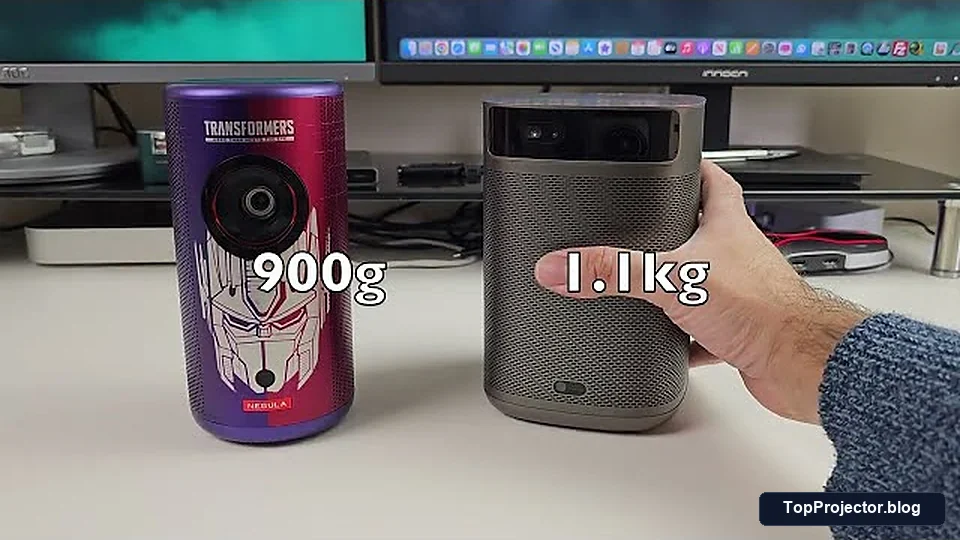
The Xgimi Mogo Pro pushes higher nominal brightness, ensuring punchier images on white matte surfaces. Without relying on complex optical lens shift mechanics, your projector placement precision remains critical.
Testing reveals the MoGo Pro delivers roughly 300 ANSI lumens, outperforming the Capsule Max's lower output. This extra headroom helps maintain a sharper image when ambient lights are dimmed slightly in casual spaces.
- True ANSI lumen ratings govern real-world visibility.
- LED thermal management dictates sustained light output.
- Surface reflectivity multiplies perceived brightness effectively.
Small-Room Luminance Dynamics
Inside compact bedrooms, stray light ruins native contrast instantly. Maintaining at least 300 ANSI lumens is essential for combating residual ambient light during evening streaming sessions.
Neither unit replaces a dedicated home theater lamp, but careful light control makes both viable. Darkening your environment yields immediate dividends in perceived punchiness.
- Light control dictates overall visual dynamics.
- Small spaces amplify minor lumen deficiencies.
Contrast Ratio and Black Floor Performance
Native contrast defines how deep shadows appear during dark cinematic sequences. Portable LED engines frequently struggle with black floor elevation due to compact DLP chip limitations.
The Mogo Pro manages decent shadow separation in pitch-black environments. Conversely, the Capsule Max exhibits slightly grayer blacks when displaying high-contrast interstellar scenes.
Native contrast on both units remains modest due to single-chip DLP limitations. However, the Xgimi achieves a deeper black floor in dark rooms, yielding superior shadow detail during nighttime cinematic viewing sessions.
- Native contrast anchors cinematic realism.
- Black floor elevation washes out deep shadows.
Dark Room Contrast Realities
Turning off all ambient lighting unlocks the true potential of these micro-projectors. A 1000:1 native contrast ceiling provides passable depth for moody thriller movies.
Dynamic iris features are absent here, forcing users to rely entirely on inherent panel performance. Careful gamma calibration helps recover lost detail in dark cinematic moments.
- Pitch-black rooms maximize shadow fidelity.
- Calibration compensates for limited native contrast.
Ambient Light Rejection and Screen Matching
Ambient light destroys image saturation on low-gain portable projection setups. Without dedicated ambient light rejection fabrics, daytime viewing remains washed out and virtually unwatchable.
Pairing these units with the best projector screen for living room improves daytime black levels. However, their modest lumen outputs struggle against bright daylight streams.
Neither projector features enough output for daylight use without an ALR screen. Pairing them with a high-gain portable fabric surface maximizes perceived contrast, preventing washed-out imagery during outdoor movie nights.
- Ambient light acts as an optical kryptonite.
- Screen gain choices dictate off-axis visibility.
Living Room Daylight Challenges
Deploying a portable projector in a sunlit living room demands extreme caution. Direct window glare overwhelms the limited light output of both compact competitors instantly.
Drawing blackout curtains is mandatory for achieving acceptable color saturation and contrast. Casual daytime sports viewing requires tight focal distances to concentrate photons.
- Window glare washes out micro-projectors.
- Curtains remain mandatory for daytime use.
Color Accuracy and HDR Tone Mapping
Accurate color reproduction ensures skin tones look natural rather than oversaturated. Both projectors utilize LED light sources known for wide Rec. 709 gamut coverage.
Out-of-the-box color temperatures tend toward a slightly cool blue bias on the Nebula. The Xgimi offers more balanced white points right through standard movie presets.
Out-of-the-box Rec.709 tracking favors natural skin tones. Similar to findings in our Xgimi Horizon Ultra review, neither budget model handles true HDR tone mapping effectively for cinema viewing.
- LED primaries ensure vibrant color saturation.
- Preset white points dictate overall fidelity.
Handling High Dynamic Range Content
True HDR delivery requires massive peak luminance that micro-projectors simply cannot supply. Instead, they accept HDR10 signals and downmix them into standard dynamic range gamuts.
Tone mapping algorithms attempt to preserve highlight details without crushing dark gradients. Expect compressed dynamic ranges when streaming modern 4K HDR cinematic masters.
- Micro-projectors downmix HDR input signals.
- Tone mapping prevents severe highlight clipping.
Motion Handling and Input Latency for Gaming
Gamers care deeply about input lag and response times during fast-paced sessions. High input latency makes competitive reflex gaming frustrating on compact entertainment projectors.
The Xgimi keeps processing delays relatively low in game mode. Meanwhile, the Capsule Max introduces noticeable lag that hampers fast twitch-shooter mechanics significantly.
Casual gamers will notice acceptable input lag hovering around 40ms on the MoGo Pro. Fast-moving camera pans reveal standard 60Hz motion blur, making these compact units better suited for puzzle games than competitive shooters.
- Input lag dictates responsive gaming performance.
- Game modes bypass heavy image processing pipelines.
Console Gaming Versus Casual Play
Casual puzzle titles and turn-based games play wonderfully on both portable form factors. Fast-paced competitive multiplayer titles demand sub-40ms input lag thresholds for accuracy.
Motion blur remains minimal due to fast LED switching times. However, standard 60Hz refresh rate caps limit ultra-smooth high-frame-rate console gaming experiences.
- Turn-based titles mask input latency effectively.
- Refresh rate limits cap gaming fluidity.
Throw Geometry and Physical Installation
Throw ratios dictate projector placement distances to achieve specific viewing targets. Consulting our screen size and viewing distance guide ensures your 1.2:1 throw ratio fits the room layout.
Keystone correction tools help square the image when off-center placement is unavoidable. Be mindful that digital keystone adjustments sacrifice native pixel resolution for geometry correction.
With a fixed throw ratio of 1.2:1, the MoGo Pro requires more physical distance to project a 100-inch diagonal image. Tripod placement flexibility becomes critical when dealing with tight bedrooms or unconventional ceiling angles.
- Throw ratios determine required room depth.
- Digital keystone degrades native pixel sharpness.
Flexible Placement and Portability
Transporting these miniature projectors from room to room highlights their primary design purpose. Built-in batteries offer untethered viewing for backyard movie nights under the stars.
Threaded tripod mounts on the base ensure stable ceiling or table installations. Lightweight chassis designs make casual repositioning effortless for temporary entertainment setups.
- Battery power unlocks true outdoor portability.
- Tripod mounts secure flexible tabletop positioning.
Verdict: Choosing the Right Portable Projector
Selecting the ideal compact projector comes down to your specific environmental constraints. The Xgimi Mogo Pro delivers sharper resolution and superior optical brightness overall.
For casual bedroom streaming and ultimate convenience, the Nebula remains a strong contender. Assess your room lighting before committing to either portable optical solution.
Choose the MoGo Pro if you prioritize brightness and sharper native resolution for mixed usage. Select the alternative only if extreme ultra-portability and built-in handle convenience outweigh absolute optical performance requirements.
- Environmental light dictates your final hardware choice.
- Resolution advantages favor the Xgimi option.
Final Buying Recommendations
Dedicated home theater enthusiasts should view these units as secondary travel companions. Casual users will love the plug-and-play streaming ecosystem integration built right in.
Prioritize optical sharpness and color fidelity by opting for the Xgimi model. Balance your decision against your specific room geometry and daily viewing habits.
- Secondary travel use highlights micro-projector strengths.
- Room geometry dictates final purchase decisions.
Frequently Asked Questions
Can I use these portable projectors in a bright living room during the day?
Neither of these compact LED projectors possesses the extreme ANSI lumen output required to combat direct daylight or unshaded living room windows effectively during afternoon hours.
You must draw heavy blackout curtains or restrict your viewing sessions entirely to dark nighttime environments to maintain acceptable image contrast, shadow depth, and vibrant color saturation.
Do these devices require an external streaming stick to play Netflix and YouTube?
Both portable projectors integrate robust built-in smart operating systems equipped with native access to major streaming applications straight out of the box without requiring extra hardware.
However, certain popular streaming services like Netflix may occasionally require specific workaround installation methods or a dedicated external streaming stick for optimal software navigation and reliable system updates.
How does digital keystone correction affect overall image sharpness?
Engaging digital keystone correction artificially shrinks your active projection matrix, discarding valuable native pixels in order to square up off-axis viewing geometry on your screen.
This digital processing compromise inevitably reduces fine image sharpness and overall panel resolution, making optimal physical projector placement absolutely essential for maximizing your native optical clarity.
Are built-in batteries sufficient for watching full-length feature films?
Internal rechargeable batteries typically provide around two hours of continuous playback under standard conditions, which comfortably covers normal television episodes or shorter movies.
However, watching longer epic feature films will definitely require keeping the compact power adapter plugged directly into a wall outlet to prevent unexpected mid-screen shutdown interruptions.
Can I connect a gaming console directly to these micro-projectors?
You can easily plug modern gaming consoles directly into the standard HDMI ports located on the chassis of both portable projectors for big-screen play.
Keep in mind that inherent input latency and standard refresh rate limitations make them far better suited for casual puzzle games rather than fast-paced competitive online shooters.