Ust Projector vs. Tv: Which Wins for Your Room?
Choosing between ultra-short throw projection and giant flat panels requires weighing ambient light management against massive cinematic scale.
Choose a giant flat-panel TV for bright living rooms with zero light control, or invest in an ambient-rejecting UST projector setup for dedicated cinematic immersion over one hundred inches.
Compare full category rankings in our Best Portable Video Projectors: Top Rated Picks.
Side-by-Side Specification Breakdown
| Criteria | Ust Projector | Tv | Edge |
|---|---|---|---|
| Ambient Light Rejection | High with specialized ALR screen | Superior native panel polarization | Tv |
| Black Levels & Perceived Contrast | Dependent on room and screen gain | Pixel-level dimming or deep native blacks | Tv |
| Peak Brightness & HDR Punch | 2,000 to 3,000 ANSI lumens typical | Exceeds 1,000 to 2,000 nits easily | Tv |
| Screen Size & Immersion | 100 to 120 inches standard scale | Cost-prohibitive above 85 inches | Ust Projector |
| Viewing Angles & Uniformity | Wide off-axis via ALR lenticular layers | Flawless uniform angles on OLED/QLED | Tv |
| Gaming Motion & Input Lag | 15ms to 20ms lag with 60Hz limits | Sub-5ms lag with 4K/120Hz support | Tv |
| Room Setup & Maintenance | Requires precise alignment and wall space | Simple tabletop or VESA wall mount | Tv |
Optical Physics of Light Emission Versus Ambient Reflection
Traditional direct-view flat panels emit light straight toward your eyes. This self-emissive or backlit nature allows flat panels to cut through sunlit rooms with incredible authority and visual punch.
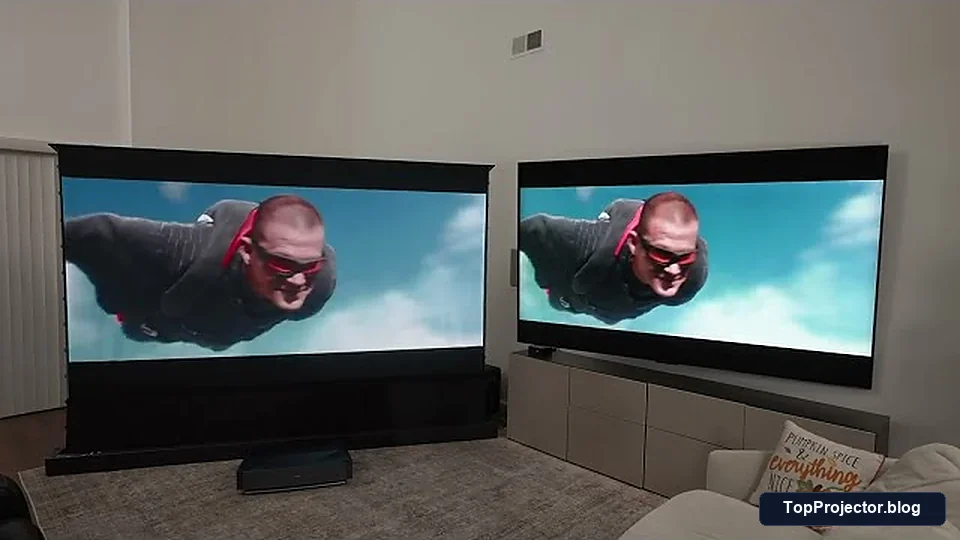
While desktop models shine elsewhere—like our guide to the best portable video projectors—ultra-short throw models rely on reflective optics, bouncing ambient light away while channeling projected photons directly into your seated viewing cone.
Emissive television panels produce direct light photons straight toward your retinas, whereas ultra-short throw setups bounce high-output lumens off specialized ALR surfaces to scatter overhead environmental glare away from seated viewers.
- Direct-view panels bypass external room reflection entirely.
- UST projectors require specialized micro-serrated ALR surfaces.
- Ambient daylight washes out projected images much faster.
Managing Daytime Illumination
Placing an ultra-short throw projector in a sunlit living room demands a dedicated ambient light rejection screen. Standard white walls will scatter overhead light and ruin your contrast ratios.
Flat-panel televisions naturally absorb ambient room illumination using advanced surface coatings. They maintain deep ink blacks even when multiple living room windows remain wide open during noon daylight.
- ALR screens reject up to 80 percent of overhead light.
- Uncontrolled daylight destroys projected black floor levels.
Micro-Lens Arrays and Angular Rejection
Specialized ambient light rejecting screens use microscopic saw-tooth optical structures that actively absorb down-firing ceiling illumination while precisely reflecting ultra-shallow projection angles upward toward your eyes for superior perceived contrast.
Black Floor Depth, ANSI Contrast, and Dynamic Range
Achieving deep black levels is the holy grail of home theater displays. Flat panels with local dimming zones or self-lit pixels deliver near-infinite contrast ratios for dramatic cinematic shadow detail.
Ultra-short throw projection struggles with absolute black floors in ambient light, a factor you can balance using our ANSI lumens room calculator since projected black is simply the absence of light.
Traditional flat panels achieve near-infinite black floor depth via organic pixel dimming, whereas laser projectors struggle with ambient room reflections lifting dark scenes unless paired with high-gain micro-layered optical rejection boundaries.
- OLED and high-end Mini-LED deliver true reference blacks.
- Projectors require pitch-dark rooms to match native panel contrast.
- ALR materials enhance perceived punch but cannot alter physics.
Evaluating High Dynamic Range Performance
High dynamic range requires both blistering peak highlights and deep shadows. Televisions effortlessly hit 1,500 nits of peak brightness, making HDR specular highlights genuinely dazzle your eyes.
Projectors measure output in ANSI lumens rather than nits. While modern triple-laser engines deliver vibrant colors, they lack the localized luminance required for true HDR punch in bright spaces.
- Televisions handle metadata-heavy HDR streams with ease.
- Projector HDR relies on aggressive tone mapping algorithms.
ANSI Contrast Ratios in Light-Controlled Chambers
Measuring checkerboard patterns reveals that flat panels maintain deep blacks under bright conditions, while projection optics require pitch-black bat-cave environments to approach a competitive 500:1 ANSI contrast performance benchmark.
Screen Size Scalability, Throw Ratios, and True Immersion
When pushing past eighty-five inches, flat panels become financially impractical and structurally terrifying to mount. Ultra-short throw projectors easily scale from 100 to 120 inches without exponential cost increases.
Throw ratios define projector placement geometry. A typical UST unit sits mere inches from the wall, casting a massive cinematic image that fills your entire peripheral field of view.
Transitioning beyond standard flat panel limits requires massive glass manufacturing investments, whereas ultra-short throw projection easily scales from 100 inches to 120 inches diagonal without exponential hardware cost penalties or structural wall reinforcement.
- Giant flat screens suffer from extreme shipping and doorway limits.
- UST projectors fit gracefully on standard media credenzas.
- Cinematic immersion scales dramatically beyond 100 inches.
The Geometry of Cinematic Scale
True cinematic immersion demands a wider viewing angle. Projectors fill your natural field of view far better than standard televisions, replicating commercial cinema scales inside residential living rooms.
Viewing a television from close range reveals pixel structures or loss of perspective. Massive projection screens absorb you into the narrative without feeling like an oversized glowing monitor.
- Wider fields of view elevate emotional movie engagement.
- Projectors excel at recreating authentic commercial theater vibes.
Throw Geometry and Cabinet Clearance Math
Achieving a massive image requires calculating strict throw ratios using tools like our Optoma CinemaX P2 distance calculator guide, where lenses demand a mere 0.21:1 ratio to project huge diagonal sizes.
Peak Brightness, Spectral Gain, and Direct Daylight Control
Raw lumen output determines how well a display fights ambient daylight. Modern UST laser engines often produce 2,500 ANSI lumens, filling large screens with impressive daytime color saturation.
Flat panels utilize massive nit counts and matte anti-glare filters. They conquer glaring windows and overhead recessed lighting without requiring specialized optical screen materials or room darkening.
Modern high-end television displays effortlessly push searing specular highlights exceeding 2000 nits, overpowering sunlit living rooms, whereas projectors must rely on specialized ambient rejecting screens to combat daylight washouts effectively.
- Laser light engines last upwards of 25,000 operational hours.
- Television panels maintain stable brightness across all viewing angles.
Surface Gain and Viewing Cones
ALR projector screens utilize specialized directional gain. They concentrate reflected light toward seated viewers while rejecting off-axis environmental light sources from side windows and lamps.
Televisions disperse light uniformly across a 178-degree viewing cone. Everyone on the sectional sofa enjoys identical brightness and color fidelity without off-axis degradation or hotspotting.
- Directional screen gain narrows optimal vertical viewing angles.
- Flat panels guarantee uniform color across every seat.
Laser Light Engines and Phosphor Wheels
Single and triple laser illumination architectures generate intense luminous output—as detailed in our Epson EH-LS12000B review—often reaching 3000 ANSI lumens to maintain vibrant daytime saturation across oversized cinematic projection screens.
Color Accuracy, Color Gamut Volume, and Motion Handling
Triple-laser ultra-short throw models cover wide color gamuts easily. They saturate 100% of the BT.2020 space, delivering hyper-vibrant cinematic palettes that rival professional grading monitors.
Televisions excel at rapid motion resolution and pixel response times. Fast-moving sports and action sequences appear razor-sharp on flat panels without the rainbow artifacts or motion blur of projectors.
Premium televisions effortlessly hit wide color spaces out of the box, whereas ultra-short throw laser engines require meticulous calibration to achieve accurate Rec. 2020 tracking and natural cinematic skin tones consistently.
- Laser projection offers stunning primary color saturation.
- OLED televisions feature near-instantaneous pixel response times.
- Projectors occasionally exhibit minor laser speckle artifacts.
Handling Rapid Motion and Artifacts
Fast-paced camera pans can introduce judder or motion blur on projection systems. High-end televisions feature robust motion interpolation and black frame insertion to keep panning shots impeccably crisp.
DLP-based projectors utilize spinning color wheels which may trigger minor color breakup for sensitive viewers. Modern laser engines mitigate this, but flat panels remain entirely immune to it.
- Televisions dominate rapid motion clarity for sports fans.
- DLP color wheel artifacts affect a small percentage of viewers.
Speckle Reduction and Frame Interpolation
Laser projection systems frequently introduce minor optical speckle that requires diffusing screens to mitigate, alongside advanced motion processing algorithms smoothing out 24p judder during panning cinematic camera shots.
Console Gaming Performance, Refresh Rates, and Input Lag
Modern gamers demand low input lag and high refresh rates. Premium televisions offer sub-10ms input lag alongside multiple HDMI 2.1 ports supporting native 4K gaming at 120Hz.
Ultra-short throw projectors have closed the performance gap significantly. Many modern laser consoles now feature dedicated gaming modes yielding 15ms to 20ms input lag for casual sessions.
Competitive multiplayer gaming demands ultra-low response times, with modern televisions easily delivering lightning-fast 4ms input lag at native 4K 120Hz via dedicated HDMI 2.1 chipsets and Variable Refresh Rate.
- Televisions provide superior HDMI 2.1 connectivity options.
- Projectors deliver unmatched visceral scale for immersive RPGs.
- Competitive twitch gamers should stick to responsive flat panels.
High Refresh Rate Gaming Realities
Playing fast-paced multiplayer titles on a 120-inch projected display is undeniably breathtaking. However, input lag and response times rarely match dedicated gaming monitors or high-end OLED televisions.
Console gamers seeking flawless frame rates and variable refresh rate synchronization will find televisions vastly more reliable for competitive online multiplayer matches and twitch reflexes.
- VRR support is more mature on modern flat-panel displays.
- Massive screen size enhances single-player atmospheric gaming.
Projector Latency and Gaming Optimizations
While early projection hardware suffered from sluggish response times, latest-generation gaming projectors now achieve a respectable 16ms input delay in specialized low-latency modes designed for modern console players.
Physical Installation, Acoustic Profiles, and Room Geometry
Installing a television is straightforward with standard VESA wall mounts or tabletop stands. Cable management remains clean, and integrated speakers offer respectable everyday dialogue clarity for casual viewing.
Projector setups require meticulous geometric alignment. Positioning the laser console precisely relative to your ALR screen demands patience, and internal cooling fans introduce a faint acoustic hum.
Wall-mounted televisions offer sleek, low-profile aesthetics, whereas ultra-short throw setups require precise media console placement, meticulous optical focus adjustments, and careful management of internal cooling fan acoustic noise levels.
- Televisions require minimal ongoing maintenance and calibration.
- UST projectors need dedicated media console depth and clearance.
- Cooling fans on projectors generate noticeable ambient noise.
Acoustic Footprint and Thermal Management
High-output laser engines generate substantial internal heat. Projector cooling fans ramp up during extended movie sessions, creating a faint mechanical whisper that requires external surround sound to mask.
Televisions operate in absolute silence with zero thermal fans. Their passive cooling designs ensure your audio experience remains uninterrupted by mechanical whirring or high-frequency electrical hums.
- Projector fans require proper console ventilation clearance.
- Televisions maintain silent, fanless operational profiles.
Thermal Management and Exhaust Placement
High-output laser engines generate significant internal heat, necessitating multi-fan cooling arrays that must maintain low decibel outputs to prevent fan whine during quiet movie dialogue scenes under normal operating loads.
Scenario-Based Winner: Choosing Your Optical Champion
Selecting between these technologies depends entirely on your room environment. Choose a giant flat-panel TV if your living room floods with uncontrolled daylight and you prioritize plug-and-play simplicity.
Invest in a UST projector and ALR screen if you crave a dedicated private cinema experience exceeding one hundred inches without sacrificing your entire architectural wall to a black glass monolith.
Selecting the ultimate display technology depends heavily on your daily room lighting conditions, viewing habits, and budget flexibility, balancing giant cinematic scale against everyday ambient light rejection practicalities.
- Daylight-heavy rooms heavily favor high-nit television displays.
- Dedicated media rooms unlock the full magic of ultra-short throw.
The Ultimate Living Room Decision
If your household watches morning news with curtains open, a television is essential. Projectors require controlled lighting conditions to truly shine and deliver their cinematic best.
For evening movie buffs who want a transformative visual centerpiece that disappears when powered off, ultra-short throw projection paired with a motorized floor-rising screen offers unmatched versatility.
- Assess your daily lighting habits before purchasing.
- Match display technology directly to your primary content.
The Dedicated Theater Versus Living Room Split
Choose ultra-short throw projection for immersive, multi-viewer cinematic scaling in controlled dens, while flat panel televisions remain the undisputed champions for bright multi-purpose living rooms demanding instant power-on convenience.
Frequently Asked Questions
Can a UST projector completely replace a living room television?
Yes, provided you pair the unit with an ambient light rejection screen. However, unmanaged daytime glare will still wash out dark scenes more than a high-nit flat panel.
Do ultra-short throw projectors require specialized wall screens?
While you can project onto flat drywall, an ALR screen is mandatory to maintain deep contrast and reject overhead ceiling lights during daytime viewing sessions.
Are televisions better for competitive console gaming?
Yes, televisions offer sub-5ms input lag and full HDMI 2.1 support for 4K at 120Hz, whereas projectors typically hover around 15ms to 20ms lag.
How long do laser projector light engines last?
Modern solid-state laser engines boast a lifespan exceeding 25,000 operational hours, ensuring years of daily multi-hour viewing without bulb replacements or degradation.
Which option offers better overall value for large screen sizes?
UST projectors provide significantly better value when scaling past 100 inches, whereas televisions become prohibitively expensive and structurally difficult above 85 inches.