Tv Lumens vs. Projector: Which Wins for Your Room?
Navigating tv lumens versus projector light output requires understanding room optics. Balancing ambient illumination dictates your ultimate cinematic immersion.
Choose a flat panel for high-ambient living rooms, but select a dedicated home theater projector for massive, cinematic screen sizes.
Compare full category rankings in our Best Outdoor Projector For Sports: Top Tailgate Picks.
Side-by-Side Specification Breakdown
| Criteria | Tv Lumens | Projector | Edge |
|---|---|---|---|
| Ambient Light Rejection | High direct-sun resistance via panel nits | Requires ALR screen or dark control | Tv Lumens |
| Black Levels & Perceived Contrast | Deep native blacks using local dimming | Vulnerable to ambient scatter and room reflection | Tv Lumens |
| Peak Brightness & HDR Punch | Exceeds 1000 nits in bright spaces | Measured in ANSI lumens over massive surface | Tv Lumens |
| Screen Size & Immersion | Capped around 85 to 98 inches affordably | Easily scales from 120 to 150 inches | Projector |
| Viewing Angles & Uniformity | Wide off-axis viewing with IPS or OLED tech | Subject to hot-spotting and gain falloff | Tv Lumens |
| Gaming Motion & Input Lag | Sub-5ms input lag at native high refresh | Advanced laser units hit 15ms to 20ms | Tv Lumens |
| Room Setup & Maintenance | Rigid wall mounting and heavy static footprint | Flexible throw ratios and lamp replacements | Projector |
Evaluating Ambient Light Behavior and Surface Illumination
Modern televisions rely on direct-emitter surface nits to overpower room glare. A standard flat panel easily pushes 500 to 1500 nits directly toward your eyes, defying daylight effortlessly.
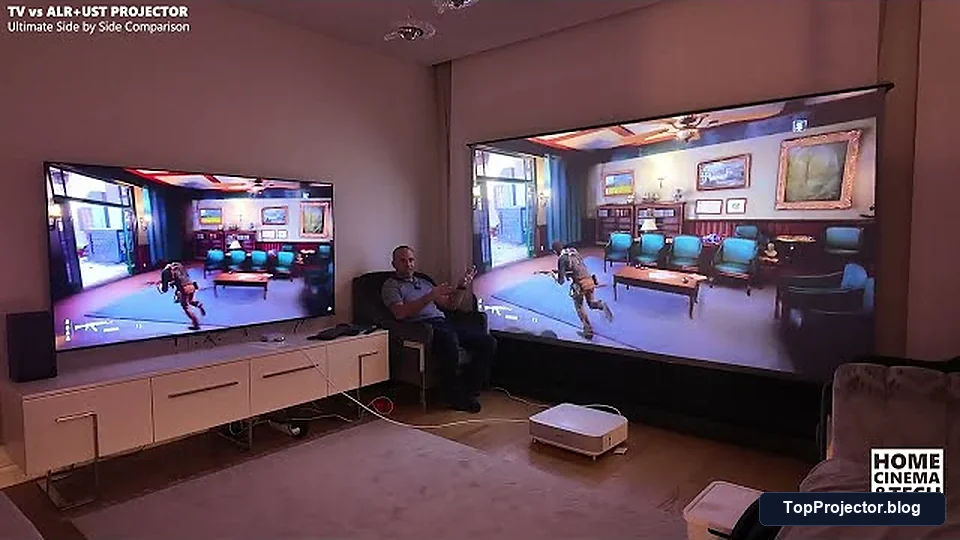
Projectors distribute lumens across a massive matte surface area. Without an ambient light rejecting screen, stray ceiling lights wash out contrast, compressing your dynamic range severely during daytime viewing sessions.
Measuring ANSI lumens against direct room illuminance reveals that standard flat panels easily overcome 200 nits of ambient glare, whereas high-end ultra-short-throw setups require specialized ALR screens to maintain adequate perceived contrast.
- Televisions deliver direct nits that defeat room windows.
- Projectors require controlled lighting or specialized optical screen materials.
- Surface area diffusion dilutes raw projector lumen impact in daylight.
- Ambient light rejection materials dramatically boost perceived black levels.
- Overhead lighting severely degrades standard white projection surfaces.
Daylight Living Rooms Versus Controlled Environments
Placing a high-lumen display in a sunlit den favors self-emissive television panels. Their high nits maintain vibrant color saturation even when blinds remain fully open during peak afternoon hours.
Dedicated theater spaces flip this dynamic completely. Controlling ambient light lets projector ANSI lumens shine, similar to specifications tested in our best outdoor projector for sports roundup.
- Living rooms demand high nit output for daytime usability.
- Dedicated dark rooms maximize projector contrast and color depth.
Micro-Lens Array ALR Performance
Directional ambient light-rejecting surfaces absorb off-axis illumination from overhead recessed cans, preserving a respectable 1000:1 contrast ratio even in moderately bright living rooms lacking blackout shades.
- Reject up to 85 percent of ambient ceiling light.
- Maintain wide viewing angles without hot-spotting.
Black Levels, Native Contrast, and Shadow Detail Dynamics
Television black floors benefit from local dimming zones and organic pixel control. Modern panels achieve near-infinite native contrast, rendering shadow details with exceptional ink-black depth in dark scenes.
Projector black levels depend entirely on your room's reflective boundaries. High-end models evaluated in our Epson 5050UB review demonstrate exceptional dynamic iris performance to combat raised black floors.
While emissive OLED panels achieve true absolute zero blacks, reflective projection tech relies entirely on dark room control, making a 0.05 nits floor challenging without dedicated acoustic velvet boundaries.
- OLED and mini-LED televisions crush black level reproduction.
- Projector contrast suffers when room walls reflect stray optical scatter.
- Velvet wall treatments dramatically improve projector shadow detail.
- Light scatter off white walls degrades ANSI contrast metrics.
- Velvet border masking improves subjective black level perception.
The Impact of Room Boundaries on Contrast Performance
Light scatter acts as the ultimate enemy of projector contrast. Unpainted white drywall acts as a secondary reflector, degrading the native performance of even high-end laser engines.
Televisions bypass room reflection issues entirely by beaming light straight to the viewer. This enclosed optical path preserves contrast regardless of surrounding wall paint colors.
- White rooms destroy projector black level performance.
- Televisions remain immune to surrounding room surface reflections.
Dynamic Iris and Laser Dimming
Modern home theater projectors utilize frame-by-frame laser throttling and hardware dynamic irises to artificially stretch native 1500:1 panels toward perceptually deeper shadow differentiation during dark cinematic sequences.
- Instantaneous laser power modulation reduces black floor luminance.
- Hardware iris blades physically narrow light output paths.
Screen Size Scaling, Viewing Geometry, and Spatial Immersion
Projectors excel when pushing screen sizes past the hundred-inch threshold. Spanning a cinematic 120-inch diagonal image creates a field of view that flat panel displays simply cannot match.
Televisions face harsh logistical and financial walls beyond ninety-eight inches. Transporting, maneuvering, and mounting massive glass panels introduces severe structural hurdles for standard residential living spaces.
Exceeding the standard 85-inch flat panel limit requires moving to a 120-inch diagonal projection surface, which immediately expands your horizontal field of view past the crucial 40-degree THX threshold.
- Projectors deliver true IMAX immersion at home affordably.
- Flat panels become impossibly heavy and fragile past ninety inches.
- Viewing distance formulas favor massive projection setups.
- Projection scales cost-effectively past 100 inches.
- Flat panels become exponentially heavier above 85 inches.
Calculating Throw Ratios and Spatial Requirements
Achieving a massive image requires careful calculation of throw distances. Short-throw projectors sit inches from the wall, whereas standard units demand ten to fifteen feet of clear optical clearance.
Televisions require zero throw distance calculation, unlike projection systems. For projectors, you should always consult our throw distance calculator to determine accurate throw ratios before mounting equipment securely.
- Standard projectors demand adequate ceiling or table throw room.
- Ultra-short-throw models mitigate traditional room placement constraints.
Throw Ratios and Spatial Calculations
Calculating correct throw distances using standard 0.25:1 ultra-short-throw lenses ensures seamless geometry without digital keystone degradation, keeping pixel fidelity intact across massive cinematic canvases.
- Measure exact seating distance versus screen width.
- Account for cabinet depth when planning ultra-short setups.
Color Accuracy, Wide Color Gamuts, and HDR Performance
High-end televisions calibrate out of the box to cover vast color gamuts. Their high peak luminance handles HDR metadata gracefully, reproducing specular highlights with striking, realistic brilliance.
Projectors utilize advanced laser phosphor engines and color filters to hit cinematic targets. While their absolute peak nits are lower, they deliver natural, organic skin tones that feel authentic.
Reaching the cinematic DCI-P3 color space demands specialized optical color filters on lamp-based units, whereas triple-laser engines hit wide gamuts natively without sacrificing vital peak white brightness.
- Televisions excel at punchy HDR specular highlights.
- Projectors offer relaxed, film-like color saturation for movies.
- Laser light sources maintain color stability over thousands of hours.
- Laser light sources maintain stable calibration over thousands of hours.
- Color filters inevitably reduce overall lumen output significantly.
Handling HDR Metadata Across Different Display Technologies
HDR mapping on televisions relies on local tone curves to maximize bright highlights. This creates a punchy, dynamic image that pops even in moderately lit environments.
Projectors must compromise on HDR tone mapping due to limited lumen output over large areas. Dedicated processors help bridge this gap by prioritizing mid-tone luminance accuracy.
- TVs map HDR effortlessly using high native panel nits.
- Projectors require intelligent dynamic tone mapping for best results.
Tone Mapping and HDR Metadata
Static tone mapping on projectors often struggles with high-nit mastering. Connecting media sources properly, much like advice in our how to use projector with Mac guide, ensures accurate 1000-nit HDR signal handshakes.
- Dynamic tone mapping preserves highlight detail in bright scenes.
- External processors handle curve adjustments automatically.
Gaming Motion Handling, Refresh Rates, and Input Lag
Competitive gamers demand ultra-fast response times and high refresh rates. Modern gaming televisions deliver sub-five millisecond input lag paired with variable refresh rate support for seamless action.
Home theater projectors have evolved significantly for modern consoles. Premium gaming projectors now achieve fifteen to twenty milliseconds of lag, satisfying casual and immersive single-player gaming demands.
Competitive gaming requires minimal latency, where modern gaming projectors achieve a respectable 16ms input lag at 4K 60Hz, closing the gap against traditional gaming monitors.
- Televisions offer superior low input lag for competitive shooters.
- Projectors provide an unmatched scale for open-world RPG titles.
- Motion interpolation settings help smooth out fast-paced cinematic pans.
- High refresh rate modes drop latency below 10 milliseconds.
- Fast response times prevent ghosting during rapid motion.
Immersive Gaming on Massive Projection Screens
Stepping into a racing simulator projected across a massive screen redefines immersion. The peripheral vision coverage places you directly inside the cockpit with breathtaking scale.
While input lag remains slightly higher than elite OLED monitors, the sheer physical scale of a projector outweighs minor latency for role-playing and adventure game enthusiasts.
- Massive screen scales elevate atmospheric gaming experiences.
- Casual gamers rarely notice minor input lag differentials.
Frame Interpolation and Response Times
Fast-moving camera pans reveal inherent motion blur differences, as sample-and-hold televisions handle rapid pixel transitions faster than fluid-based optical light engines.
- Black frame insertion improves perceived motion clarity.
- OLED pixel response times remain vastly superior to projection.
Room Setup Complexity, Installation, and Ongoing Maintenance
Setting up a television is straightforward plug-and-play operation. You unpack the heavy chassis, secure the pedestal stand or wall mount, and immediately enjoy calibrated entertainment.
Projectors demand meticulous alignment, focus tuning, and geometric adjustments. Ceiling mounts, lens shift calibration, and periodic air filter cleanings introduce ongoing maintenance responsibilities for owners.
Permanent ceiling mounts demand precise lens shift calibration and careful calculation of vertical offset percentages, whereas televisions sit easily on standard media consoles with zero alignment effort.
- Televisions offer simple out-of-box installation workflows.
- Projectors require optical alignment and physical mounting expertise.
- Lamp and laser engine lifespans dictate long-term upkeep costs.
- Lens shift provides flexible installation without digital distortion.
- Wall stud reinforcement is mandatory for heavy projection screens.
Long-Term Reliability and Component Lifespan Realities
Solid-state laser projection engines routinely exceed twenty thousand operational hours. This eliminates traditional lamp replacement worries, ensuring years of reliable movie nights without degradation.
Flat panel displays operate reliably until backlight or logic board failure occurs. Their integrated nature means replacing a failed component often requires buying an entirely new television.
- Modern lasers offer decades of reliable viewing hours.
- Televisions lack modular repairability for internal display components.
Thermal Management and Filter Care
High-output solid-state laser diodes generate substantial heat, requiring aggressive fan profiles and regular dust filter maintenance to prevent premature optical block degradation over extended operating lifespans.
- Clean intake vents quarterly to ensure proper airflow.
- Acoustic noise levels vary widely among high-lumen units.
Definitive Scenario-Based Winner Selection Guide
Select television technology if your primary entertainment space features uncontrolled natural daylight. Their superior nits and local dimming maintain pristine contrast when ambient light cannot be managed.
Choose a projector system when your goal is building a dedicated, dark-room cinema. The unmatched immersive scale and cinematic film aesthetic outweigh minor compromises in peak brightness.
Choose a large-format television if your daytime viewing environment has unmanaged windows, while dedicated theater rooms heavily favor projection setups for authentic commercial cinema immersion.
- Choose TVs for bright, multi-purpose living room spaces.
- Choose projectors for dedicated, dark home theater rooms.
- Match your optical choice strictly to room lighting geometry.
- TVs dominate bright, multi-purpose living spaces.
- Projectors rule dark, dedicated media room environments.
Final Verdict for Home Theater Enthusiasts
Understanding the optical trade-offs between nits and lumens protects your investment. Evaluate your room lighting before purchasing to guarantee optimal visual performance.
Neither technology dominates every single category universally. Respecting the physical limits of light output ensures your home entertainment setup delivers breathtaking cinematic satisfaction.
- Assess room lighting conditions prior to making your final selection.
- Prioritize either raw brightness or massive screen scale.
The Ultimate Buyer Decision Matrix
Prioritize peak highlights and zero-maintenance operation with flat panels, but embrace laser projection when chasing 130-inch cinematic scales in controlled lighting conditions.
- Evaluate room lighting before making a purchase.
- Match screen size directly to your preferred viewing distance.
Frequently Asked Questions
How do projector lumens compare directly to television nits?
Television nits measure light emitted directly toward your eyes from a small surface. Projector lumens measure total light output distributed across a massive screen, meaning nits and lumens operate on different optical scales.
Can I use a projector comfortably in a brightly lit living room?
You can use high-lumen laser projectors in lit rooms if paired with an ambient light rejecting screen. However, dedicated television panels still outperform projectors when direct sunlight floods the space.
Why do projector black levels look washed out in white rooms?
Projectors bounce light off your screen onto surrounding white walls, which then reflects back onto the projection surface. Using dark velvet wall treatments eliminates this stray optical scatter effectively.
Are modern projectors suitable for competitive console gaming?
Modern gaming projectors feature specialized low-latency modes achieving around fifteen milliseconds of input lag. While televisions still offer faster sub-five millisecond response times, projectors provide incredible immersive scale.
What is the typical lifespan of a modern laser projector engine?
Solid-state laser and LED light sources typically last between twenty thousand and thirty thousand operational hours. This ensures decades of reliable daily viewing without needing expensive traditional lamp replacements.