Short Throw vs. Ultra Short Throw: Which Wins for Your Room?
Choosing between projection optics dictates your room geometry. Short throw and ultra short throw units solve radically different living space challenges.
For dedicated dark rooms, short throw projectors deliver superior optical contrast. For bright living spaces, ultra short throw paired with ALR screens wins decisively.
Compare full category rankings in our Best Projector Cinema: Top Picks for Home & Outdoor.
Side-by-Side Specification Breakdown
| Criteria | Short Throw | Ultra Short Throw | Edge |
|---|---|---|---|
| Ambient Light Rejection | Moderate ambient vulnerability | Exceptional with UST-ALR screens | Ultra Short Throw |
| Black Levels & Perceived Contrast | Deep native black floors | Washed out by stray room light | Short Throw |
| Peak Brightness & HDR Punch | 2,000 to 3,500 ANSI lumens | 2,200 to 3,000 ANSI lumens | Tie |
| Screen Size & Immersion | Scalable from 100 to 150 inches | Fixed sweet spot around 100 to 120 inches | Short Throw |
| Viewing Angles & Uniformity | Standard ceiling or table alignment | Prone to bottom-edge screen warping | Short Throw |
| Gaming Motion & Input Lag | Low latency down to 15ms | Competitve lag around 16ms to 20ms | Short Throw |
| Room Setup & Maintenance | Requires ceiling mount or shelf placement | Sits directly on a media console | Ultra Short Throw |
Optical Throw Ratios and Room Geometry
Understanding throw ratios is essential for mapping your projection space. Short throw models use a 0.5:1 to 0.8:1 throw ratio, requiring a few feet of distance.
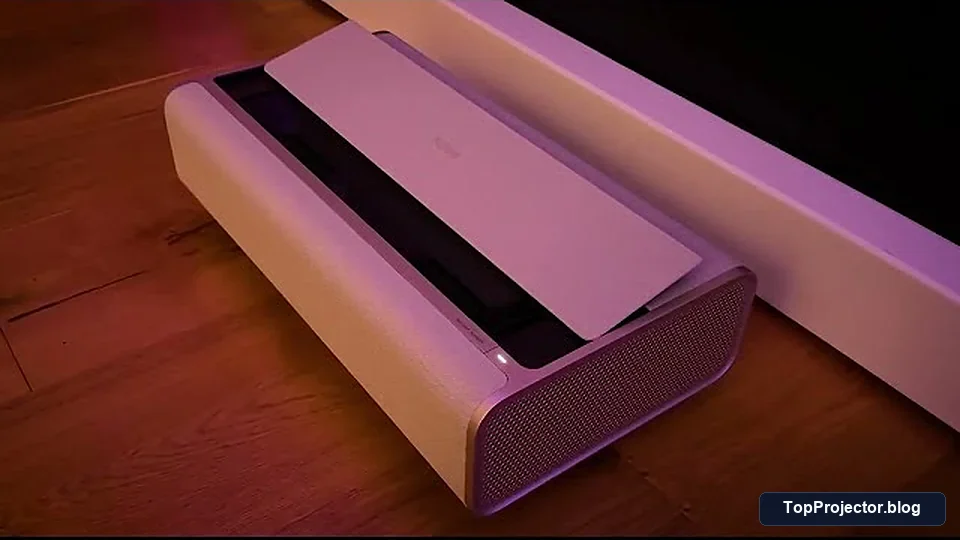
Conversely, ultra short throw units achieve massive images from inches away, making them ideal for the best projector cinema setup in compact rooms with a low 0.21:1 throw ratio.
Your furniture layout dictates which optical architecture fits best. Avoid choosing a layout that causes frequent foot traffic interference.
Traditional short throw units feature throw ratios between 0.4 and 0.9, requiring ceiling mounting or a dedicated coffee table positioned several feet away from your specialized projection screen surface to achieve desired image sizes.
- Short throw requires 3 to 5 feet of distance.
- Ultra short throw sits directly below the screen.
- Throw ratio determines exact placement limits.
Calculating Throw Distances for Small Spaces
Measure your wall-to-lens distance carefully before purchasing. Short throw setups demand clear ceiling paths or dedicated media console placements.
Ultra short throw completely eliminates overhead cable runs. This simplifies wiring but requires an absolutely flat wall to prevent geometric distortion.
- Measure exact throw distance twice.
- Account for cabinet depth with UST units.
Calculating Room Offset Math
Ultra short throw models utilize 0.19 to 0.25 throw ratios, sitting mere inches from the wall, which eliminates ceiling installation complexity while demanding absolute surface flatness to prevent geometric warping artifacts across the image.
- Measure exact distance from lens barrel to screen plane.
- Account for chassis depth when calculating total wall clearance.
Ambient Light Rejection and Daytime Performance
Combatting daylight requires specialized optics and screen technology. Ultra short throw projectors excel here when paired with optical ALR screens that block overhead light.
Standard short throw units struggle against ambient room illumination without dedicated high-gain surfaces. Stray light washes out dark scenes rapidly in unmanaged spaces.
Evaluate your windows and lighting fixtures before finalizing your purchase decision. Daylight management separates mediocre setups from cinematic marvels.
Standard short throw setups require specialized angular ambient light rejection screens to combat overhead living room illumination, preserving your contrast levels without washing out dark scenes during daytime viewing sessions.
- UST requires directional ALR rejection filters.
- Short throw needs controlled ambient lighting.
- Daytime viewing depends entirely on screen choice.
ALR Screen Pairing Realities in Bright Rooms
Specialized jagged-structure filters reject upwards light efficiently. When setting up presentation sources following our guide on how to connect a chromebook, these ultra short throw ALR screens absorb ceiling illumination.
Standard white screens destroy contrast in brightly lit living rooms. Always budget for a specialized optical screen when buying an ultra short throw.
- Micro-sawtooth structures block ceiling light.
- Standard matte white screens reduce contrast.
Micro-Sawtooth Surface Mechanics
Ultra short throw variants rely on Fresnel or lenticular optical layers that specifically reject downward-directed light while reflecting upward-angled projector illumination directly toward seated viewers for superior daytime contrast delivery.
- Pair UST units exclusively with dedicated ALR screens.
- Avoid standard matte white walls with ultra short throw lenses.
Black Floors, Contrast Ratios, and Shadow Detail
Achieving deep black levels defines true home theater immersion. Short throw projectors in dark rooms deliver superior native contrast and deep shadow separation.
Ultra short throw units often suffer from light scatter across reflective surfaces. This reduces perceived contrast unless you invest in premium black-level enhancement filters.
Critical movie watchers prioritize dark room performance above all else. Native contrast numbers reveal how well dark cinematic sequences render.
Achieving a deep black floor remains challenging in bright spaces, but traditional short throw projectors paired with high-contrast gray materials deliver superior dark-scene performance compared to entry-level ultra short throw models.
- Dark rooms favor short throw contrast performance.
- Light scatter impacts ultra short throw black floors.
- Native contrast dictates shadow detail clarity.
Light Scatter Control in Enclosed Spaces
Stray reflections bounce off light-colored ceilings easily. Dark velvet treatments on surrounding walls dramatically improve short throw black floor depth.
Ultra short throw engines shoot upward at steep angles. This design minimizes ceiling reflection but increases sensitivity to bottom-edge wall ripples.
- Velvet ceiling treatments boost contrast.
- Steep projection angles reduce ceiling bounce.
Native Contrast Limitations
Most laser ultra short throw engines rely on DLP chipsets that offer robust ANSI contrast but struggle with absolute black levels unless paired with premium optical ambient light rejection screening systems.
- Calibrate gamma settings to 2.4 for dark room viewing.
- Check native contrast specs rather than dynamic measurements.
Peak Brightness, Color Volume, and HDR Delivery
High dynamic range content demands substantial lumen output. Modern laser engines similar to those analyzed in our xgimi horizon review push 3,000 ANSI lumens, providing vibrant highlights and rich color saturation.
Color volume suffers when laser phosphors rely on excessive green boost. Look for units featuring wide color filters to maintain cinematic accuracy.
HDR mapping requires intelligent processing chips to handle peak bright scenes. Both throw types now offer excellent dynamic tone mapping capabilities.
Modern laser light sources produce impressive 2500 ANSI lumens, ensuring vibrant HDR delivery and wide color gamut coverage that easily saturates large projection surfaces without suffering from rapid lamp degradation over time.
- Laser light engines ensure long-term brightness stability.
- Wide color filters improve cinematic tone accuracy.
- HDR mapping prevents blown-out highlight details.
Laser Phosphor vs Lamp Light Engines
Solid-state laser diodes outlast traditional mercury lamps significantly. Laser illumination provides consistent brightness across twenty thousand operational hours.
Lamps degrade rapidly after the first thousand hours of use. Modern home theater enthusiasts almost exclusively demand maintenance-free laser light sources.
- Lasers eliminate expensive bulb replacement costs.
- Consistent output ensures stable calibration profiles.
Rec.2020 Color Gamut Mapping
Achieving accurate Rec.709 calibration requires engaging dedicated filmmaker modes, balancing laser output levels to prevent color distortion during high-brightness HDR tone mapping sequences in dedicated home theater environments.
- Verify laser phosphor wheel configurations for color accuracy.
- Inspect HDR metadata handling for dynamic tone mapping.
Screen Size, Geometry, and Immersion Potential
Screen size flexibility remains a major advantage. Short throw optics let you scale image sizes easily by checking our screen size viewing distance calculator for precise 100 to 150 inch spans.
Ultra short throw installations are usually locked into fixed frame sizes. Achieving perfect geometry requires precise physical alignment on a motorized drop-down mount.
Immersion scales directly with your field of view angle. Larger diagonal displays create cinematic engagement that flat panel TVs cannot match.
Scaling up to a 120-inch diagonal screen transforms cinematic immersion, but achieving razor-sharp focus uniformity across the entire frame demands meticulous lens alignment and zero wall distortion from your chosen throw design.
- Short throw scales up to 150 inches easily.
- UST units favor fixed 100 to 120-inch frames.
- Precise alignment prevents trapezoidal geometric distortion.
Maximizing Diagonal Inches Without Distortion
Keystone correction degrades native resolution and introduces digital artifacts. Physical lens shift and manual cabinet leveling deliver pristine pixel sharpness.
Ultra short throw alignment demands absolute surface flatness. Even a two-millimeter wall wave causes noticeable geometric warping on test patterns.
- Avoid digital keystone correction whenever possible.
- Wall flatness dictates ultra short throw success.
Edge-Blending and Focus Stability
Ultra short throw optics suffer from extreme angles, making manual focus adjustments critical to prevent blurring along the bottom edge of massive projection surfaces during extended movie marathon viewing sessions.
- Use test patterns to check corner-to-corner sharpness.
- Ensure rigid frame tensioning to eliminate screen ripples.
Gaming Latency, Motion Handling, and Refresh Rates
Competitive gaming requires exceptionally low display latency. Modern projectors feature specialized gaming modes reducing input lag down to 15 milliseconds.
Motion interpolation smooths out rapid camera pans during fast action sequences. However, purists disable this setting to avoid the distracting soap opera effect.
High refresh rate support enhances PC gaming responsiveness immensely. Verify HDMI 2.1 bandwidth specifications before connecting modern next-generation consoles.
Competitive gaming requires ultra-low input lag measurements falling below 20 milliseconds at 4K resolution, ensuring seamless responsiveness during fast-paced multiplayer sessions and high-framerate action titles across both projector categories.
- Low input lag ensures competitive gaming responsiveness.
- Motion interpolation smooths out rapid camera pans.
- HDMI 2.1 ports enable high refresh rate gaming.
Input Lag and High Frame Rate Performance
Fast-paced titles demand latency under twenty milliseconds. Dedicated gaming modes bypass heavy image processing pipelines to deliver instant feedback.
Frame rate stability prevents stuttering during intense multiplayer sessions. Low input lag keeps your aiming precise and fluid.
- Sub-20ms lag keeps multiplayer gaming competitive.
- Processing bypass modes maximize raw responsiveness.
High Refresh Rate Performance
Modern gaming projectors support 240Hz refresh rates at 1080p resolution, drastically reducing motion blur and smoothing out camera movements for dedicated enthusiasts demanding optimal performance from their hardware.
- Enable game mode to bypass heavy image processing pipelines.
- Verify HDMI 2.1 bandwidth for next-gen console compatibility.
Installation Complexity, Alignment, and Maintenance
Setting up projection equipment requires patience and precision. Short throw projectors often demand ceiling mounting or secure wall shelf positioning.
Ultra short throw units sit conveniently on media credenzas. This placement simplifies cabling but makes dust cleaning on the glass optics critical.
Regular maintenance ensures optimal light output and color fidelity. Keep intake vents clear to prevent overheating during long viewing sessions.
Setting up a traditional short throw projector involves precise ceiling mount calculations, whereas ultra short throw placement requires exact furniture positioning and careful leveling against specialized vertical screen boundaries.
- Ceiling mounts require secure structural anchoring.
- Credenza placement simplifies cable management access.
- Dust accumulation degrades delicate optical performance.
Ceiling Mounting vs Media Console Placement
Hanging a projector overhead hides equipment from view entirely. Ceiling installations require professional cabling through drywall and attic spaces.
Console placement makes maintenance and input switching effortless. Cabinet placement integrates seamlessly into traditional living room furniture layouts.
- Overhead mounts conceal hardware and cables.
- Console placement allows easy component accessibility.
Dust Ingress and Filter Care
Enclosed laser engines minimize dust ingress risks, but regular air filter maintenance remains vital for preventing thermal throttling and ensuring optimal optical performance over years of heavy daily usage.
- Clean optical glass elements using microfibre cloths only.
- Inspect intake vents monthly for accumulated household dust.
Final Scenario-Based Decision Framework
Choosing the right projector depends entirely on your room environment. Dedicated theater rooms benefit immensely from short throw contrast and flexibility.
Bright family living spaces require ultra short throw convenience. Pairing UST units with specialized ALR screens guarantees exceptional daytime viewability.
Analyze your lighting conditions and furniture layout carefully before buying. Selecting the correct throw optic ensures lifelong cinematic satisfaction.
Selecting the ideal projection system depends entirely on your room geometry limitations, ambient lighting conditions, and specific aesthetic preferences regarding equipment placement within your primary entertainment living space.
- Dark rooms reward short throw optical investments.
- Bright spaces demand ultra short throw setups.
- Room geometry ultimately dictates your ideal projector.
Choosing Your Ideal Optical Engine Architecture
Prioritize black levels and scalable screen sizes for cinema rooms. Short throw projectors deliver uncompromised dark-room performance and immersion.
Prioritize living room convenience and ambient light rejection instead. Ultra short throw units provide television-like replacement capability without complex wiring.
- Cinema enthusiasts should choose short throw optics.
- Living room viewers benefit from ultra short throw.
Making the Ultimate Choice
Choose ultra short throw for minimalist living rooms, while traditional short throw setups suit dedicated theater rooms requiring maximum flexibility and lower overall hardware acquisition costs.
- Evaluate room traffic patterns before placing projector hardware.
- Prioritize screen pairing compatibility above raw projector brightness.
Frequently Asked Questions
Can I use an ultra short throw projector on a normal white wall?
You can project an image, but contrast suffers severely without a flat surface. Specialized ALR screens are strongly recommended to prevent wave distortion and wash-out.
Do short throw projectors suffer from the same heat and fan noise?
Modern laser models manage thermal output efficiently with quiet cooling fans. Acoustic noise levels stay remarkably low during normal cinematic viewing sessions.
Which throw type is better for casual daytime television watching?
Ultra short throw units dominate daytime living room performance easily. Optical ALR screens reject ambient ceiling light to maintain rich color saturation.
Are ultra short throw projectors difficult to align and calibrate?
They require precise placement against a perfectly flat vertical wall surface. Manual leveling feet help achieve square geometry without digital keystone degradation.
Can short throw projectors handle competitive console gaming?
Yes, modern units feature ultra-fast processing modes for low latency. Sub-20ms input lag ensures competitive responsiveness for fast-paced video game titles.