Short Throw Projector vs. Tv: Which Wins for Your Room?
Navigating the optical trade-offs between massive projected imagery and self-emissive flat-panel displays demands careful analysis of room lighting and throw geometry.
Choose a television for bright living rooms with superior ambient light rejection, but invest in an ultra-short throw projector for massive cinematic immersion in controlled lighting.
Compare full category rankings in our Best Wirecutter Best Projectors: Top Picks.
Side-by-Side Specification Breakdown
| Criteria | Short Throw Projector | Tv | Edge |
|---|---|---|---|
| Ambient Light Rejection | Requires specialized ALR screen | Emissive panel fights room light | Tv |
| Black Levels & Perceived Contrast | Vulnerable to light scatter | Deep blacks and local dimming | Tv |
| Peak Brightness & HDR Punch | Good laser output, limited HDR tone mapping | Exceptional specular highlights | Tv |
| Screen Size & Immersion | Easily spans 100 to 120 inches | Capped economically around 85 inches | Short Throw Projector |
| Viewing Angles & Uniformity | Depends entirely on ALR screen angle | Flawless off-axis viewing uniformity | Tv |
| Gaming Motion & Input Lag | Low latency, fixed 60Hz/120Hz modes | Advanced VRR, 144Hz, instant response | Tv |
| Room Setup & Maintenance | Precise cabinet alignment required | Standard VESA wall mounting | Tv |
Optical Physics and Ambient Light Rejection in Real Rooms
Evaluating display performance requires understanding how ambient room light interacts with projection screens versus self-emissive television panels in everyday domestic environments.
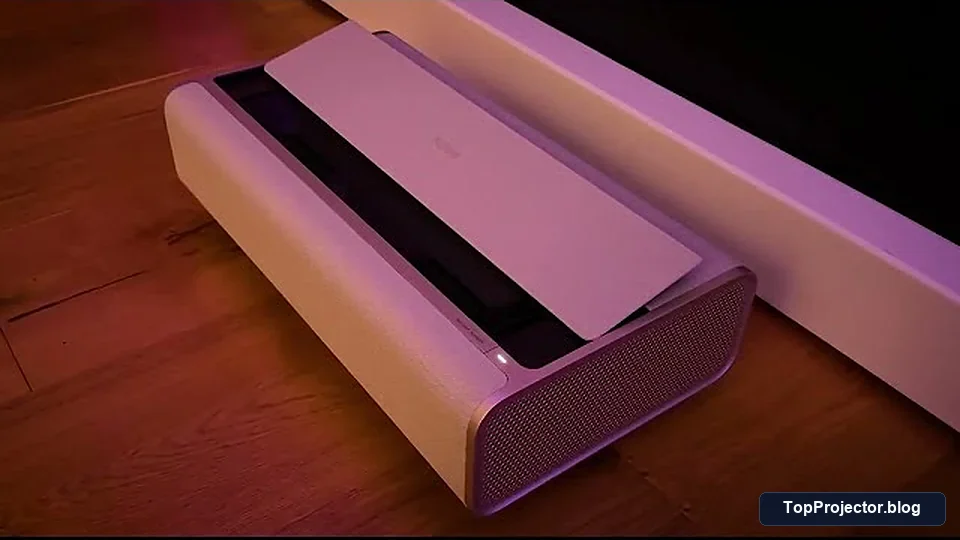
Short throw models featured in our best projector roundups shoot light upward from tight spaces, making them uniquely susceptible to overhead illumination without specialized ambient light rejection layers.
Ultra-short throw units rely heavily on specialized ALR screens to deflect overhead ceiling illumination while accurately reflecting the laser light source directly toward seated viewers.
- Projectors require dedicated ALR screens to combat ambient glare.
- Televisions utilize anti-reflective glass to absorb environmental room lighting.
- Standard white walls destroy contrast for projection systems instantly.
- Pair UST units with directional optical filters.
- Account for off-axis viewing cone limitations.
Daylight Living Rooms Versus Controlled Home Theaters
Sunlit living rooms severely wash out projected images by reflecting ambient photons back toward viewer eyes across the entire projection surface.
Televisions maintain high contrast ratios in broad daylight thanks to self-emissive pixels that generate high luminance independently of room lighting conditions.
- Projectors demand blackout curtains for optimal daytime performance.
- Televisions punch through daylight with high nit output.
Ceilings and Light Control
Standard white drywall destroys projected contrast by scattering ambient light across the entire image plane, destroying black levels even when running at 3000 ANSI lumens.
- Pair projectors with Fresnel ALR surfaces.
- Avoid glossy living room paint.
Black Floor Depth, ANSI Contrast, and Shadow Details
Achieving deep black levels remains a fundamental optical challenge for projection systems, especially in rooms with light-colored walls and ceilings.
Stray light bouncing around domestic spaces reflects back onto projection screens, raising the black floor and washing out dark cinematic shadows.
Using our room lighting calculator, you can determine whether your space requires ambient light rejection or if a low native contrast ratio will ruin dark cinematic scenes.
- Projectors suffer in white-walled rooms due to light scatter.
- Televisions achieve near-infinite contrast using local dimming zones.
- Shadow detail preservation favors high-end emissive displays.
- Examine dynamic black performance claims.
- Consider black velvet borders for screens.
Laser Engine Innovations and Dynamic Iris Controls
Modern laser engines utilize dynamic iris algorithms and advanced phosphors to improve dark-scene performance across challenging viewing environments.
Despite these optical improvements, televisions retain a distinct advantage in ANSI contrast measurements during mixed bright and dark sequences.
- Laser dimming helps bridge the native contrast gap.
- OLED panels deliver absolute zero black floors.
Laser Dimming and Dynamic Iris
Advanced laser light engines utilize dynamic dimming algorithms to modulate output during dark movie scenes, drastically improving perceived shadow detail without crushing near-black gradients.
- Check checkerboard contrast metrics.
- Calibrate gamma for dark rooms.
Peak Brightness, HDR Specular Highlights, and Color Volumes
High dynamic range content, as we noted in our Anker Nebula Cosmos review, demands substantial peak brightness to render realistic specular highlights like flashing explosions or metallic surfaces.
Television panels routinely exceed one thousand nits of localized luminance, delivering impactful HDR punch that current projectors struggle to replicate.
While premium televisions easily hit 2000 nits of sustained peak brightness for blinding HDR explosions, ultra-short throw models distribute light over massive diagonal surfaces, reducing perceived punch.
- Projectors measure output in ANSI lumens rather than nits.
- Televisions excel at small-area specular highlight reproduction.
- Color volume expands significantly under high peak brightness.
- Measure foot-lamberts across chosen screen sizes.
- Verify tone mapping capabilities for 4K discs.
Laser Phosphor Output Versus Direct-View Panel Luminance
Triple-laser short throw models produce vibrant wide color gamut coverage, often exceeding standard cinematic specifications with remarkable color saturation.
However, direct-view televisions maintain that color saturation even at maximum brightness levels without suffering from filter degradation.
- Triple-laser units cover wide color spaces easily.
- Panel displays maintain saturation under high output.
Wide Color Gamut Coverage
Laser phosphor and triple-laser engines achieve expansive color volumes, frequently exceeding 100 percent Rec. 2020 coverage to deliver saturated cinematic grading without standard filter losses.
- Prioritize triple-laser models for color.
- Adjust tone mapping settings carefully.
Massive Screen Sizes, Throw Ratios, and Cinematic Immersion
Screen size represents the primary architectural differentiator for projection technology, delivering true cinema-scale visuals inside standard residential spaces.
An ultra-short throw projector sits inches from the wall, projecting a breathtaking one-hundred-twenty-inch diagonal image without casting obstructive room shadows.
Achieving a cinematic 120-inch diagonal view requires massive physical television panels that rarely fit through standard doorways, whereas ultra-short throw projectors utilize ultra-short 0.21 throw ratios.
- Projectors scale easily up to one hundred fifty inches.
- Televisions become exponentially more expensive past eighty-five inches.
- Throw ratios dictate cabinet placement distance precisely.
- Calculate seating distance versus pixel pitch.
- Ensure media consoles accommodate deep chassis.
Spatial Geometry and Living Room Footprint Realities
Mounting an enormous television requires reinforced wall anchors and massive physical clearance during delivery through narrow residential hallways.
Projectors rest discreetly on media consoles, hiding away when powered off while transforming entire living room walls into immersive displays.
- Projectors offer a clean, unobtrusive footprint.
- Large televisions dominate room aesthetics permanently.
Placement and Wall Proximity
Positioning the chassis merely 12 inches away from the projection surface yields massive immersive scales that dwarf conventional living room flat screens for true theater-style viewing.
- Measure cabinet depth before buying.
- Verify lens offset specifications.
Input Latency, Refresh Rates, and High-Motion Gaming Dynamics
Competitive gaming requires exceptionally low input lag and fast response times to ensure smooth control tracking during fast-paced action sequences.
Modern gaming televisions feature dedicated low-latency modes, variable refresh rates up to one hundred forty-four hertz, and lightning-fast pixel response.
Competitive console gaming demands exceptionally low response times, and modern ultra-short throw models achieve competitive 16ms input lag at 4K resolution alongside high 240Hz refresh rates.
- Televisions dominate competitive gaming performance metrics.
- Projectors now achieve acceptable input lag for casual play.
- Motion handling varies widely across display technologies.
- Verify ALLM support for automated switching.
- Test motion interpolation settings for artifacts.
Console Gaming and Variable Refresh Rate Implementation
While premium projectors have reduced input lag significantly, they frequently lack advanced HDMI features found on modern flagship gaming panels.
Console players prioritizing frame rate synchronization and instant response will find traditional televisions far more accommodating for competitive titles.
- Projector refresh rates are improving annually.
- Flagship TVs support advanced gaming protocols seamlessly.
Motion Handling and Ghosting
DLP chipsets eliminate motion blur inherent in slower liquid crystal displays, delivering crystal-clear tracking during fast-paced esports sessions without introducing unwanted pixel response artifacts.
- Enable game mode on all inputs.
- Check HDMI 2.1 bandwidth limits.
Installation Geometry, Wall Surface Requirements, and Maintenance
Setting up an ultra-short throw projector demands precise alignment calibration to eliminate geometric distortion across large projection surfaces.
Any slight shifting of the media console alters the focal plane, requiring meticulous manual adjustment of focus and image geometry.
Achieving flawless geometric alignment requires absolute wall flatness, because even minor drywall undulations distort ultra-short throw laser reflections, necessitating rigid tensioned frame screens.
- Projectors require precise physical alignment.
- Televisions offer straightforward plug-and-play installation.
- Screen surface flatness dictates optical sharpness.
- Utilize multi-point warping adjustments carefully.
- Check manual focus rings for thermal drift.
Maintenance Schedules and Long-Term Component Lifespan
According to our laser projector lifespan guide, solid-state engines provide 20,000 hours of maintenance-free operation, easily outlasting traditional lamp-based systems by substantial operational margins.
Televisions offer similar long-term reliability without requiring delicate alignment checks or specialized optical screen cleaning routines over time.
- Laser engines eliminate expensive bulb replacements.
- Solid-state panels require zero optical maintenance.
Dust Sealing and Airflow
Solid-state laser diodes generate substantial internal heat, requiring robust multi-stage cooling filters that demand regular cleaning to prevent premature optical engine degradation.
- Inspect air filters every six months.
- Never block side ventilation ports.
Ultimate Home Entertainment Verdict for Specific Room Layouts
Choosing between these technologies depends entirely on your specific room architecture, lighting control, and preferred entertainment content types.
Prioritize a television for multi-purpose bright rooms, but select a projector for unmatched cinematic scale in dedicated theater spaces.
Choose large-format television panels if your living space suffers from uncontrollable daytime lighting, or invest in laser projection systems when prioritizing cinematic scale above all else.
- Evaluate your daily ambient lighting conditions first.
- Match screen size expectations to your available wall space.
- Balance gaming needs against cinematic immersion goals.
- Weigh installation complexity against utility.
- Prioritize light control for optimal projection.
Final Recommendations for Dedicated Enthusiasts
Dedicated cinephiles seeking authentic movie theater proportions will find short throw projectors deliver unbeatable immersion despite minor contrast compromises.
Casual viewers watching daytime sports and news should stick with robust television panels for guaranteed brightness and ease of use.
- Cinephiles benefit most from projection scale.
- General households thrive with reliable television displays.
The Final Balancing Act
Dedicated media rooms favor projection optics for authentic theater immersion, while bright multipurpose family spaces benefit immensely from bright flat panel emissive display technologies.
- Evaluate ambient lighting conditions first.
- Match display type to content habits.
Frequently Asked Questions
Can short throw projectors replace televisions in bright rooms?
They can replace televisions if paired with specialized ambient light rejecting screens and controlled window treatments. However, standard white walls will wash out images during daylight hours.
Do projectors require special screens or can I use a plain wall?
Textured walls scatter light and ruin optical clarity, so a smooth surface is mandatory. Using an ambient light rejecting screen drastically improves contrast and perceived black levels.
How long do laser light sources last compared to traditional bulbs?
Modern laser engines routinely exceed twenty thousand hours of continuous operation before significant degradation occurs. This eliminates frequent lamp replacements common in older projection systems.
Are short throw projectors good for modern console gaming?
They offer acceptable input lag for casual titles, but televisions remain superior for gaming. High-end panels feature variable refresh rates and higher frame rate support.
What is the primary setup challenge with ultra-short throw projectors?
Precise physical alignment on a stable media console is critical for geometry. Any minor bump to the furniture requires manual focus and keystone calibration adjustments.