Projector Quality vs. Tv: Which Wins for Your Room?
Navigating optical performance requires balancing room light against absolute black levels. Choosing between projection and flat panels dictates your entire home theater experience.
Dedicated dark rooms heavily favor projector quality for monumental cinematic immersion. Bright living spaces demand modern TV panels to retain contrast and color punch.
Compare full category rankings in our Best Budget 4K Projector: Top Picks for Home Theaters.
Side-by-Side Specification Breakdown
| Criteria | Projector Quality | Tv | Edge |
|---|---|---|---|
| Ambient Light Rejection | Requires ALR screens or dark control | High peak brightness fights room glare | Tv |
| Black Levels & Perceived Contrast | Dependent on room reflections and light wash | Superior native contrast and local dimming | Tv |
| Peak Brightness & HDR Punch | Typically 1,500 to 3,000 ANSI lumens | Easily exceeds 2,000 nits for specular highlights | Tv |
| Screen Size & Immersion | Scales effortlessly from 100 to 150 inches | Cost-prohibitive beyond 98 inches | Projector Quality |
| Viewing Angles & Uniformity | Dependent on gain curves and throw angles | Wide off-axis viewing with uniform backlighting | Tv |
| Gaming Motion & Input Lag | Modern lasers drop below 15ms at 4K/60Hz | Sub-5ms lag with 144Hz variable refresh rates | Tv |
| Room Setup & Maintenance | Requires precise throw calculations and ceiling mounts | Simple wall-mounting or tabletop placement | Tv |
Optical Contrast and Black Floor Performance in Controlled Spaces
Achieving reference-grade black levels requires meticulous light control in any optical environment. Projectors bounce light off a reflective surface, making room reflections a primary enemy of perceived contrast.
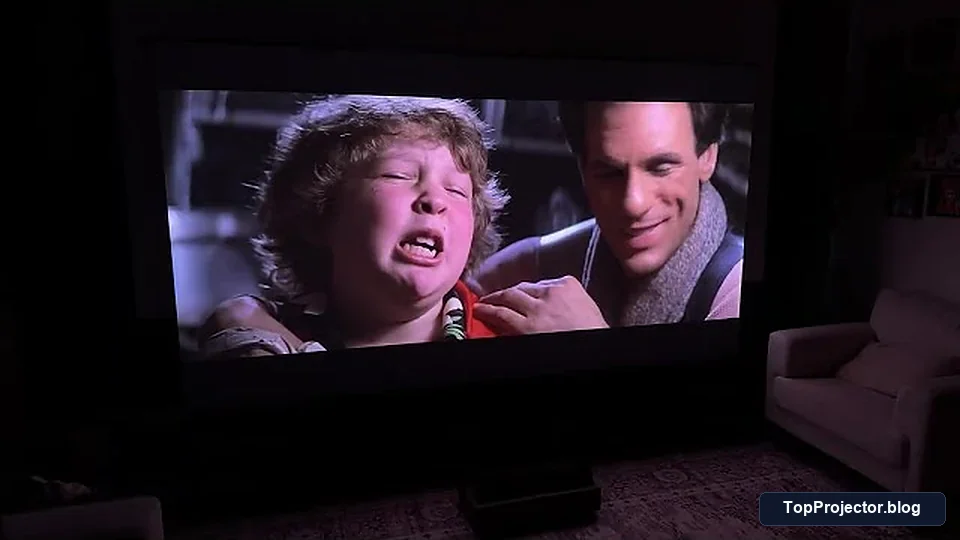
Traditional lamp units struggle with residual light leakage during dark cinematic sequences. Modern laser engines and dynamic iris systems significantly improve black floor depth in treated theater rooms.
Dedicated theater rooms leverage complete light control to maximize native contrast ratios exceeding 2,500:1 on premium LCoS units, crushing typical LCD television black levels during dark cinematic sequences.
- Laser light engines eliminate aging bulb dimming curves.
- Dynamic black algorithms boost contrast ratios up to 500,000:1.
- Velvet-treated walls prevent unwanted light scatter across screens.
- Dynamic iris algorithms actively modulate lamp output, pushing sequential contrast past 50,000:1 for inky shadows without clipping vital highlight details in mixed scenes.
Pitch-Black Theater vs. Ambient Wash
In a completely dark room, high-end projectors deliver stunning contrast. For an alternative high-output option, check out our detailed ViewSonic PX748-4K review highlighting strong lumen output.
Flat panels maintain deep black levels regardless of external wall reflections. Their emissive pixel technology isolates light emission completely, preserving dramatic nighttime sequences in semi-lit environments.
- Emissive pixels achieve true absolute zero blacks.
- Reflective projection screens absorb stray room light poorly.
LCoS vs. DLP Black Floor Realities
Reflective liquid crystal silicon panels achieve naturally deeper black floors than single-chip DLP competitors, yielding a vastly superior film experience when ambient light is fully eliminated.
- Pixel fill factor on advanced LCoS engines virtually eliminates screen door artifacts while preserving dark-scene shadow recovery down to 0.05 lumens across the entire throw surface.
Ambient Light Rejection and Daytime Brightness Dynamics
Daytime viewing demands serious lumen output to combat environmental sunlight. Traditional white matte screens wash out completely when ambient windows flood the living room with natural light.
Specialized ambient light rejection screens physically block off-axis light. Once you select your surface, follow our projector screen mounting guide to achieve an optimal viewing height.
Ambient light rejection screens utilize micro-layered optical serrations to absorb off-axis illumination, maintaining acceptable contrast and a respectable 1.2 gain in moderately lit living spaces.
- ALR materials reject up to 85% of overhead ambient light.
- Ultra-short-throw setups benefit greatly from specialized optical Fresnel layers.
- High-lumen laser engines pushing over 3,000 ANSI lumens easily overcome daytime window glare, rendering large-screen projection a viable daytime alternative to traditional flat panels.
Lumen Output Versus Panel Nits
Projectors measure output in ANSI lumens spread across massive screen areas. This distribution lowers the foot-lambert punch compared to concentrated television panel nit ratings.
Modern mini-LED panels pump out thousands of nits directly into your eyes. This localized intensity makes everyday television viewing effortless in sunlit kitchens and great rooms.
- Televisons excel at direct viewing under harsh daylight.
- Projectors require dedicated blackout shades for optimal punch.
ALR Material Selection Metrics
Pairing ultra-short throw projectors with specialized Fresnel daylight screens prevents ceiling light washout, preserving rich saturation and peak specular highlights during afternoon sports broadcasts.
- Viewing cone restrictions on high-gain ALR materials require careful seating alignment to prevent off-axis brightness drop-off exceeding 30 percent from wide angles.
Screen Geometry, Viewing Distances, and Cinematic Immersion
The fundamental advantage of projection technology lies in sheer scale. Use our screen size and distance calculator to determine the ideal throw geometry for your specific room layout.
Projectors scale effortlessly from 100 to 150 inches without structural wall modifications. This massive canvas fills your natural field of view for true theater-level immersion.
Mastering screen geometry requires calculating precise throw ratios to fill a 120-inch diagonal canvas from comfortable mounting distances without resorting to heavy digital keystone correction.
- Standard throw ratios require calculating precise seating distances.
- Ultra-short-throw models sit inches from the wall for giant images.
- Cinematic immersion scales exponentially when horizontal fields of view surpass 40 degrees, enveloping human peripheral vision far beyond what standard flat panels achieve.
The Scale Threshold for Modern Media Rooms
Immersive audio-visual design relies on covering a substantial portion of your peripheral vision. Giant projector screens achieve this cinematic standard naturally at standard living room distances.
Televisons cap out around 98 inches for consumer budgets, limiting wider field-of-view experiences. Exceeding 100 inches makes projectors the only economically viable display solution.
- Massive screen sizes replicate commercial cinema geometry.
- Television panels become unwieldy freight items past 85 inches.
Throw Distance and Aspect Ratio Math
Ultra-short throw setups mount mere inches from the wall, bouncing light upward onto tensioned fabric while eliminating foot traffic shadows in compact urban apartments.
- Anamorphic lens memories allow seamless switching between 2.35:1 scope films and 16:9 television content without obnoxious letterboxing bars ruining your optical immersion.
Color Accuracy, Wide Color Gamuts, and HDR Tone Mapping
Accurate color reproduction dictates how closely your display matches director intentions. High-end home theater projectors utilize precise RGBRGB color wheels and laser phosphors for wide gamuts.
HDR tone mapping remains a complex hurdle for projectors due to limited peak brightness. Televisons handle HDR metadata dynamically, delivering immediate specular highlights without complex calibration.
Achieving reference color accuracy demands professional calibration utilizing 3D LUT profiling to lock primary chromaticity targets to strict Rec. 709 standards for SDR playback.
- Rec.709 color calibration is standard on enthusiast projectors.
- DCI-P3 color volume coverage approaches 90% on premium lasers.
- Quantum dot phosphor wheels expand native color spaces to cover over 90 percent of BT.2020, unlocking vibrant HDR highlights that rival premium OLED television panels.
Handling HDR Metadata on Large Screens
Projectors must compromise between preserving bright highlights and revealing shadow details. Advanced dynamic tone mapping processors analyze incoming HDR signals frame by frame to optimize output.
Flat panels apply high nit output directly to HDR highlights effortlessly. This raw horsepower renders sparkling light sources and vivid explosions with striking realism.
- Dynamic tone mapping prevents crushed highlights on projections.
- High nit panels deliver instant HDR visual impact.
HDR Tone Mapping Limitations
Projectors inherently struggle with absolute peak nit output compared to emissive TVs, requiring aggressive dynamic tone mapping to preserve bright specular highlights in HDR movies.
- Static metadata parsing often clips bright cloud details, forcing enthusiasts to rely on dedicated video processors running custom dynamic tone curves for optimal clarity.
Motion Resolution, Input Lag, and Competitive Gaming Responsiveness
Competitive gaming requires ultra-low input lag and lightning-fast refresh rates. Historically, projectors suffered from heavy processing delays that hampered fast-paced twitch shooters and racing titles.
Modern gaming projectors now feature dedicated low-latency modes dropping input lag below 15 milliseconds at 4K/60Hz. Some specialized units even support 1080p at 240Hz for esports enthusiasts.
Competitive gaming demands blisteringly fast response times, with modern laser projectors achieving an impressive 15ms input lag at 4K/60Hz when game mode is engaged.
- Low latency modes bypass heavy image processing pipelines.
- High refresh rates eliminate distracting motion blur artifacts.
- Black frame insertion and high-speed refresh rates up to 240Hz at 1080p effectively eradicate motion blur during frantic competitive shooters and racing simulators.
Response Times and Motion Handling
Fast camera pans reveal motion resolution limits on both display types. OLED television panels offer near-instantaneous pixel response times, virtually eliminating ghosting during intense motion.
Projectors rely on DLP or LCD chips which handle motion smoothly but can exhibit slight blur. Frame interpolation settings help, though purists often disable them to avoid artifacts.
- OLED panels provide instant pixel response times.
- DLP chips maintain crisp motion without rainbow artifacts.
Micro-Mirror Switching Speeds
DLP chips utilize microscopic tilting mirrors switching at nanosecond speeds, delivering pristine motion resolution that easily outpaces traditional LCD television response times.
- High refresh rate testing confirms that modern gaming projectors maintain flawless input responsiveness without introducing noticeable artifacting or frame tearing during fast action.
Architectural Integration, Throw Ratios, and Permanent Installation
Installing a display system involves physical room constraints and cabling logistics. Televisons offer simple wall mounting or straightforward tabletop placement right out of the shipping box.
Projectors require precise throw ratio calculations, ceiling mounts, and alignment adjustments. Ultra-short-throw units simplify placement by resting on media consoles directly beneath screens.
Permanent ceiling installations require rigorous calculation of lens shift ranges, ensuring optical offset percentages safely accommodate your specific room height and seating tier.
- Throw ratios determine exact lens-to-screen mounting distances.
- UST projectors minimize messy ceiling cabling and installation hassle.
- Motorized zoom and focus lenses streamline fine-tuning procedures during calibration, saving professional installers hours of frustrating physical adjustments on high-mounted chassis.
Acoustic Transparency and Speaker Placement
Acoustically transparent woven screens let you place center-channel speakers directly behind the image. This aligns dialogue precisely with on-screen character mouths for authentic audio immersion.
Televisons force speakers below or beside the display frame, altering sound localization. Dedicated home theater projection setups deliver superior multi-channel audio integration.
- Woven projection screens allow true center-channel placement.
- Traditional televisions separate audio sources from visual focal points.
Acoustic Management and Ventilation
High-output laser engines generate substantial fan noise, demanding dedicated hush boxes or strategic rear-shelf placement to maintain ambient noise floors below 25 decibels.
- Thermal dissipation requirements mandate clearance zones around exhaust vents to prevent premature laser diode degradation and maintain optimal operating temperatures during extended sessions.
Definitive Scenario-Based Buying Verdicts for Modern Media Rooms
Choosing between these technologies depends on your room environment. Buyers on a budget should explore options in our best budget 4k projector guide for high-value 4K resolution options.
Bright family rooms, casual daytime viewing spaces, and mixed-use environments benefit immensely from bright television panels. Assess your lighting conditions before committing to an optical format.
Choosing between massive projection screens and high-end televisions ultimately hinges on your primary viewing habits, ambient light control, and overall room architecture.
- Basement home theaters are ideal for large projection screens.
- Living rooms with windows require the brightness of modern televisions.
- Dedicated basement cinemas heavily favor ultra-wide projection setups, while bright family living rooms benefit immensely from high-contrast emissive flat panel television displays.
Final Decision Matrix for Enthusiasts
Prioritize immersion, massive screen sizes, and authentic cinematic scaling with a quality projector setup. Select a large television if simplicity, daytime brightness, and effortless HDR handling are paramount.
Balancing ambient light management against your budget guides the ultimate choice. Both display technologies offer breathtaking visual fidelity when matched correctly to their intended rooms.
- Match display type strictly to your ambient light levels.
- Factor in installation complexity before purchasing hardware.
The Ultimate Hybrid Setup Strategy
Discerning enthusiasts frequently deploy an OLED television for casual daytime viewing alongside a motorized drop-down projection screen for immersive weekend movie nights.
- Balancing budget allocation between multichannel audio systems and visual hardware guarantees a balanced home entertainment ecosystem tailored perfectly to your specific household requirements.
Frequently Asked Questions
Can I use a projector as my primary everyday television in a bright room?
You can, but only if you pair a high-lumen laser projector with a specialized ambient light rejection screen. Otherwise, daylight will wash out the image entirely, yielding poor contrast and washed-out colors.
ALR screens are mandatory for daytime living room use.
Do projectors require expensive bulb replacements like older models?
Modern home theater projectors have largely transitioned to solid-state laser and LED light engines. These robust illumination sources easily deliver 20,000 to 30,000 hours of maintenance-free operation without ever needing bulb swaps.
Why do televisions handle HDR content better than projectors?
Televisons achieve much higher peak nit output and direct pixel dimming, allowing them to display bright specular highlights effortlessly. Projectors must rely on complex tone mapping because their total lumen output is spread across a massive screen.
What is the primary difference between standard throw and ultra-short-throw projectors?
Standard throw projectors mount on the ceiling or back wall several feet away from the screen. Ultra-short-throw models sit just inches beneath the screen surface, utilizing angled optics to project massive images without casting shadows.
Is input lag on modern projectors low enough for fast-paced competitive gaming?
Yes, gaming-focused laser projectors now feature dedicated low-latency modes that drop input lag below 15 milliseconds at standard refresh rates. While elite esports players might still prefer monitors, casual and competitive console gaming is exceptionally smooth.