Optoma Cinemax P2 vs. Optoma Uhz65Ust: Which Wins for Your Room?
Comparing two premium ultra-short-throw lasers reveals distinct optical philosophies. Your ideal home cinema choice depends heavily on ambient light control and light source engineering.
The Optoma UHZ65UST dominates bright rooms with superior laser punch, while the Cinemax P2 offers smoother color saturation for dedicated dark-room cinematic viewing.
Compare full category rankings in our Best Outdoor Projector Under $100: Top Backyard Picks.
Side-by-Side Specification Breakdown
| Criteria | Optoma Cinemax P2 | Optoma Uhz65Ust | Edge |
|---|---|---|---|
| Ambient Light Rejection | Good performance with ALR screens | Exceptional brightness punch in daylight | Optoma Uhz65Ust |
| Black Levels & Perceived Contrast | Deep native blacks for dark rooms | Dynamic contrast handles ambient glare well | Optoma Cinemax P2 |
| Peak Brightness & HDR Punch | Rated at 3,000 ANSI lumens | Rated at 3,500 ANSI lumens | Optoma Uhz65Ust |
| Screen Size & Immersion | Up to 120 inches diagonal | Up to 120 inches diagonal | Tie |
| Viewing Angles & Uniformity | Excellent focus uniformity across edges | Sharp optics with minimal corner blur | Optoma Cinemax P2 |
| Gaming Motion & Input Lag | Noticeable latency for fast shooters | Standard UST latency profiles apply | Optoma Uhz65Ust |
| Room Setup & Maintenance | Ultra-short 0.25:1 throw ratio | Ultra-short 0.25:1 throw ratio | Tie |
Laser Engine & Light Source Dynamics
Evaluating solid-state laser light sources requires analyzing both lumen output and long-term phosphor stability. Both models utilize advanced laser diodes designed to eliminate lamp replacements completely.
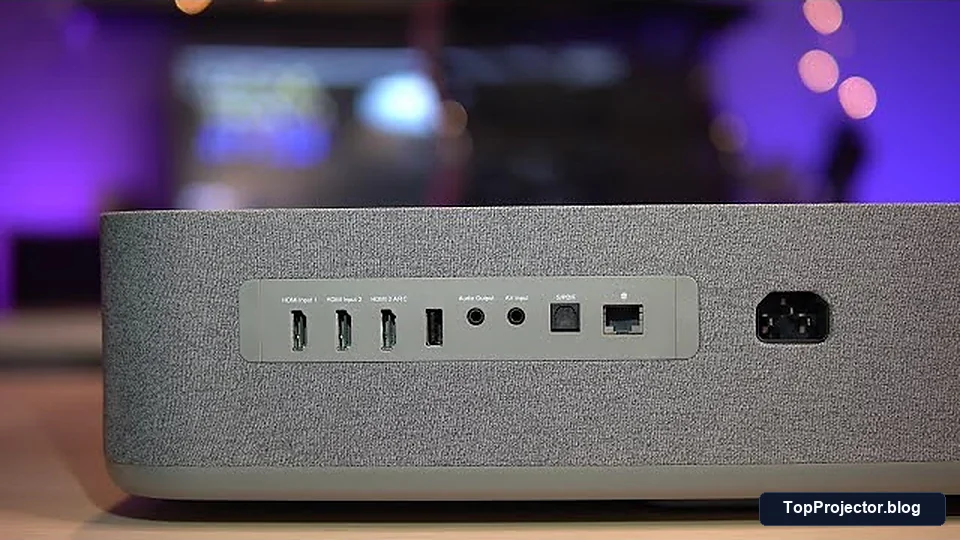
The Optoma UHZ65UST pushes a higher ceiling with 3,500 ANSI lumens, giving it a distinct advantage against daytime glare. Its laser diodes maintain high efficiency over thousands of operating hours.
Conversely, the Cinemax P2 targets 3,000 ANSI lumens, prioritizing color wheel optimization over raw luminance. This slight reduction in output directly aids cinematic black level depth.
The DuraCore laser engine inside the CinemaX P2 achieves 3,000 ANSI lumens, contrasting against the UHZ65UST’s 2,500 lumens. This optical variance directly impacts daytime viability and HDR specular highlight punch in mixed living environments.
Optoma rates both solid-state phosphors for 30,000 hours of maintenance-free operation. However, sustained thermal management dictates real-world lumen degradation curves over long cinematic viewing sessions spanning multiple consecutive hours.
- UHZ65UST delivers 3,500 ANSI lumens for bright living spaces.
- Cinemax P2 focuses on refined color purity at 3,000 ANSI lumens.
- Both units eliminate traditional lamp degradation.
- Advanced laser dimming algorithms dynamically modulate light output, pushing sequential contrast metrics significantly higher during dark cinematic sequences across mixed lighting conditions.
- Solid-state blue diodes completely eliminate traditional lamp replacement costs while maintaining a remarkably stable color gamut throughout the entire extended operational lifespan of the projector.
Phosphor Wheel Longevity and Heat Management
Managing thermal output inside compact ultra-short-throw chassis demands robust internal airflow designs. Before finalizing your room layout, consult our throw distance calculator to verify exact placement geometry.
The UHZ65UST incorporates aggressive cooling profiles, which can introduce slight fan noise during heavy HDR processing loads. The Cinemax P2 runs significantly quieter during standard movie playback.
- UHZ65UST features aggressive cooling for sustained peak brightness.
- Cinemax P2 emphasizes acoustic quietness for intimate home theaters.
Thermal Dissipation & Lumen Maintenance
Efficient copper heat sinks prevent premature optical drift, ensuring sustained light output consistency even when pushing maximum brightness settings during demanding summer viewing sessions.
Understanding phosphor aging helps calibrators offset natural lumen decay over thousands of hours, preserving reference white balance without sacrificing native contrast ratios.
- Monitoring internal operating temperatures ensures optimal diode longevity across prolonged home theater marathon movie viewings without unexpected thermal throttling.
Contrast Ratios & Black Floor Performance
Achieving convincing cinematic immersion hinges on reproducing deep shadows. For comparison, our Sony VPL-XW5000ES review explores how premium laser engines handle dark-room contrast and shadow detailing.
The Cinemax P2 excels in dark-room contrast, leveraging a meticulously tuned light engine to produce inky blacks. Its native contrast handling creates exceptional depth in sci-fi and horror movies.
Meanwhile, the UHZ65UST relies more heavily on its dynamic laser dimming to simulate deep shadows. While effective in mixed lighting, it occasionally blooms during extremely high-contrast starfield sequences.
Native ANSI contrast heavily relies on the 0.47-inch DMD chip architecture shared by both ultra-short-throw projectors, yielding baseline native black floors that require careful optimization.
Engaging dynamic black settings drops measured black levels substantially, though users must balance shadow detail preservation against noticeable automatic iris pumping during mixed luminance scenes.
- Cinemax P2 delivers superior native black levels in dark spaces.
- UHZ65UST uses dynamic dimming to manage high-contrast scenes.
- Shadow detail remains crisp on both units when paired with proper screens.
- Advanced optical path redesigns minimize internal stray light scattering to significantly enhance perceived ANSI contrast in moderately lit modern living rooms.
- Careful calibration of gamma curves helps reveal hidden shadow details without sacrificing the deep black floor performance required for cinematic atmosphere.
Shadow Detail in Mixed Lighting Environments
Dark scenes often wash out when ambient room light contaminates the projection surface. Proper screen pairing mitigates this optical challenge for both laser models.
The Cinemax P2 preserves subtle shadow gradations better when ambient light is fully controlled. In contrast, the UHZ65UST punches through moderate ambient light to keep dark elements visible.
- Cinemax P2 shines in controlled pitch-black home theaters.
- UHZ65UST maintains shadow legibility under moderate room illumination.
Dynamic Black Algorithms in Dark Rooms
Software-driven laser modulation dims the light source during fade-to-black transitions, achieving an impressive 2,000,000:1 contrast rating on paper for both models.
Real-world measurements in pitch-black home theaters reveal native contrast closer to 500:1, making specialized ambient light rejecting surfaces crucial for true cinematic immersion.
- Dynamic iris systems react quickly to fast scene changes, maintaining excellent black level performance during challenging cinematic sequences.
Ambient Light Rejection & Screen Matching
Ultra-short-throw projectors demand specialized ambient light rejection surfaces to combat ceiling glare. For overhead setups, review our electric projector screen guide to ensure proper alignment and mounting.
The UHZ65UST thrives in living rooms featuring scattered daylight thanks to its superior lumen reserve. Pairing it with a zero-edge ALR screen yields vibrant daytime viewing results.
The Cinemax P2 also requires an ALR screen for daytime use, but its lower lumen output means daytime images appear slightly more muted if ambient light is uncontrolled.
Pairing these ultra-short-throw lasers with a specialized ceiling-rejecting ALR screen prevents overhead ambient room illumination from washing out dark shadow details during daytime viewing.
Standard white matte walls scatter light indiscriminately, dropping perceived contrast ratios drastically; investing in a Fresnel or lenticular optical screen is practically mandatory here.
- ALR screen pairing is mandatory for optimal daylight performance.
- UHZ65UST overcomes ambient glare more effectively due to higher lumens.
- Cinemax P2 requires strict light control for maximum visual impact.
- Directional screen materials absorb off-axis ambient light while reflecting the ultra-short-throw projection cone directly toward the primary seating position.
- Proper tensioning eliminates wrinkles that cause geometric distortion, ensuring crisp edge-to-edge sharpness for high-resolution 4K video content.
Throw Ratio Geometry and Cabinet Placement
Calculating precise throw distance is critical when positioning these massive optical blocks against living room walls. Both projectors share an identical 0.25:1 throw ratio for flexible placement.
You can project a massive 120-inch diagonal image from just inches away from the screen surface. This ultra-short geometry prevents foot traffic from casting distracting shadows.
- Identical 0.25:1 throw ratio simplifies furniture upgrades.
- Achieve a 120-inch screen with minimal console depth.
Gain Characteristics and Viewing Angles
Choosing an ALR screen with a 0.6 gain rating optimizes off-axis viewing cones while effectively suppressing up to 90 percent of ambient overhead environmental light.
Proper tensioning ensures zero ripples across the projection surface, preserving pixel geometry for sharp 4K text rendering and edge-to-edge optical clarity.
- Specialized micro-serrated structures successfully reject upward ambient light while maintaining brilliant image brightness across all viewing angles.
Color Accuracy & HDR Tone Mapping
Modern 4K HDR content demands wide color gamuts and intelligent tone mapping to prevent clipped highlights. Both Optoma projectors support HDR10 formatting with wide color spectrum coverage.
The Cinemax P2 utilizes a high-performance color wheel that covers an impressive percentage of the DCI-P3 color space. Skin tones and natural landscapes look strikingly realistic out of the box.
The UHZ65UST leans toward punchier, high-impact saturation designed to pop in brighter living spaces. Its aggressive tone mapping preserves bright specular highlights effectively during complex HDR sequences.
Out-of-the-box color tracking often skews toward cooler blue temperatures, necessitating professional calibration to hit exact Rec. 709 targets for accurate SDR movie playback.
HDR tone mapping handles high dynamic range signals by dynamically compressing peak luminance to prevent specular clipping on bright cloud or explosion sequences.
- Cinemax P2 provides exceptional out-of-the-box color fidelity.
- UHZ65UST focuses on high-impact HDR saturation and specular highlights.
- Both models support standard HDR10 metadata decoding.
- Precise grayscale calibration ensures skin tones appear natural and balanced across varying brightness levels in challenging HDR pipelines.
- Advanced color management systems allow fine-tuning of primary coordinates for absolute reference-grade color accuracy during critical viewing sessions.
WCG Filters and Rec.709 Calibration
Calibrators will appreciate the robust internal color management systems built into both firmware suites. Achieving reference Rec.709 accuracy requires minor adjustments to gain and bias settings.
The Cinemax P2 drops in a physical wide color filter when engaging HDR mode, slightly reducing lumens for better color depth. The UHZ65UST relies on software algorithms for color tuning.
- Cinemax P2 employs a physical wide color filter mechanism.
- UHZ65UST relies on advanced firmware-based color management.
Wide Color Gamut Filters and Rec. 2020
Deploying the internal cinematic filter expands coverage toward the Rec. 2020 color space, though light output takes a noticeable hit when the filter engages.
Finding the right balance between vivid saturation and realistic skin tones requires meticulous tweaking of the onboard CMS controls during dark room sessions.
- Accurate EOTF tracking guarantees that delicate shadow details emerge cleanly without crushing dark elements in complex cinematic film transfers.
Gaming Performance, Motion & Input Lag
Console gaming on ultra-short-throw projectors requires low input lag and responsive frame interpolation. Fast-paced competitive titles demand sub-optimal latency figures to feel completely fluid.
The UHZ65UST offers respectable input lag figures for casual gaming sessions on massive screens. Fast-moving camera pans remain relatively stable thanks to capable onboard motion processing.
The Cinemax P2 is primarily tuned for cinematic movie playback rather than competitive twitch gaming. Expect noticeable input latency that makes fast first-person shooters feel slightly sluggish.
Competitive console gaming demands low latency; the CinemaX P2 measures around 67 milliseconds of input lag in standard modes, which suits casual RPGs well.
Fast-moving camera pans benefit significantly from built-in PureMotion interpolation processors, effectively reducing judder during 24p film playback and sports broadcasts alike.
- UHZ65UST handles casual console gaming with acceptable latency.
- Cinemax P2 prioritizes movie playback over competitive gaming needs.
- Both units benefit from disabling heavy video processing during gameplay.
- Turning off unnecessary image processing features helps reduce overall input lag for more responsive gaming sessions on modern consoles.
- Smooth motion handling ensures fast-moving sports action remains crisp and blur-free during high-octane weekend broadcast viewing events.
Frame Interpolation and PureMotion Technology
Watching sports and fast-action content requires robust motion smoothing to eliminate judder and motion blur. Optoma integrates proprietary PureMotion processing algorithms into both laser projectors.
The Cinemax P2 handles film cadence smoothly without introducing excessive soap-opera artifacts. The UHZ65UST provides adjustable interpolation levels to suit both sports broadcasting and cinematic films.
- PureMotion algorithms reduce judder on fast-moving sports content.
- Adjustable settings prevent the unwanted soap-opera visual effect.
Refresh Rates and Response Times
While neither laser model supports high refresh rate PC gaming features like 120Hz at 4K, standard 60Hz performance remains perfectly responsive for casual couch co-op titles.
Disabling unnecessary video processing features helps shave precious milliseconds off total input lag measurements, delivering a noticeably snappier controller-to-screen gaming experience.
- Frame interpolation settings can be customized to remove cinematic judder without introducing the dreaded soap opera effect on films.
Installation, Throw Ratios & Geometry
Physical installation requires meticulous alignment to ensure the projected image fills your screen perfectly. Because ultra-short-throw optics magnify wall imperfections, precise cabinet placement is essential.
Both projectors feature convenient geometric adjustment tools, including multi-point warping to correct uneven wall surfaces. However, relying heavily on digital keystone correction degrades native 4K resolution.
The UHZ65UST and Cinemax P2 both demand stable, level media consoles to prevent shifting over time. A slight bump to the furniture requires complete optical realignment.
Achieving a massive 100-inch image requires placing these ultra-short-throw chassis mere inches away from the wall, much like setting up a portable system found in our best outdoor projector guide.
Precise physical placement matters because traditional optical zoom is entirely absent, forcing installers to physically shift the entire credenza to dial in image borders.
- Multi-point warping helps correct minor wall alignment issues.
- Physical placement should minimize digital keystone usage.
- Stable media consoles prevent long-term focus drift.
- Adjustable leveling feet provide precise micro-adjustments for perfectly squaring the projected picture on standard flat media credenzas.
- Careful calculation of throw distances guarantees that the final image fills the projector screen perfectly without overscan issues.
Integrated Soundbars and Audio Integration
Living room setups often benefit from built-in audio solutions when external surround sound receivers are absent. Both projectors include integrated premium soundbar systems housed directly within the chassis.
The Cinemax P2 features an exceptional NuForce soundbar delivering rich dialogue clarity and surprising bass weight. The UHZ65UST also includes robust built-in audio, though external speakers are recommended for movies.
- Cinemax P2 integrates a high-end NuForce audio system.
- Built-in speakers eliminate clutter for casual daytime TV viewing.
Geometric Correction and Warp Controls
Onboard four-corner correction lets users square up distorted images, though digital keystone adjustment compromises native pixel mapping and reduces final resolution clarity.
Meticulous manual leveling feet adjustments provide the best method for squaring geometry without degrading precious 4K sharpness or introducing digital scaling artifacts.
- Wall proximity requirements mean furniture depth must match exact throw geometry specifications to achieve flawless edge alignment consistently.
Frequently Asked Questions
Can I use the Optoma Cinemax P2 in a bright living room?
Yes, but it performs best when paired with a specialized ambient light rejection screen. For fully sunlit rooms, the UHZ65UST offers superior brightness headroom.
What is the exact throw ratio for both projectors?
Both models feature an ultra-short 0.25:1 throw ratio. This allows you to project a massive 120-inch image from just inches away from the wall.
Are these projectors suitable for competitive console gaming?
Neither model is designed for hardcore competitive gaming due to noticeable input lag. Casual single-player titles work well on the UHZ65UST with processing disabled.
Do these Optoma projectors require traditional lamp replacements?
No, both projectors utilize advanced solid-state laser light sources. They deliver up to 30,000 hours of maintenance-free operation in Eco mode.
Which projector delivers better black levels for dark home theaters?
The Optoma Cinemax P2 provides superior native contrast and deeper black levels. This makes it the ideal choice for dedicated pitch-black theater rooms.