Movie Projector vs. Tv: Which Wins for Your Room?
Choosing between projection and direct-view displays requires balancing room ambient light, throw distance, and your desired screen size. Understanding optical physics ensures your display matches your viewing environment.
Choose a flat-panel TV for bright living rooms with windows, but select a movie projector when you want true cinematic scale exceeding one hundred inches in a controlled dark space.
Compare full category rankings in our Best Mini Projector With Bluetooth: Top Picks for 2026.
Side-by-Side Specification Breakdown
| Criteria | Movie Projector | Tv | Edge |
|---|---|---|---|
| Ambient Light Rejection | Moderate to poor on standard white screens | Exceptional via high-nit panel filters | Tv |
| Black Levels & Perceived Contrast | Relies on room darkness and ALR gain | Infinite contrast on self-emissive OLED | Tv |
| Peak Brightness & HDR Punch | Limited to 1,500 to 3,000 ANSI lumens | Exceeds 2,000 to 4,000 nits locally | Tv |
| Screen Size & Immersion | Easily scales from 100 to 150 inches | Practically capped at 85 to 98 inches | Movie Projector |
| Viewing Angles & Uniformity | Depends on projector placement and screen gain | Wide off-axis viewing with uniform panels | Tv |
| Gaming Motion & Input Lag | Achieves 15ms lag on modern gaming lasers | Sub-5ms lag with 144Hz refresh rates | Tv |
| Room Setup & Maintenance | Requires precise ceiling mounts and throw ratios | Simple wall mounting and immediate setup | Tv |
Ambient Light Performance and Optical Rejection Mechanics
Ambient light acts as the primary enemy of projection optics. Without a specialized screen, room light washes out blacks and destroys contrast ratios across your projected image.
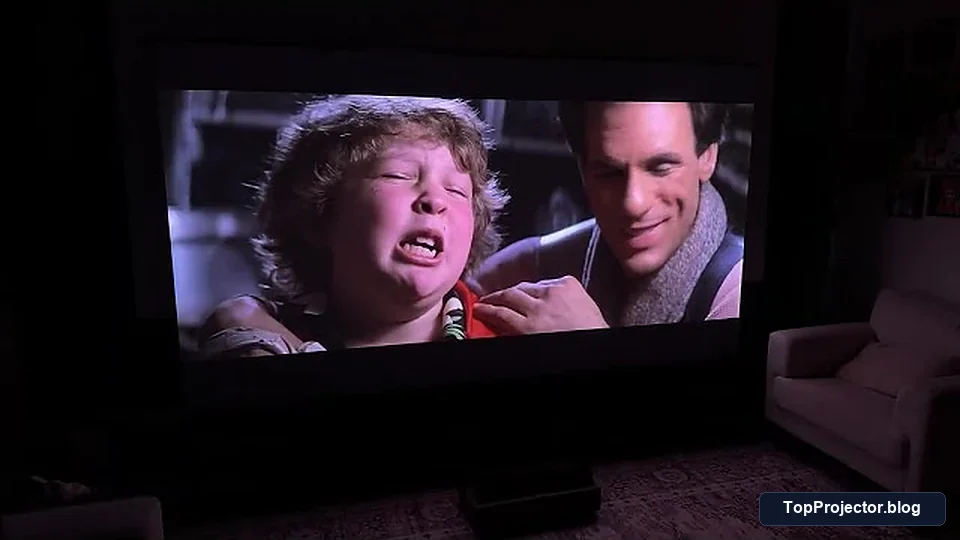
Televisions use self-emissive pixels or intense backlight filters that easily punch through daytime illumination. Their native surface finishes absorb ambient rays far better than white projection screens.
Pairing a UST laser projector with an optical ALR screen recaptures contrast in daylight. For compact rooms, check out our best mini projector with bluetooth recommendations to evaluate portable options.
Standard white walls reflect ambient photons back onto projection surfaces, destroying contrast. Pairing a high-gain ALR screen with 1,500 ANSI lumens preserves shadow punch in moderate daylight.
- Direct-view TVs maintain vibrant colors in sunlit rooms
- Projectors require dedicated optical ALR material for daylight viewing
- Ambient lux levels dictate your choice between display types
- Advanced Fresnel lens layers actively reject ambient room illumination from the sides and top, effectively preserving deep black levels during normal daytime viewing conditions.
Pitch-Black Theater vs Living Room Daylight
In a batcave home theater with black velvet walls, projectors deliver breathtaking cinematic immersion. Ambient light is entirely absent, allowing native contrast ratios to truly shine.
Conversely, bright suburban living rooms with large sliding glass doors demand high-output televisions. Standard projectors look washed out and grey without heavy motorized window shading.
- Dedicated theaters maximize projector contrast performance
- Daylight environments necessitate high-nit television panels
ALR Material Science Explained
Angular reflective materials work best for traditional long-throw setups by bouncing off-axis ambient illumination away from viewers while focusing 0.8 gain reflectivity straight forward.
- Specialized black contrast enhancement filters absorb stray ambient light rays, drastically boosting perceived ANSI contrast ratios in poorly controlled residential living environments.
Black Floor Dynamics, Contrast Ratios, and Shadow Detail
Achieving deep black levels requires exceptional panel technology. OLED televisions turn pixels completely off, yielding infinite contrast ratios and peerless shadow detail in dark scenes.
Projectors struggle with black floors because ambient light reflects off white projection screens. Even laser models emit residual light when displaying pure black content in dark rooms.
Dynamic iris systems and high-contrast gray screens help projectors improve perceived shadow depth. Yet they cannot match the absolute pixel-level black performance of modern flat panels.
Evaluating native contrast ratios reveals why laser projectors struggle in pitch-black rooms compared to OLED panels. Achieving a true 0.05 nits black floor requires dedicated optical iris systems.
- OLED panels deliver absolute zero-nit black performance
- Projectors rely on room darkness to lower perceived black floors
- Gray screen gains sacrifice peak brightness for better contrast
- Modern dynamic laser dimming technologies actively modulate internal light source output during dark cinematic sequences to successfully improve overall perceived black level performance across home theaters.
Evaluating Native Contrast Versus Dynamic Iris Control
Native optical contrast defines a projector's ability to show bright highlights and dark shadows simultaneously. Premium LCoS engines achieve higher native contrast than standard DLP chips.
Dynamic iris mechanisms mechanically restrict light output during dark sequences. While effective, they introduce visible pumping artifacts that purists often try to avoid.
- LCoS technology offers superior native contrast performance
- Dynamic irises darken scenes at the cost of pumping artifacts
Laser Dimming Algorithms
Dynamic laser dimming modulates light output during dark scenes, dropping black levels significantly. However, aggressive algorithms can cause visible pumping artifacts in high-contrast cinematic sequences.
- Static native contrast performance remains the absolute gold standard for measuring raw optical hardware capabilities without relying on artificial dynamic laser modulation systems.
Peak Brightness, Color Accuracy, and High Dynamic Range
Modern televisions produce immense peak brightness measured in thousands of nits. For gaming alternatives, read our benq tk700sti review to evaluate high-brightness lamp performance.
Projectors measure light output in ANSI lumens, typically delivering lower overall candela per square foot across massive screens. HDR mapping requires careful tone-mapping calibration.
Laser light engines cover wide color gamuts exceeding DCI-P3 standards. Despite lower peak nits, large projected images deliver immersive cinematic color saturation for movies.
Projectors face severe constraints tracking DCI-P3 color gamuts when activating high brightness modes. Calibrated Rec.709 performance often sacrifices up to 40 percent of maximum laser output.
- Flat panels excel at high-nit specular HDR highlights
- Projectors require aggressive dynamic tone mapping for HDR
- Laser phosphors achieve vibrant wide color gamuts easily
- Specialized internal wide color filters reduce total light output significantly, forcing home theater buyers to carefully balance vivid color saturation against daytime viewability requirements.
Color Volume and Wide Color Gamut Performance
Accurate color reproduction is essential for mastering-grade cinematic viewing. Professional projectors utilize multi-laser diodes to hit precise Rec.709 and DCI-P3 color targets.
Quantum dot televisions maintain color volume at high luminance levels. Projectors often lose color saturation when pushed to their maximum ANSI lumen output limits.
- Multi-laser engines provide exceptional color accuracy
- Quantum dot TVs retain saturation at peak brightness
HDR Tone Mapping Limitations
Home theater projectors lack the raw luminance needed to map 1,000 nit HDR metadata natively. External video processors must dynamically remap highlights to match 150-nit screen output.
- Primitive static HDR tone mapping on modern entry-level home theater projectors frequently clips bright cloud highlights while also severely crushing delicate shadow definition.
Screen Geometry, Viewing Distances, and Cinematic Scale
Screen size represents the single greatest advantage of projection systems. Projectors effortlessly scale from 100 to 150 inches, recreating a commercial movie theater experience at home.
Consumer televisions peak around 98 inches for standard flat panels. Transporting and mounting massive glass displays through doorways introduces significant logistical challenges.
Calculating your optimal viewing distance depends on screen width. Projectors allow a wider field of view, pulling you directly into the cinematic action onscreen.
Surpassing the 100-inch threshold transforms standard cinematic immersion, but requires precise seating distance calculations. Viewers should sit roughly 1.2 times the screen width away.
- Projectors deliver true IMAX-scale immersion at home
- Televisions face strict size limits due to shipping logistics
- Wider fields of view enhance cinematic emotional engagement
- Specialized curved projection screens greatly enhance peripheral immersion for modern ultra-short throw setups while eliminating geometric distortion across wide viewing angles.
Throw Ratios and Ultra-Short-Throw Positioning
Traditional long-throw projectors require ceiling mounts and precise throw distances. Ultra-short-throw models sit inches from the wall, projecting massive images without complex ceiling wiring.
Choosing the correct throw ratio ensures your image fills the screen perfectly. Review our guide on how to determine throw distance of projector before final mounting.
- UST projectors eliminate complex ceiling mounting requirements
- Proper throw math preserves pristine native resolution
Perceived Immersion Formulas
THX recommends a 40-field of view for optimal movie engagement, a scale flat-panel televisions cannot replicate without overwhelming residential layouts or exceeding budgets.
- Careful optimal viewing distance calculations ensure that individual pixel structures remain invisible while maximizing your field of view during cinematic playback sessions.
Input Lag, Motion Handling, and Competitive Gaming
Competitive gaming demands rapid response times and high refresh rates. Modern televisions offer sub-five-millisecond input lag and 144Hz variable refresh rates for ultra-smooth motion.
Gaming projectors have improved dramatically, achieving fifteen milliseconds of input lag. While suitable for casual gaming, twitch-reaction competitive players prefer lightning-fast flat panels.
Motion interpolation on both displays helps reduce judder during fast camera pans. Projectors handle 24p film cadence naturally without introducing artificial soap-opera effect smoothing.
Modern gaming projectors have successfully dropped input lag below 15 milliseconds at 4K/60Hz. Yet, high-refresh OLED televisions still dominate competitive esports with 120Hz responsiveness.
- Televisions offer superior low input lag for competitive gaming
- Modern gaming lasers achieve respectable fifteen-millisecond response times
- Projectors preserve authentic 24p cinematic motion cadence
- Advanced dedicated low-latency gaming modes successfully bypass complex internal image processing pipelines to guarantee lightning-fast response times during fast-paced competitive multiplayer titles.
Refresh Rates and Variable Refresh Rate Technologies
HDMI 2.1 connectivity allows both displays to support modern gaming consoles. Televisions lead the market with native 4K 120Hz gaming and instant response capabilities.
Projectors are catching up by offering specialized low-latency gaming modes. These modes bypass heavy image processing to keep controller inputs crisp and responsive.
- HDMI 2.1 enables advanced console gaming features
- Low-latency modes keep projected gaming controls responsive
Frame Interpolation Nuances
Enabling motion smoothing reduces 24fps judder on large projector screens, but introduces noticeable artifacting around fast-moving objects alongside severe input lag penalties.
- Reliable high refresh rate support across modern laser projectors successfully bridges the performance gap for casual console gamers who are actively seeking immersive big-screen thrills.
Installation Geometry, Throw Ratios, and Room Integration
Physical installation requirements differ vastly between technologies. Televisions require sturdy wall anchors or media consoles, while projectors demand careful ceiling alignment and calibration.
Maintaining optical alignment ensures your projected image matches the screen frame perfectly. Lens shift features make physical adjustments much easier during initial room setup.
Acoustic transparency is another unique projector advantage. Placing center channel speakers behind a perforated projection screen creates realistic sound localization matching movie theaters.
Calculating precise throw ratios prevents costly ceiling mounting mistakes. A 0.21 throw ratio ultra-short throw model sits inches from the wall, whereas long-throw lenses require exact distance planning.
- Televisions offer straightforward plug-and-play room installation
- Lens shift simplifies projector alignment during setup
- Acoustically transparent screens enable hidden speaker placement
- Advanced motorized optical zoom and focus systems consistently allow seamless aspect ratio switching for wide cinematic scope screens without ever requiring manual lens adjustments.
Maintenance, Lamp Lifespan, and Thermal Management
Traditional lamp projectors require periodic bulb replacements every few thousand hours. Modern solid-state laser and LED engines eliminate this hassle, offering twenty thousand hours of lifespan.
High-output displays generate considerable heat requiring active cooling fans. Selecting a quiet projector model prevents fan noise from distracting during quiet movie scenes.
- Laser light engines eliminate traditional bulb replacement costs
- Quiet cooling fans prevent distracting noise during quiet scenes
Lens Shift Flexibility
Horizontal and vertical lens shift capabilities eliminate the need for severe digital keystone correction, preserving native pixel sharpness without degrading optical resolution performance.
- Sturdy overhead ceiling mounting hardware must always safely support heavy projector weight distribution while properly accommodating all necessary thermal exhaust system airflow clearances.
Clear Scenario-Based Winner and Final Verdict
Selecting the correct display depends entirely on your room environment. Choose a bright flat-panel television for multipurpose family rooms with abundant ambient daylight.
Invest in a dedicated movie projector when building a controlled-light home theater where massive screen size and authentic cinematic scale matter most to you.
Evaluate your viewing habits, lighting conditions, and budget carefully before purchasing. Both display technologies offer incredible performance when matched to the right room.
Choosing between projectors and televisions depends entirely on your room's light control and desired screen size. Dedicated basements favor massive projection setups, while bright living rooms demand OLED or Mini-LED brightness.
- Televisions win for bright living rooms and casual viewing
- Projectors win for dedicated theaters and massive scale
- Room lighting dictates your ideal home display choice
- Carefully balance overall home theater equipment acquisition expenditures by factoring in specialized screen costs alongside recurring projector lamp replacements or long laser engine lifespans.
Making Your Final Home Theater Investment Decision
Balancing optical performance with room constraints guarantees satisfaction. Use our interactive screen size and viewing distance tool before committing to your final purchase.
Consulting expert optical guides ensures your home entertainment setup delivers reference-quality images for years of movie enjoyment.
- Measure room lighting and distance before buying
- Expert optical guides ensure reference-quality results
The Ultimate Buyer Matrix
Prioritize televisions for daytime sports and casual viewing in unmanaged lighting. Invest in premium projection systems when building a dedicated, bat-cave home theater environment.
- Thoroughly evaluate complex long-term hardware maintenance requirements, including regular filter cleaning schedules and expensive bulb replacement costs for high-output optical projector light sources.
Frequently Asked Questions
Can movie projectors replace televisions in bright rooms?
Standard projectors struggle heavily in sunlit spaces. However, pairing an ultra-short-throw laser model with an ambient light rejecting screen makes daytime viewing viable.
Do televisions offer better picture quality than projectors?
Televisions deliver superior contrast, peak brightness, and black levels. Projectors win primarily on cinematic screen size and immersive scale in dark rooms.
How long do modern projector light sources last?
Modern laser and LED engines easily last twenty thousand hours. This eliminates the need for frequent traditional lamp replacements during regular daily use.
Are movie projectors good for playing video games?
Gaming projectors now feature low input lag around fifteen milliseconds. While great for casual gaming, competitive players prefer fast flat-panel televisions.
What size screen do I need for a projector?
Most home theater rooms benefit from a one-hundred-inch screen. Calculate your viewing distance to ensure comfortable eye movement across the display.