Mini Projector vs. Tv: Which Wins for Your Room?
Choosing between a compact projection system and a modern flat-panel display requires balancing ambient lighting against maximum screen scaling.
Choose a flat-panel display for bright daytime living rooms, but deploy a mini projector when you demand a massive cinematic canvas in a controlled, dark home theater.
Compare full category rankings in our Best 8K Projector For Home Theater: Ultimate Picks.
Side-by-Side Specification Breakdown
| Criteria | Mini Projector | Tv | Edge |
|---|---|---|---|
| Ambient Light Rejection | Poor without specialized ALR screens | Exceptional self-emissive panel filters | Tv |
| Black Levels & Perceived Contrast | Elevated black floor in light rooms | Infinite contrast on OLED panels | Tv |
| Peak Brightness & HDR Punch | Limited to 300-800 ANSI lumens | Exceeds 1000 to 2000 nits easily | Tv |
| Screen Size & Immersion | Scalable from 80 to 150 inches | Fixed physical chassis dimensions | Mini Projector |
| Viewing Angles & Uniformity | Dependent on projection angle and gain | Uniform off-axis color and luminance | Tv |
| Gaming Motion & Input Lag | Moderate latency around 20-40ms | Sub-10ms response with 120Hz support | Tv |
| Room Setup & Maintenance | Requires precise throw and alignment | Plug-and-play tabletop or wall mount | Tv |
Optical Physics in Ambient Light Environments
Traditional displays emit light directly toward your eyes, effortlessly cutting through daylight. Conversely, portable projection relies on reflected light, making environmental photon management an absolute necessity.
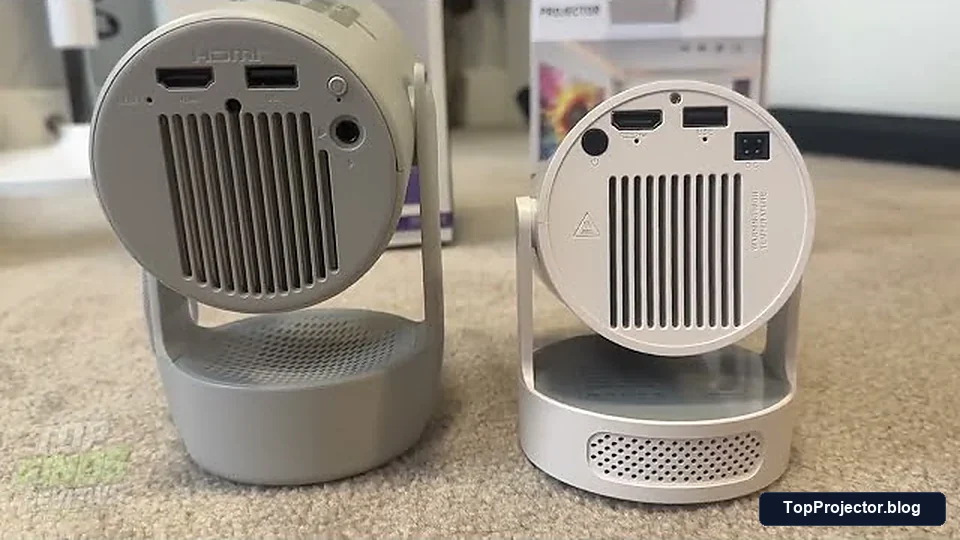
When unfiltered sunlight floods a living space, projected images wash out completely. Achieving high-contrast viewing demands specialized ambient light rejecting screens or total room darkening control.
Understanding this fundamental optical limitation prevents severe buyer remorse in multi-purpose family rooms featuring large, unshaded windows during peak afternoon hours.
Evaluating ambient light rejection requires understanding that mini projectors rely heavily on directional screen fabric, whereas televisions emit direct light to overcome typical daylight living room conditions effortlessly.
- Self-emissive displays dominate bright daytime spaces effortlessly.
- Portable projection requires dedicated light-control window treatments.
- Reflective optical surfaces alter effective viewing cone widths.
Pitch-Black Theater Versus Living Room Daylight
Controlled subterranean home theaters allow compact optical engines to shine brilliantly. For maximum resolution, consider exploring our best 8k projector for home theater guide to preserve high native contrast ratios.
Daylit family rooms destroy shadow detail on reflective surfaces. Without high-gain ALR fabric, portable optical units appear washed out and pale during daytime sports.
- Dedicated darkrooms maximize micro-contrast performance.
- Daylit living areas degrade projected black floor depths.
Black Floor Performance and Shadow Detail Extraction
Achieving deep black levels remains a classic optical challenge. When streaming media, review our how to connect xgimi to laptop tutorial for seamless input signal transmission without lag.
Advanced flat-panel organic pixel technologies completely turn off individual sub-pixels. This engineering capability delivers absolute zero luminance for ink-black cinematic starscapes.
Miniature beamers struggle with dark-scene shadow recovery unless paired with dynamic iris modulation or high-end laser dimming algorithms running during movie playback.
Achieving deep black levels on a projector demands absolute room darkness, because ambient light bounces off white screens, washing out shadows unlike self-emissive OLED panels.
- OLED and local-dimming LED panels achieve near-infinite native contrast.
- Projection systems require pitch-black rooms for true shadow depth.
- Ambient room light directly degrades projected contrast ratios.
Evaluating Native Versus Dynamic Contrast Ratios
Native panel contrast determines how well bright and dark elements coexist onscreen simultaneously. Portable projection units often rely on aggressive dynamic contrast manipulation.
Flat-panel televisions maintain stable native contrast without modulating the backlight aggressively, ensuring predictable grayscale tracking across complex cinematic sequences.
- Dynamic iris systems pump backlight intensity dynamically.
- Native panel integrity dictates true dark-scene fidelity.
Peak Luminance Capabilities and High Dynamic Range Rendering
High dynamic range metadata demands intense peak luminance to render specular highlights realistically. Flat panels easily exceed one thousand nits of localized output.
Compact beamers typically output between three hundred and eight hundred ANSI lumens. Use our ansi lumens room calculator to determine exact screen size limits for proper HDR tracking.
Consequently, flat-panel screens deliver vastly superior HDR punch, reproducing sun glints and metallic reflections with startling physical realism.
Modern televisions easily achieve 1000 nits of peak brightness for HDR content, while portable mini projectors typically peak around 300 ANSI lumens, struggling with dynamic range compression.
- Televisions deliver true specular highlight luminance effortlessly.
- Portable optical engines struggle with wide color gamut HDR mapping.
- Lumen output must be balanced against total screen size.
Understanding ANSI Lumens Versus Panel Nits
Comparing projector lumens to television nits requires calculating total illuminated surface area. A massive projection screen spreads limited light across vast square footage.
Conversely, flat-panel displays concentrate intense photon output into fixed, compact dimensions, maximizing perceived brightness per square inch for daytime viewing.
- Lumens measure total light output across an entire screen.
- Nits quantify localized light emission intensity per square meter.
Geometric Image Scale and Cinematic Immersion
Scaling past eighty inches exposes the unmatched physical dominance of projection optics. Portable units project massive one hundred and twenty-inch canvases that fill your entire visual field.
Purchasing an equivalent flat-panel television involves navigating prohibitive shipping logistics, massive wall-weight limits, and staggering hardware expenditures.
If pure cinematic scale and visceral theatrical immersion drive your purchasing decision, projection technology remains the undisputed king of large-format entertainment.
Scaling an image to 120 inches provides a massive cinematic field of view that fixed-panel televisions cannot match without incurring prohibitive manufacturing costs and transport challenges.
- Projection scales effortlessly from eighty to over one hundred inches.
- Flat panels become exponentially heavier and costlier past eighty-five inches.
- Massive visual angles replicate true commercial cinema experiences.
Calculating Throw Ratios and Room Geometry
Short-throw and ultra-short-throw optical designs permit massive image projection inside compact apartments. You no longer need a dedicated thirty-foot basement to achieve giant screens.
Measuring your exact wall distance ensures proper optical alignment, preventing severe keystone distortion that degrades pixel sharpness and crisp text rendering.
- Ultra-short-throw models sit mere inches from the wall surface.
- Keystone correction software reduces native resolution integrity.
Off-Axis Uniformity and Wide Viewing Angle Integrity
Flat-panel displays utilize advanced IPS or OLED panels to maintain perfect color and luminance fidelity from extreme side seating angles.
Projection screens suffer from directional gain characteristics. Viewers sitting far off-center experience noticeable brightness drop-off and color shifting across the canvas.
Selecting high-gain optical fabric often introduces annoying hot-spotting, creating an overly bright center circle that ruins multi-viewer seating arrangements.
Flat-panel televisions maintain consistent contrast and color accuracy from extreme side angles, whereas projection setups suffer severe brightness drop-off outside the primary viewing cone.
- Flat panels maintain perfect color consistency at extreme side angles.
- High-gain projection screens frequently suffer from noticeable hot-spotting.
- Off-axis seating degrades perceived projector image brightness.
Hot-Spotting and Gain Trade-Offs
High-gain projection surfaces bounce light straight back toward the center sweet spot. Viewers seated on the left or right couches experience a noticeably dimmer picture.
Matte white unity-gain surfaces eliminate hot-spotting entirely, but they require complete darkness to avoid washing out under moderate ambient room lighting.
- Gain fabrics sacrifice viewing angle width for center brightness.
- Unity-gain white screens provide wide, uniform off-axis performance.
Motion Processing, Refresh Rates, and Console Gaming Latency
Modern console gamers demand lightning-fast response times and high refresh rates. Premium televisions routinely feature sub-ten-millisecond input lag and one hundred and twenty hertz support.
Compact projection systems have improved dramatically, but many still suffer from higher latency figures and weaker motion interpolation engines during fast-paced competitive matches.
Competitive first-person shooters feel noticeably snappier and more responsive on flat-panel displays, minimizing frustrating input delay during critical split-second gameplay moments.
Competitive gaming requires low input lag, and while modern TVs boast under 10ms latency at 120Hz, most mini projectors hover around 35ms to 50ms for fast inputs.
- Televisions offer dedicated low-latency gaming modes under ten milliseconds.
- Many portable optical units introduce perceptible controller input lag.
- High refresh rate support remains standard on modern flat panels.
Input Lag and Response Time Benchmarks
Measuring controller-to-screen latency reveals significant performance gaps between display technologies. Fast-twitch gaming requires ultra-low input lag to maintain precise competitive accuracy.
Display panels process complex frame rates instantly, whereas projection image processors frequently add computational overhead that delays fast action sequences.
- Processor overhead increases input lag on portable projectors.
- Flat panels prioritize instant pixel response for competitive gaming.
Installation Complexity, Acoustic Footprint, and Maintenance Realities
Setting up a television is essentially plug-and-play. You unpack the chassis, attach the pedestal stand, and begin streaming your favorite media within minutes.
Mini projectors demand careful manual or automatic focus calibration, keystone alignment, and secure ceiling or tabletop placement to maintain geometric accuracy.
Additionally, projector cooling fans generate audible ambient noise during quiet movie scenes, whereas flat-panel displays operate in total, peaceful silence.
Televisions offer simple plug-and-play tabletop setup, but mini projectors require precise manual focus and keystone calibration, alongside managing internal fan noise during quiet movie scenes.
- Televisions offer straightforward tabletop or wall-mount installation.
- Projectors require precise optical alignment and regular filter cleaning.
- Internal cooling fans produce audible noise during quiet cinematic moments.
Cooling Fan Noise Versus Silent Solid-State Operation
High-output optical engines generate substantial heat requiring active cooling fans. These internal fans can spin audibly during quiet cinematic dialogue scenes.
Flat-panel televisions operate completely passively without moving parts, ensuring a silent home theater environment free of distracting mechanical whirring sounds.
- Active cooling fans generate audible noise under heavy workloads.
- Solid-state flat panels operate in complete silence.
The Definitive Room-by-Room Buying Framework
Choosing between these two distinct technologies depends entirely on your room geometry and lighting control. Bright multi-use living spaces strongly favor flat panels.
Dedicated, dark media rooms or backyard movie nights reward buyers with the breathtaking, room-filling scale of portable projection systems.
Evaluate your ambient light levels, required screen size, and gaming habits carefully before committing your hard-earned budget to either display architecture.
Selecting between display technologies depends on your room lighting profile. Read our in-depth benq ht4550i review to evaluate a top-tier LED optical engine for true 4k cinematic performance.
- Match your display technology to your primary room lighting conditions.
- Prioritize screen scaling for dedicated cinematic theater spaces.
- Select flat panels for versatile, bright family room environments.
Final Decision Matrix for Home Enthusiasts
If you watch daytime television and play competitive video games, purchase a large flat-panel display. You will enjoy superior contrast and zero setup friction.
If your priority is replicating a true commercial cinema experience with massive one hundred-inch visuals in a controlled darkroom, choose a high-quality projection system.
- Flat panels win for daytime versatility and gaming responsiveness.
- Projectors win for maximum cinematic immersion and screen scale.
Frequently Asked Questions
Can a mini projector completely replace a living room television?
Only if you can completely control ambient room lighting with heavy window drapes. In bright daylight, projected images wash out severely compared to self-emissive flat panels.
Why do televisions look much brighter than portable projectors?
Televisions concentrate high-nit output into fixed dimensions, while projectors spread limited lumens across massive screen areas. Peak luminance density heavily favors flat-panel displays.
Are mini projectors suitable for competitive console video gaming?
Most models introduce higher input lag and lower refresh rates than gaming monitors. Dedicated gamers should stick to flat panels for sub-ten-millisecond latency.
Do portable projection systems require a special projection screen?
While you can project onto plain white walls, a dedicated ambient light rejecting screen drastically improves contrast and black levels in lit rooms.
What is the typical lifespan of a modern compact projector?
Modern LED and laser optical engines routinely exceed twenty thousand hours of operational life. This longevity matches or exceeds traditional flat-panel display backlights.