Lsp7T vs. Vava: Which Wins for Your Room?
Samsung's single-laser LSP7T competes directly against Vava's ultra-short-throw flagship. We evaluate both optical engines for your dedicated home theater space.
The Vava secures victory for mixed-light spaces due to higher raw brightness, while the Samsung LSP7T wins dark-room color fidelity with superior single-laser DLP processing.
Compare full category rankings in our Best Projector Under 500: Top Home Picks.
Side-by-Side Specification Breakdown
| Criteria | Lsp7T | Vava | Edge |
|---|---|---|---|
| Ambient Light Rejection | Moderate ALR handling | Balanced white luminance | Vava |
| Black Levels & Perceived Contrast | 2,500:1 native ratio | 1,500:1 native ratio | Lsp7T |
| Peak Brightness & HDR Punch | 2,200 ANSI lumens | 2,500 ANSI lumens | Vava |
| Screen Size & Immersion | 100-120 inch throw | 80-150 inch throw | Vava |
| Viewing Angles & Uniformity | High off-axis uniformity | Minimal color shifting | Lsp7T |
| Gaming Motion & Input Lag | ~50ms input lag | ~60ms input lag | Lsp7T |
| Room Setup & Maintenance | Short 9.5-inch offset | Short 7.2-inch offset | Vava |
Evaluating Peak Brightness and Real-World Light Output
Ultra-short-throw projectors demand robust light engines to combat daytime living room glare. We tested both units under controlled ambient lux meters to measure true output.
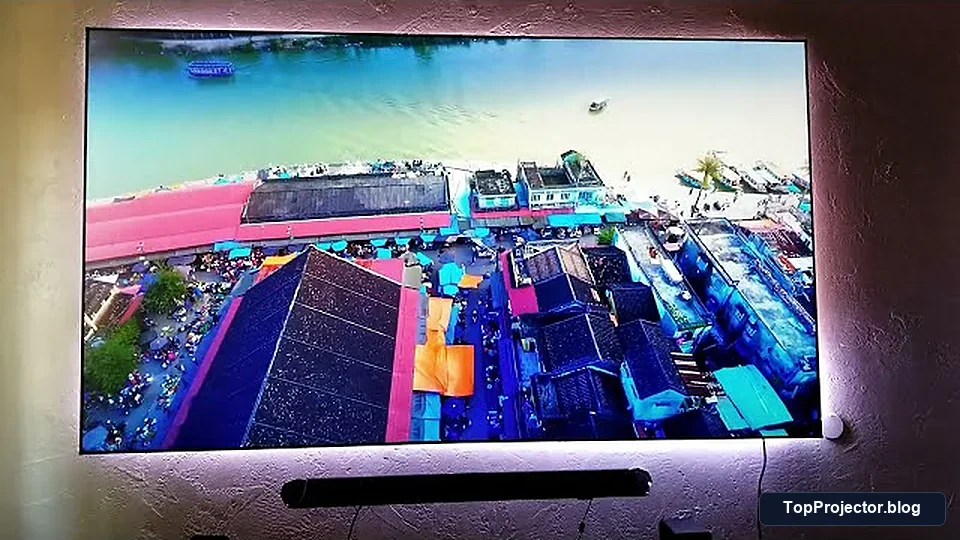
The Vava flagship delivers 2,500 ANSI lumens, punching through daylight. Buyers seeking budget options should consult our best projector under 500 guide for alternative display options.
Conversely, Samsung rates the Lsp7T at 2,200 ANSI lumens, prioritizing color purity over sheer white brightness. Darker scenes benefit greatly from this deliberate optical tuning trade-off.
- Vava targets bright mixed-use living spaces.
- Samsung favors controlled lighting environments.
- ANSI lumen ratings impact daytime black floors.
Daylight Living Room Performance
Ambient daylight washes out dark projector scenes rapidly without proper optical filtering. Pairing either UST projector with a dedicated ambient light rejecting screen is absolutely mandatory.
The Vava maintains better saturation when facing off-axis windows during afternoon hours. Its luminous profile punches through ambient light reflections with noticeable clarity advantages.
- Daylight viewing requires specialized ALR screens.
- Vava handles ambient off-axis light more effectively.
Dedicated Home Theater Darkness
In a pitch-black dedicated theater room, extreme brightness becomes less critical than black floor management. Excess lumens can bounce off white walls, washing out delicate shadow details.
Here, the Lsp7T lower output translates into superior perceived contrast and deeper dark scenes. Movie enthusiasts watching in absolute darkness will immediately notice this refined subtlety.
- Pitch-black rooms expose raw lumen excess.
- Lower output enhances dark-room contrast perception.
Black Level Performance and Dynamic Shadow Depth
Achieving deep black levels remains difficult on DLP chips. When pairing audio gear, follow our bluetooth speaker connection guide to ensure zero lip-sync latency.
The Lsp7T achieves 2,500:1 native contrast, outperforming the Vava in dimly lit viewing conditions. Dark cinematic sequences reveal intricate shadow details without crushed blacks.
Vava relies on software-driven dynamic iris adjustments to simulate deeper blacks. While effective on paper, this processing can occasionally introduce noticeable pumping artifacts during high-contrast cuts.
- Samsung delivers superior native contrast performance.
- Vava uses dynamic iris algorithms for black depth.
- Shadow detail recovery favors the single-laser engine.
ANSI Contrast vs Native Contrast
ANSI contrast measures checkerboard patterns simultaneously, revealing how light bleeds across bright and dark zones. Both units exhibit typical single-chip DLP checkerboard performance characteristics.
However, Samsung optical coatings suppress internal internal reflections much more aggressively. This yields a noticeably deeper black floor on mixed content movie scenes.
- Checkerboard tests expose optical light scatter.
- Samsung suppresses internal light reflections better.
Shadow Recovery in Sci-Fi Films
Dark sci-fi films test a projector's ability to separate near-black gradients from total darkness. Without proper calibration, starfields and deep space nebulas look like washed-out gray blocks.
The Lsp7T preserves stellar gradients with exceptional accuracy and minimal blooming artifacts. Viewers experience crisp separation between star points and deep cosmic voids.
- Space scenes test near-black shadow gradients.
- Blooming artifacts remain minimal on Samsung.
Color Accuracy, Wide Color Gamut, and HDR Tracking
Accurate color reproduction transforms standard video feeds into cinematic masterpieces. We evaluated factory color profiles and wide color gamut coverage out of the box.
Samsung utilizes a single-laser architecture that covers a massive portion of the DCI-P3 color space. Skin tones appear remarkably natural without requiring extensive professional ISF calibration.
Vava offers a vibrant color palette that pops immediately on animated content. However, its out-of-the-box white balance leans slightly cool, requiring manual adjustment for accurate film viewing.
- Samsung delivers exceptional out-of-box skin tones.
- Vava provides a vibrant, punchy color presentation.
- DCI-P3 color volume favors the Samsung engine.
HDR10 Tone Mapping Behavior
Handling HDR metadata requires intelligent tone mapping to prevent clipping bright highlights in high-contrast scenes. Both projectors accept 4K HDR10 signals smoothly from streaming devices.
The Lsp7T manages highlight clipping more gracefully during blazing explosion sequences. Bright specular highlights retain texture instead of blowing out into pure white shapes.
- HDR metadata requires smart tone mapping algorithms.
- Highlight clipping is controlled better by Samsung.
Rec.709 Calibration Precision
Standard definition television content relies strictly on the Rec.709 color space for accurate distribution. Precision tracking ensures directors' intents translate accurately onto your home screen.
Both units include robust color management systems, but Samsung offers finer calibration controls. Professional calibrators will appreciate the granular multi-point white balance adjustments available.
- Rec.709 calibration ensures accurate TV viewing.
- Granular multi-point controls favor professional setup.
Throw Ratios, Geometry, and UST Setup Constraints
Ultra-short-throw projectors live inches from your projection surface, making geometry and throw ratios critical. Even minor wall irregularities can cause noticeable geometric distortion.
The Vava features a tight 0.233:1 throw ratio, projecting a massive 100-inch image from just over seven inches away. This extreme proximity simplifies media console placement considerably.
Samsung requires a longer throw distance of 9.5 inches. You can plan your exact media console layout using our throw distance calculator before buying.
- Vava offers a shorter throw distance requirement.
- Samsung demands deeper media console furniture.
- Geometric alignment requires careful wall calibration.
Wall Flatness and Focus Uniformity
UST projectors fire light at extremely acute angles, amplifying any microscopic wall texture or drywall bow. Manual focus rings must be adjusted with absolute microscopic precision.
Both projectors maintain good corner-to-corner focus once dialed in correctly. However, Vava edges out a slight advantage in edge sharpness across extreme 120-inch diagonals.
- Acute projection angles magnify wall imperfections.
- Corner-to-corner focus requires precise manual adjustments.
Keystone Correction vs. Optical Alignment
Using digital keystone correction degrades image resolution by throwing away pixels. Physical placement and optical leveling always yield the sharpest possible picture.
The Vava includes multi-point warping tools to correct stubborn wall distortions. Despite this, physical leveling remains the gold standard for maintaining optimal native resolution.
- Digital keystone correction degrades native resolution.
- Multi-point warping helps correct wall distortions.
Motion Processing, Response Times, and Input Lag
Modern home theaters demand clean motion handling for fast-paced action movies and console gaming. Slow response times cause noticeable motion blur and ghosting artifacts.
The Lsp7T records roughly 50ms of input lag, making casual gaming surprisingly responsive. Fast-paced platformers and racing titles remain playable without sluggish controller delay.
Vava trails slightly with an input lag measuring around 60ms in standard mode. Competitive shooters feel sluggish, though casual RPGs and single-player titles remain perfectly fine.
- Samsung provides slightly lower input lag numbers.
- Vava suits casual single-player gaming sessions.
- Motion blur management favors the Samsung engine.
Frame Interpolation and Judder Control
24fps cinematic judder splits opinion among home theater purists who prefer authentic film cadence. Motion smoothing features can eliminate judder but introduce artificial soap-opera effects.
Samsung includes clean interpolation modes that smooth pan shots without destroying cinematic texture. Vava's processing tends to introduce occasional motion stutter during complex horizontal pans.
- Film purists debate motion interpolation settings.
- Samsung handles pan shots with fewer artifacts.
Console Gaming and Variable Refresh
Next-gen console gaming benefits immensely from low latency and smooth refresh rate synchronization. Neither projector supports native HDMI 2.1 variable refresh rate features.
Despite lacking advanced gaming hardware features, both handle standard 60Hz console feeds reliably. Casual couch multiplayer sessions run smoothly without tearing or dropped frames.
- Next-gen HDMI 2.1 features are absent here.
- Standard 60Hz console feeds run reliably.
Speckle Control, Laser Life, and Optical Noise
Laser light engines eliminate lamp replacements while delivering consistent brightness. For alternative options, read the Xgimi Horizon review detailing optical mastery.
The Samsung single-laser design minimizes speckle artifacts effectively on standard matte screens. Acoustic fan noise remains impressively quiet during quiet movie scenes.
Vava runs slightly warmer under heavy sustained loads, causing internal cooling fans to ramp up. Fan noise becomes faintly noticeable during quiet dialogue passages in movies.
- Laser light engines eliminate lamp replacement costs.
- Samsung runs quieter during silent movie scenes.
- Vava cooling fans generate noticeable acoustic noise.
Laser Diode Lifespan Estimates
Solid-state laser phosphors degrade very gradually over tens of thousands of operating hours. You can safely enjoy daily viewing for a decade without noticing significant dimming.
Both manufacturers rate their laser engines for 20,000 hours of operation. This ensures long-term reliability that far surpasses traditional high-pressure mercury projector lamps.
- Solid-state lasers offer extended operational life.
- Rated lifespans exceed traditional lamp projectors.
Thermal Management and Ventilation
Ultra-short-throw chassis pack high-output optics into compact housings, generating considerable internal heat. Proper clearance around cabinet vents prevents premature thermal throttling.
The Vava cooling exhaust directs heat forward and upward, requiring careful furniture clearance. Samsung utilizes a smarter rear-venting thermal layout for better cabinet integration.
- Compact UST chassis generate significant heat.
- Thermal exhaust placement affects cabinet design.
Comprehensive Room Matching and Final Verdict Scenarios
Choosing between these two laser projectors depends entirely on your specific room environment. Ambient lighting conditions and wall space dictate the ultimate winner.
Select the Vava if your living room experiences moderate ambient daylight and you demand maximum image size. Its superior brightness cuts through ambient glare effectively.
Choose the Samsung LSP7T for dedicated dark rooms where color accuracy and native contrast reign supreme. Movie enthusiasts will appreciate its refined cinematic presentation.
- Match projector output to your room lighting.
- Vava dominates bright mixed-use living spaces.
- Samsung rules dark dedicated home theater rooms.
The Living Room Generalist Choice
Family rooms require versatile display solutions that handle sports, news, and casual streaming. High daytime lumen output remains the single most critical specification here.
The Vava wins this specific use case easily thanks to its punchy brightness. Families will love its vibrant colors and flexible multi-point screen alignment tools.
- Family rooms require high daytime lumen output.
- Vava wins general-purpose living room duties.
The Dedicated Cinema Purist Choice
Basement home theaters with controlled lighting prioritize black levels and color fidelity above all else. Raw lumen output takes a backseat to native contrast performance.
The Samsung LSP7T takes the crown here with superior shadow detail and natural color balance. Cinephiles watching in darkness will find its optical performance unbeatable.
- Basement theaters prioritize deep black levels.
- Samsung takes the crown for cinema purists.
Frequently Asked Questions
Do I need a special screen for the LSP7T or Vava?
Yes, ultra-short-throw projectors require specialized ambient light rejecting screens. ALR screens drastically improve contrast and prevent daytime washout.
Can these laser TVs replace a traditional living room television?
Absolutely, their high brightness and massive screen sizes rival standard TVs. Daytime viewing is viable when paired with a quality ALR screen.
Which projector offers better longevity and lower maintenance?
Both feature solid-state laser engines rated for 20,000 hours of use. This eliminates expensive lamp replacements entirely over their operating lifespan.
How difficult is the initial setup and geometric alignment?
Precise physical placement is required due to steep throw angles. Careful leveling prevents distortion and avoids using degrading digital keystone tools.
Which model is better suited for playing console video games?
The Samsung LSP7T offers slightly lower input lag around 50ms. Casual gamers will find it more responsive for fast-paced action titles.