Long Throw vs. Short Throw Projector: Which Wins for Your Room?
Choosing between long throw and short throw projectors involves balancing room geometry against ambient light performance. Your ultimate optical layout dictates black levels and viewing immersion.
Traditional long throw units dominate dedicated dark theaters with superior native contrast, while short throw systems conquer bright living rooms using specialized ambient light rejection screens.
Compare full category rankings in our Best Projector For Bedroom: Top Picks & Setup Guide.
Side-by-Side Specification Breakdown
| Criteria | Long Throw | Short Throw Projector | Edge |
|---|---|---|---|
| Ambient Light Rejection | Requires complete darkness or pricey ALR paint | Exceptional pairing with specialized Fresnel ALR screens | Short Throw |
| Black Levels & Perceived Contrast | Superior native ANSI contrast in bat-caves | Prurient hotspots can reduce shadow depth slightly | Long Throw |
| Peak Brightness & HDR Punch | High lumen counts scale efficiently over distance | Maintains punchy highlights despite high ambient light | Short Throw |
| Screen Size & Immersion | Easily achieves 150-inch diagonals with cheap lenses | Typically capped at 100 to 120 inches max | Long Throw |
| Viewing Angles & Uniformity | Flawless corner-to-corner focus and uniform brightness | Prone to laser speckle and edge warping issues | Long Throw |
| Gaming Motion & Input Lag | Features ultra-low 8ms input lag on flagship lasers | Lag ranges between 16ms and 35ms depending on processing | Long Throw |
| Room Setup & Maintenance | Demands complex ceiling mounts and precise alignment | Plugs in on media credenzas with zero ceiling wiring | Short Throw |
Optical Throw Geometries and Living Room Real Estate
Traditional long throw projectors require substantial distance from the screen surface, demanding rooms with at least twelve feet of clearance to achieve a massive cinematic image.
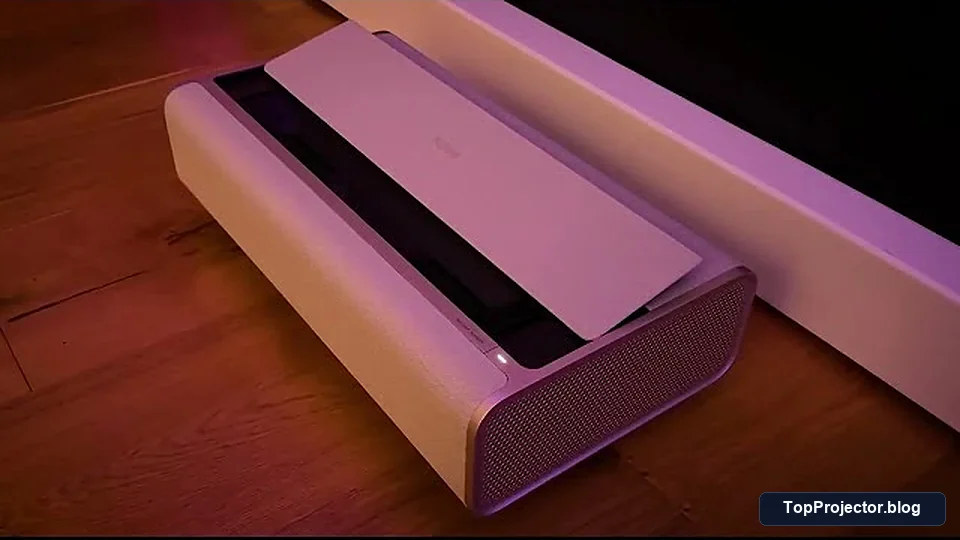
Conversely, ultra-short throw models sit mere inches from the wall. Verify exact placement using our helpful Epson throw distance calculator to achieve optimal optical alignment.
Standard long-throw setups require a 1.5:1 to 2.0:1 throw ratio, demanding deep rooms where seating positions comfortably align behind the central optical axis without casting annoying shadows on the wall.
- Long throw needs dedicated ceiling mounts and clear optical paths.
- Short throw replaces standard television stands with credenza placement.
- Throw ratios under 0.25:1 define ultra-short throw engineering marvels.
- Always measure precise mounting depth from the absolute front lens element, not the chassis rear, to prevent unexpected positioning errors during complex multi-point ceiling installations.
- Account for severe high-speed HDMI cable bend radiuses directly behind flush-mounted units when calculating precise rear wall clearances inside tight dedicated home theater enclosures.
Managing Physical Obstacles in Custom Spaces
Ceiling fans and hanging light fixtures can disrupt long throw light paths, creating annoying shadows across your projected canvas. Short throw units eliminate this entirely.
Living room traffic patterns favor short throw setups because pets and children cannot walk between the lens and the screen, preserving uninterrupted family movie nights.
- Eliminate walking path disruptions with credenza placement.
- Protect expensive glass optics from accidental physical contact.
Ultra-Short Throw Mirror Folding Physics
UST projectors utilize complex folded optical paths with asymmetric mirrors, creating steep projection angles that demand absolute surface flatness to avoid severe geometric warping.
- Even a tiny one millimeter wall wave creates highly noticeable geometric image distortion across ultra-wide cinema scopes when using standard table-mounted ultra-short throw hardware configurations.
Ambient Light Rejection and Daytime Performance Physics
Battling daytime illumination requires sophisticated optical matching, making ambient light rejection essential for your setup. Check out our best projector for bedroom options for dark-room performance.
Short throw laser TVs leverage microscopic sawtooth ridges that actively reject overhead ceiling light while reflecting ultra-sharp images downward toward seated viewers.
Pairing a short-throw projector with a specialized ceiling-light rejecting screen drastically improves daytime contrast by absorbing overhead illumination while actively reflecting the ultra-steep upward projection cone.
- Overhead light rejection filters save daytime viewing sessions.
- Standard matte white screens fail miserably in lit rooms.
- High gain ratings help punch through stubborn ambient glare.
- Standard white matte walls completely destroy daytime perceived contrast ratios by scattering ambient room light directly back toward viewers sitting in normal brightly lit living environments.
- Advanced micro-structured optical filters embedded within premium ALR surfaces require exact vertical alignment to successfully block off-axis ceiling illumination without causing noticeable destructive hot-spotting.
Pitch-Black Theater Versus Living Room Daylight
Dedicated basements allow long throw projectors to shine by utilizing velvet-wrapped walls and high-contrast gray screens to maximize ANSI contrast ratios without interference.
Bright family rooms demand specialized UST ALR screens featuring negative 0.6 gain to absorb ambient light sources from the sides while maintaining intense brightness.
- Basement theaters maximize dark-room cinematic performance.
- Daylight living rooms require directional light-rejecting materials.
Angular Versus Fresnel ALR Architecture
Fresnel screens use curved microscopic lens layers to reject light from all sides, making them ideal partners for ultra-short throw projectors operating in heavily lit multipurpose living spaces.
- Traditional angular reflective materials perform much better in standard long-throw configurations where ambient light originates primarily from side windows rather than harsh overhead architectural downlights.
Native Black Floors, Contrast Ratios, and Shadow Detail
Achieving deep black levels depends heavily on optical throw distance and room reflections. Run your numbers through our ANSI lumens room calculator to maintain optimal optical contrast.
Long throw systems installed in optimized optical bunkers maintain superior native black floors, revealing intricate shadow details in dark cinematic sequences.
Achieving deep black levels in a dark room depends heavily on native contrast ratios rather than dynamic iris manipulation, which often introduces distracting pumping artifacts during dark cinematic sequences.
- Dark room cavities preserve deep shadow performance.
- Stray light reflection washes out subtle contrast gradients.
- Long-throw laser engines with dual modulation can achieve phenomenal sequential contrast exceeding 50,000:1, rendering rich shadow detail that standard budget lamps simply cannot touch.
- Ultra-short throw light paths are inherently more vulnerable to internal optical stray light reflections, slightly elevating the native black floor compared to premium ceiling-mounted long-throw units.
Preserving Shadow Depth in Complex Scenes
Nighttime combat scenes and deep space exploration demand exceptional native contrast ratios. Long throw DLP and LCoS engines handle dark palettes exceptionally well.
Short throw projectors sometimes suffer from slight optical distortion artifacts across extreme angles, marginally impacting absolute black uniformity in dark movie scenes.
- LCoS technology excels at maintaining deep black floors.
- Check dynamic iris settings to boost perceived contrast.
Dynamic Laser Dimming Performance Metrics
Modern solid-state illumination engines allow instantaneous laser power modulation, dropping output near zero during fade-to-black scenes to enhance perceived ansi contrast ratios dramatically.
- Aggressive gamma tracking algorithms must be calibrated correctly to prevent crushing critical near-black shadow gradients into pure digital noise during high-contrast movie master playback sessions.
Peak Brightness, HDR Specular Highlights, and Color Gamut
Modern laser engines deliver staggering lumen counts, but optical delivery mechanisms dictate how that brightness translates to realistic HDR specular highlights.
Long throw laser projectors push massive lumen power across expansive throw distances, lighting up massive 150-inch screens with accurate wide color gamuts.
Accurate HDR tone mapping requires a healthy balance of high peak lumens and wide color volume, ensuring bright specular highlights pop without washing out saturated primary color coordinates.
- Laser phosphor engines maintain brightness over thousands of hours.
- HDR tone mapping requires robust onboard processing power.
- Reaching the full DCI-P3 color space usually requires engaging internal cinema filters that sacrifice roughly twenty to thirty percent of total calibrated projector lumen output.
- Laser phosphor color wheels utilizing secondary yellow segments can deliver massive white brightness boosts, though sometimes at the direct expense of rich, saturated red secondary tones.
Handling Wide Color Gamut and Rec.2020 Coverage
Achieving cinematic color accuracy requires high-grade optical glass and precise phosphor wheel alignment to hit targeted Rec.2020 color space coverage.
Triple-laser short throw engines achieve stunning color saturation without losing vital white brightness, outperforming older lamp-based long throw alternatives easily.
- Triple-laser architectures eliminate physical color wheels.
- Wide color filters reduce total lumen output noticeably.
BT.2020 Color Filter Deployment Trade-offs
Wide color filters physically swing into the optical path to expand color volume, requiring robust internal scalers to remap HDR metadata effectively within limited lumen budgets.
- Dedicated home theater enthusiasts typically prefer trading maximum peak brightness for expanded color saturation when projecting movies inside completely light-controlled reference dark rooms.
Screen Uniformity, Geometric Distortion, and Keystone Trade-offs
Aligning optics perfectly requires careful attention to geometric distortion and focus uniformity across every corner of your viewing surface.
Long throw projectors offer forgiving geometry with minimal corner blurring, making manual focus adjustments simple even on massive custom screens.
Relying on digital keystone correction degrades optical resolution by throwing away valuable pixel real estate, making lens shift capabilities mandatory for pristine long-throw installations.
- Corner focus accuracy defines high-end optical glass lenses.
- Avoid digital keystone correction to prevent resolution loss.
- Optical focus uniformity across the entire projection screen remains a significant engineering challenge, particularly for complex ultra-short throw glass lenses operating at extreme incident angles.
- Convenient powered lens memories allow seamless aspect ratio changes from widescreen movies to scope presentations without manually readjusting physical zoom or mechanical focus rings.
Overcoming Ultra-Short Throw Alignment Challenges
Because ultra-short throw lenses project at extreme angles, even a millimeter of wall unevenness can introduce noticeable geometric distortion into your image.
Manufacturers include multi-point electronic warping tools to square the image, though native optical alignment remains vastly superior for crisp text.
- Use rigid fixed-frame screens for ultra-short throw setups.
- Avoid manual wall painting for short throw projection surfaces.
Minimizing Lens Shift Optical Artifacts
Pushing mechanical lens shift to its absolute maximum limit introduces subtle chromatic aberration and edge softness, meaning centered projector placement always yields superior optical sharpness.
- Always verify that your heavy-duty ceiling mount provides robust multi-axis micro-adjustments to eliminate barrel distortion before locking down final screen alignment coordinates.
Input Latency, High Refresh Rates, and Competitive Gaming
Competitive gamers require blazing-fast response times and minimal input lag to ensure split-second reactions translate accurately on screen.
Flagship long throw gaming projectors achieve an astonishing 8ms input lag at 240Hz, rivaling dedicated desktop gaming monitors for fluid motion.
Modern gaming projectors achieve remarkably low input lag figures under 15 milliseconds at native 4K/60Hz, ensuring instant visual feedback during fast-paced competitive multiplayer titles.
- Low input lag prevents frustrating controller delay during matches.
- High refresh rate support enhances fast-paced shooter titles.
- Support for 240Hz refresh rates at 1080p resolution drastically reduces motion blur and input response times for esports enthusiasts using high-end gaming personal computers.
- Activating advanced heavy image processing features like frame interpolation or dynamic contrast enhancements frequently introduces unacceptable input latency spikes during responsive gaming sessions.
Console Gaming Immersion in Compact Spaces
Short throw units have evolved rapidly, now offering dedicated gaming modes that reduce latency down to 16ms for smooth console experiences.
The immersive scale of a giant projected image transforms role-playing games, though fast-paced esports titles favor the ultra-low latency of long throw models.
- Check HDMI 2.1 support for modern console compatibility.
- Auto low latency modes simplify display settings adjustments.
HDMI 2.1 Bandwidth and VRR Implementation
Equipped with full-bandwidth HDMI 2.1 ports, current high-end projectors support variable refresh rate technologies to completely eliminate screen tearing during fluctuating frame rate gameplay.
- Always confirm that dedicated low latency game modes bypass non-essential video processing pipelines without sacrificing critical color accuracy or vital contrast performance metrics.
Final Environmental Buying Verdict and Room Matching
Choosing the right optical architecture depends entirely on your room architecture, ambient light control, and long-term aesthetic goals.
Invest in a long throw system if you have a dedicated basement theater; choose a short throw setup for a sleek living room entertainment center.
Choosing between throw styles ultimately hinges on balancing room acoustics, available square footage, and ambient light control to achieve the ultimate home theater experience.
- Dedicated rooms favor long throw contrast and flexibility.
- Living rooms thrive on short throw daytime practicality.
- Select a traditional long-throw projector when designing a dedicated basement theater featuring dark velvet walls, controlled lighting, and maximum screen size flexibility.
- Opt for a short-throw or UST model when outfitting a multipurpose living room where preserving floor space and combating daytime ambient light remain top priorities.
Matching Hardware Specifications to Real-World Layouts
Evaluate your ceiling height, seating distance, and window placement before committing to expensive projector investments or specialized screens.
Balancing optical throw ratios ensures you achieve maximum cinematic immersion without compromising on brightness, contrast, or everyday living convenience.
- Measure exact throw distances prior to purchasing screens.
- Consult professional installation guides for optimal results.
Total Cost of Ownership and Maintenance
Modern solid-state laser engines eliminate costly lamp replacements while delivering stable light output over 20,000 hours of usage. Read our detailed Epson LS12000 review for performance insights.
- Factor specialized ALR screen investments directly into your initial hardware budget, as pairing premium projectors with inadequate screen surfaces severely limits overall optical performance.
Frequently Asked Questions
Can I use a normal screen with a short throw projector?
You should never pair an ultra-short throw projector with a standard flat white screen because light will wash out entirely. Always choose an ambient light rejecting screen specifically engineered to absorb overhead rays.
Why do long throw projectors offer better native contrast?
Long throw systems operate within controlled optical distances that minimize internal scattering and stray reflection artifacts. This geometry allows superior native black floors compared to steep-angle short throw lenses.
Do short throw projectors make a lot of fan noise?
Modern laser short throw projectors feature advanced cooling systems and quiet fans that operate below baseline living room noise levels. However, high brightness modes can increase internal fan speeds noticeably during intense scenes.
Is installation harder for long throw or short throw?
Long throw units require precise ceiling measurements, mount alignment, and cable management across the room. Short throw projectors offer plug-and-play simplicity right from your existing media furniture credenza.
Which projector type is better for casual daytime sports viewing?
Short throw laser projectors paired with specialized ALR screens dominate daytime sports viewing environments. Their directional light rejection properties maintain vibrant color saturation even with open living room windows.