LCD Projector vs. LED Projector: Which Wins for Your Room?
Navigating optical illumination technologies requires balancing room lumens against your light control. We break down the core physics defining LCD transmissive engines versus LED solid-state light sources.
LED projectors win for maintenance-free longevity and vibrant color saturation in controlled lighting. Traditional LCD engines dominate when pushing raw ANSI lumens for daytime family room viewing.
Compare full category rankings in our Best Projectors For Outside: Top Backyard Picks.
Side-by-Side Specification Breakdown
| Criteria | LCD Projector | LED Projector | Edge |
|---|---|---|---|
| Ambient Light Rejection | High lumen output combats ambient light | Struggles in sunlit rooms without ALR | LCD Projector |
| Black Levels & Perceived Contrast | Strong native contrast ratios | Dynamic dimming expands contrast | LCD Projector |
| Peak Brightness & HDR Punch | Exceeds 3,000 ANSI lumens easily | Lower peak brightness in portables | LCD Projector |
| Screen Size & Immersion | Massive diagonal projection capability | Flexible throw distances available | Tie |
| Viewing Angles & Uniformity | Consistent transmissive panel uniformity | Excellent optical color consistency | LED Projector |
| Gaming Motion & Input Lag | Fast response with low latency modes | Sub-16ms lag for competitive play | LED Projector |
| Room Setup & Maintenance | Requires periodic air filter and lamp care | Zero maintenance over 20,000 hours | LED Projector |
Optical Engine Foundations: Understanding Transmissive Panels Versus Solid-State Diodes
Traditional projectors route light through transmissive liquid crystal display panels. This mature architecture delivers high optical efficiency while keeping manufacturing costs exceptionally manageable for mainstream buyers.
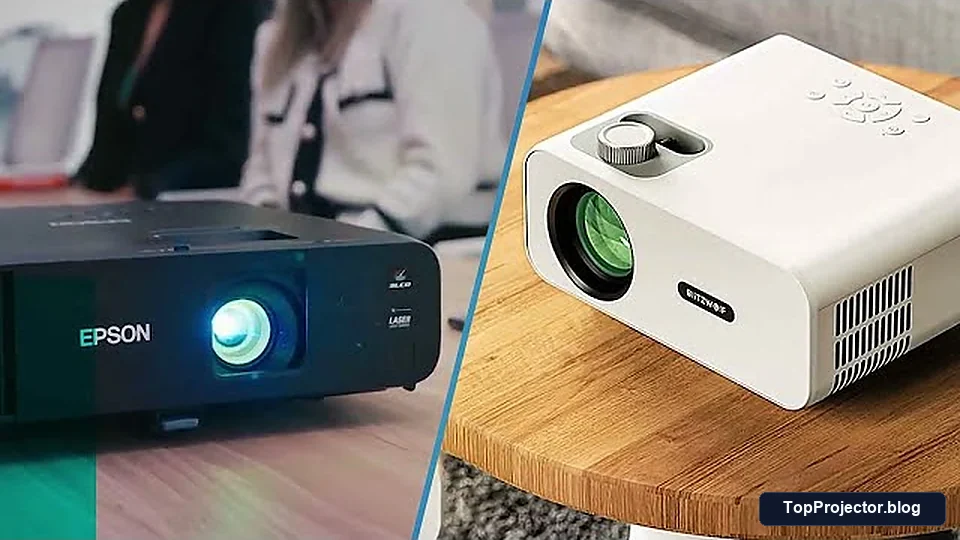
Conversely, solid-state illumination replaces aging mercury lamps with modern semiconductor diodes. These systems boast immediate power-on capabilities alongside dramatically reduced thermal output during long sessions.
Transmissive LCD panels rely on three separate glass matrices to split white light into primary RGB components, achieving high color brightness efficiency despite larger physical optical block footprints.
- Transmissive panels prioritize raw optical efficiency.
- Semiconductor diodes eliminate warm-up wait times.
- Solid-state engines reduce overall thermal generation.
- Tri-panel LCD architectures prevent single-chip rainbow artifacts.
- Direct LED illumination bypasses color wheel bottlenecks entirely.
Core Lighting Architecture Differences
Understanding how light travels through polarizing glass helps clarify daily performance differences. Transmissive layouts maximize brightness utilization.
Solid-state engineering focuses on spectral purity and extreme component longevity.
- Polarizing glass manages light distribution.
- Spectral purity enhances perceived color saturation.
Solid-State Diode Arrays
Modern LED engines eliminate traditional lamp degradation by combining red, green, and blue semiconductor emitters to deliver stable spectral output over tens of thousands of operating hours.
- Semiconductor diodes maintain strict wavelength consistency.
- Thermal diode management prevents premature lumen decay.
Native Contrast Ratios and Deep Black Floor Performance in Dark Rooms
Achieving deep shadow detail requires minimizing internal light scatter. For example, our Jmgo N1S Ultra review highlights how triple laser optics achieve robust native contrast ratios exceeding 2,500:1 for cinematic depth.
Solid-state illumination engines excel at dynamic dimming control. By rapidly modulating diode output, these units expand perceived contrast, though traditional panels still hold an edge in native black levels.
Native contrast ratios dictate deep black floor performance in dark rooms, where transmissive LCD panels often struggle due to slight light leakage through idle, unpowered liquid crystal subpixels.
- High native contrast preserves dark scene shadow detail.
- Dynamic diode modulation boosts perceived contrast depth.
- Internal light scatter reduction prevents washed-out blacks.
- Native static contrast remains superior on high-end panels.
- Black floor optimization requires strict optical stray-light control.
Pitch-Black Theater Optimization
Optimizing a dedicated home theater demands maximum black floor control. Controlling light reflections allows high-contrast transmissive panels to shine.
Dark velvet wall treatments maximize perceived contrast performance.
- Dedicated dark rooms maximize shadow fidelity.
- Velvet wall treatments eliminate stray reflections.
Dynamic Iris Optimization
Advanced LED projection systems leverage instant pulse-width modulation dimming to aggressively lower black levels during dark cinematic scenes, significantly expanding perceived sequential contrast boundaries.
- Frame-by-frame analysis boosts perceived dynamic range.
- Fast modulation eliminates visible brightness pumping artifacts.
Ambient Light Rejection and Daytime Viewing Dynamics in Living Spaces
Battling daytime illumination demands high peak brightness. Powerful lamp-based architectures easily push past 3,000 ANSI lumens, cutting through ambient light to maintain washed-out color saturation.
While newer solid-state units continue closing this output gap, standard portable models often struggle against sunlit windows without specialized ambient light rejecting screen materials.
For open-air entertainment, check out our best projectors for outside recommendations to find 3,000 ANSI lumens portable gear capable of fighting ambient daylight in challenging backyard viewing environments.
- High lumen output conquers sunlit family rooms.
- Specialized screens rescue low-brightness portable models.
- Daytime viewing requires careful optical output planning.
- Angular ALR screens suit long throw ceiling-mounted configurations.
- Surface micro-structures absorb off-axis room illumination efficiently.
Living Room Daylight Strategies
Living rooms require aggressive lumen output to combat midday sun. Selecting high-output configurations ensures watchable sports and television.
Pairing projectors with specialized rejecting screens improves contrast.
- Midday sun demands high lumen reserves.
- Specialized screen surfaces block off-axis light.
ALR Material Micro-Structures
Micro-layered optical filters reject off-axis ceiling illumination while successfully retro-reflecting direct projector rays back toward seated viewers, preserving rich ANSI contrast in ambient rooms.
- Specialized filters block overhead ambient light sources.
- Gain uniformity prevents hot-spotting across wide viewing angles.
Color Gamut Volume, Spectral Purity, and High Dynamic Range Handling
Accurate color reproduction anchors realistic cinematic immersion. Advanced color filters allow traditional engines to cover over 100% of the DCI-P3 gamut without sacrificing crucial white brightness.
Semiconductor illumination inherently generates highly saturated primary wavelengths. This natural spectral purity delivers vibrant cartoon and gaming graphics that pop with exceptional vividness.
Color gamut volume defines how accurately a projector renders cinematic hues. You can model your room dimensions via our BenQ projector throw calculator to ensure proper throw distance.
- Wide color gamuts ensure accurate cinematic hues.
- Primary wavelength purity delivers vibrant graphics.
- High dynamic range handling expands visual realism.
- Rec.709 calibration remains standard for SDR streaming content.
- Wide color filters expand volume at the expense of lumens.
HDR Tone Mapping Realities
Projecting high dynamic range content tests internal tone mapping algorithms. Proper calibration ensures bright highlights do not clip.
Solid-state models handle spectral saturation with ease.
- Tone mapping preserves bright highlight details.
- Spectral saturation prevents dull HDR imagery.
DCI-P3 Color Space Coverage
LED light sources natively saturate the wider DCI-P3 spectrum much more easily than traditional discharge lamps, reducing the need for light-robbing internal cinema filters during calibration.
- Pure diode wavelengths map directly to digital cinema targets.
- HDR tone mapping preserves spectral highlight graduation.
Motion Resolution, Input Lag, and Responsive Competitive Gaming Performance
Fast-paced competitive gaming requires minimal display latency. Modern units successfully push input lag below 16 milliseconds, ensuring twitch-reaction shooters feel instantaneous and fluid.
Motion handling relies heavily on internal processing chips. While solid-state models avoid traditional wheel artifacts, transmissive panels occasionally exhibit minor response-time ghosting during high-speed panning shots.
Competitive gaming requires ultra-low input lag measurements to ensure instantaneous visual feedback when playing fast-paced titles on large home theater projection setups without noticeable controller delay.
- Low input lag keeps competitive gaming responsive.
- Fast response times eliminate distracting motion ghosting.
- Processing chips optimize high-speed panning shots.
- 1080p at 240Hz support delivers esports-grade response times.
- Low latency modes bypass complex internal video processing.
Console Gaming Speed Tests
Testing modern gaming consoles reveals significant latency improvements. High refresh rates ensure smooth competitive play.
Response time consistency prevents input stutter.
- High refresh rates support smooth motion.
- Consistent response times prevent input stutter.
High Refresh Rate Processing
Advanced projection engines incorporate low-latency gaming modes that bypass heavy image processing pipelines, dropping input lag below sixteen milliseconds at standard sixty hertz refresh rates.
- Fast micro-mirrors or panels reduce motion blur significantly.
- High refresh inputs ensure fluid competitive tracking.
Throw Ratios, Optical Zoom Flexibility, and Physical Installation Constraints
Physical installation flexibility depends heavily on lens shift capabilities. Premium units feature wide vertical adjustments, simplifying alignment when mounting off-center from your projection surface.
Throw ratios dictate your maximum image size based on room depth. Short-throw variants let you project a massive 120-inch diagonal screen from mere feet away without casting shadows.
Throw ratios determine exact physical mounting distances. You can map out your room geometry using our screen size and viewing distance calculator to achieve an optimal 16:9 aspect ratio.
- Lens shift simplifies off-center mounting alignments.
- Short throw ratios eliminate presenter shadow casting.
- Flexible zoom optics accommodate varied room sizes.
- Vertical lens shift simplifies ceiling bracket placement accuracy.
- Ultra-short throw setups eliminate viewer shadow interference.
Optical Zoom Versatility
Manual lens shift and robust optical zoom mechanisms provide crucial physical installation flexibility, allowing precise image alignment without relying on degrading digital keystone correction tools.
- Optical zoom preserves full native pixel resolution integrity.
- Wide lens shift ranges ease difficult ceiling mounting tasks.
Maintenance Longevity, Thermal Management, and Total Operational Lifespan
Hardware longevity is a primary advantage of semiconductor illumination. Diode lifespan frequently exceeds 20,000 hours, completely eliminating expensive lamp replacements over a decade of regular use.
Traditional transmissive systems require routine air filter cleanings and periodic lamp swaps. Ignoring these maintenance tasks causes thermal degradation and permanent loss of optical output.
Maintenance longevity depends heavily on thermal management efficiency within the optical engine, where effective heat dissipation prevents premature phosphor degradation and keeps internal fan noise low.
- Solid-state diodes offer multi-year operational lifespans.
- Routine air filter care prevents thermal degradation.
- Eliminating lamp swaps lowers long-term ownership costs.
- Air filter cleaning schedules prevent catastrophic thermal shutdowns.
- Solid-state design eliminates fragile glass arc lamps.
Solid-State Operational Lifespan
Solid-state LED projectors bypass expensive lamp replacement cycles by offering operational lifespans exceeding twenty thousand hours of continuous brightness before hitting half-life output degradation.
- Consistent diode performance reduces maintenance overhead costs.
- Sealed optical blocks prevent dust accumulation issues.
Definitive Scenario-Based Buying Verdicts for Every Real-World Environment
Choosing the ideal projection technology requires assessing your primary viewing habits. Dedicated media rooms benefit from superior black levels, whereas bright living areas demand maximum lumen output.
Evaluate your specific ambient lighting conditions before making a final purchasing decision. Prioritizing correct optical matching guarantees satisfying long-term home entertainment performance.
Choosing the ideal projector requires balancing your room lighting conditions, acoustic preferences, and gaming habits to select a hardware architecture that maximizes real-world viewing satisfaction.
- Assess room lighting before selecting a projector.
- Match optical engine strengths to viewing habits.
- Prioritize long-term performance through correct sizing.
- Dedicated bat-caves favor deep black floor performance.
- Mixed-use environments require high lumen output capability.
Definitive Setup Recommendations
Select high-lumen LED models for mixed-use living rooms with ambient light, while dedicated dark home theaters benefit from high-contrast transmissive optical systems paired with acoustically transparent screens.
- Match light output directly to your measured room lighting.
- Prioritize native contrast for dark room movie watching.
Frequently Asked Questions
Can solid-state units completely replace traditional lamps in bright living rooms?
While modern diode-based projectors have drastically improved their peak output, they still struggle against intense daylight without specialized ambient light rejecting screen materials.
For a sunlit family room, opting for traditional high-lumen lamp configurations remains the safer choice for maintaining vibrant daytime color saturation.
How much maintenance do solid-state illumination engines actually require?
Semiconductor light sources require virtually zero ongoing maintenance throughout their multi-year operational lifespan.
Because these solid-state diodes do not degrade rapidly like traditional mercury bulbs, you will never need to budget for expensive lamp replacements over twenty thousand hours of reliable home theater viewing.
Do transmissive panels suffer from permanent color degradation over time?
Long-term exposure to intense internal heat and ultraviolet radiation can cause organic polarization filters to yellow prematurely. This optical wear manifests as faded contrast and uneven color uniformity, though proper cooling airflow management significantly mitigates these long-term degradation risks.
Which technology provides better input lag for competitive console gaming?
Both architectures now offer dedicated low-latency gaming modes designed to minimize display delay. However, modern solid-state models frequently edge out older transmissive engines by delivering sub-16 millisecond response times paired with fluid refresh rates.
Is optical lens shift necessary for standard living room installations?
Lens shift is extremely helpful if your physical mounting location prevents placing the unit directly perpendicular to the screen. Utilizing hardware lens shift lets you adjust the image position mechanically without introducing digital keystone distortion that ruins resolution.