Laser vs. 3Lcd Projector: Which Wins for Your Room?
Laser illumination delivers instant-on solid-state reliability and wide color volumes, whereas 3LCD architectures leverage three distinct transmissive panels to eliminate rainbow artifacts while maximizing color brightness across expansive home cinema screens.
Choose a laser projector for maintenance-free longevity and superior high-contrast HDR punch in controlled environments. Select a 3LCD projector if you prioritize intense color brightness and zero rainbow artifacts in ambient spaces.
Compare full category rankings in our Best Ceiling Mount Projector For Home Theater: Top Picks.
Side-by-Side Specification Breakdown
| Criteria | Laser | 3Lcd Projector | Edge |
|---|---|---|---|
| Ambient Light Rejection | Exceptional via high peak ANSI lumens output | Moderate relying on color brightness scaling | Laser |
| Black Levels & Perceived Contrast | Superior dynamic dimming and deep black floors | Lighter shadow detail due to transmissive design | Laser |
| Peak Brightness & HDR Punch | Consistent solid-state output up to 3000 lumens | High white and color brightness parity | Laser |
| Screen Size & Immersion | Flexible throw ratios for screens past 150 inches | Standard optical zoom ranges for media rooms | Laser |
| Viewing Angles & Uniformity | Excellent optical path luminance distribution | Balanced RGB panel alignment consistency | 3LCD |
| Gaming Motion & Input Lag | Sub-15ms latency with ultra-fast solid-state panels | Reliable 60Hz motion handling with low latency | Laser |
| Room Setup & Maintenance | Lamp-free lifespan exceeding 20,000 hours | Regular filter cleaning and periodic lamp swaps | Laser |
Optical Illuminant Engineering: Solid-State Lasers Versus Transmissive Panels
Modern projection optics rely heavily on the light source architecture. Laser diodes provide instantaneous illumination without warm-up delays, maintaining consistent output throughout a lifespan exceeding 20,000 hours of critical viewing.
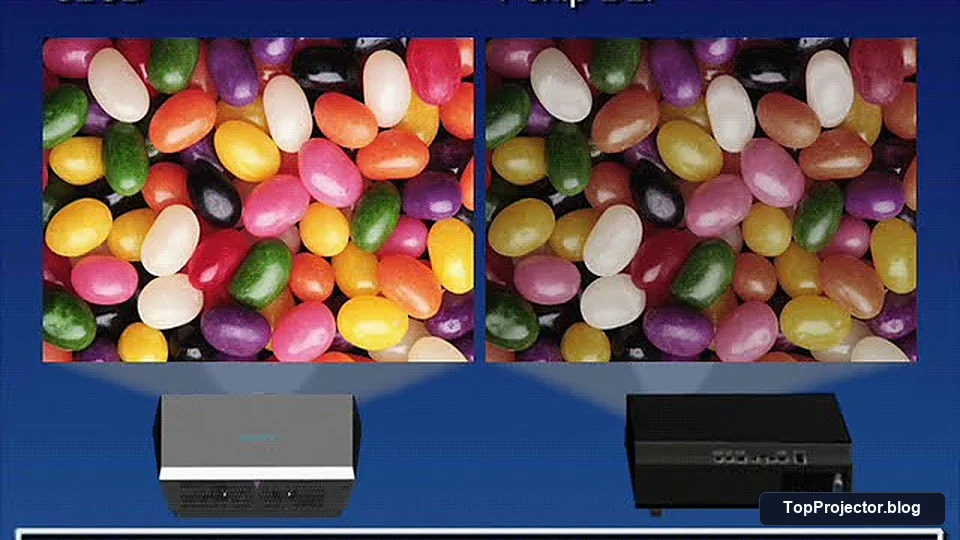
Conversely, traditional 3LCD engines split white lamp light through dichroic mirrors into red, green, and blue beams. These beams pass through three separate liquid crystal panels before combining inside a precision optical prism assembly.
Solid-state laser engines utilize discrete blue laser diodes combined with a phosphor wheel to bypass traditional lamp degradation, sustaining over 20,000 hours of peak operational life before severe output decay.
- Laser systems eliminate expensive lamp replacements over time.
- 3LCD architecture inherently prevents single-chip rainbow artifacts.
- Solid-state diodes maintain stable color calibration longer.
The Mechanical Differences in Light Engine Design
Laser engines utilize phosphor wheels or direct RGB diodes to generate photons. This removes thermal degradation bottlenecks common in high-output lamp designs.
Meanwhile, 3LCD projectors focus entirely on continuous transmissive light streams. This guarantees equal white and color brightness metrics across complex moving video scenes.
- Phosphor wheels convert blue laser light into broad-spectrum illumination.
- Transmissive liquid crystal panels regulate sub-pixel gamma curves.
Diode Spectral Purity
Transmissive 3LCD architectures split white light through dichroic mirrors onto three panels, avoiding color wheel artifacts but introducing convergence tolerances that impact pixel-level sharpness during high-magnification 4K enhancement.
Ambient Light Rejection and Daytime Living Room Performance
Combatting ambient living room light requires immense peak brightness. Laser projectors often push past 3000 ANSI lumens, cutting through daytime reflections when paired with specialized ALR projection screens.
While 3LCD units also achieve high lumen ratings, their overall contrast suffers more under washed-out ambient conditions. Proper optical pairing remains critical for daytime viewing success.
Achieving daytime viewability requires pairing high-output laser engines rated above 3000 ANSI lumens with specialized ALR screens featuring microscopic directional louvers to reject overhead ceiling illumination effectively.
- High lumen output mitigates washed-out contrast in bright rooms.
- ALR screens absorb off-axis ceiling light effectively.
- Direct sunlight severely degrades black level perception.
Pitch-Black Theater Versus Living Room Daylight
Dedicated dark rooms let laser projectors showcase deep black floors. As noted in our epson 5050ub review, dynamic contrast algorithms dim solid-state diodes to enhance black level performance.
Daylight environments demand aggressive lumen output. 3LCD models maintain high color saturation, but blacks appear elevated without strict room light control.
- Controlled theaters maximize native laser contrast capabilities.
- Living rooms need high gain or ambient rejecting surfaces.
Surface Gain Dynamics
Standard white matte surfaces wash out instantly under ambient light, whereas angular reflective materials preserve an effective contrast multiplier by reflecting off-axis light away from the primary viewer seating position.
Native Contrast Ratios, Black Floor Depth, and Shadow Details
Achieving convincing cinematic depth requires low black floors. Laser dimming dynamically modulates diode intensity, dropping overall light output to near zero during pitch-black fade-to-black scene transitions.
3LCD projectors exhibit solid native contrast ratios depending on panel generation. However, their transmissive nature allows slight light leakage through the liquid crystal matrix during dark sequences.
Traditional 3LCD imagers typically yield native contrast ratios near 1000:1, necessitating dynamic iris systems to achieve deeper blacks, though this often introduces visible pumping artifacts during dark cinematic sequences.
- Dynamic laser dimming enhances perceived HDR contrast ratios.
- Transmissive LCD panels struggle to completely block residual light.
- Shadow detail definition dictates overall cinematic realism.
Evaluating Shadow Separation in Dark Mastered Films
Dark sci-fi epics test projector shadow delineation. Following our how to connect projector to laptop using lan cable guide ensures stable signal transmission for critical calibration testing.
3LCD projectors maintain good mid-tone separation, but extreme dark corners can look slightly gray during demanding master grading passes.
- Grayscale ramps expose subtle compression artifacts.
- Black floor elevation impacts sci-fi and horror viewing.
Laser Dimming Algorithmic Controls
Laser light sources allow instantaneous power modulation, dropping output instantly during fade-to-black scenes to lower the black floor dramatically and elevate your overall perceived dynamic contrast.
Colorimetric Precision, Wide Color Gamuts, and HDR Tone Mapping
Accurate color reproduction transforms standard video into immersive art. Wide color filters on laser engines easily achieve strict DCI-P3 color space targets for modern 4K HDR content distribution.
3LCD projectors excel in color brightness metrics because all three primary colors render simultaneously. This eliminates color breakup artifacts while delivering vibrant, saturated natural tones.
Multi-laser engines effortlessly saturate the DCP-P3 color space without engaging optical filters, preserving native brightness while delivering exceptionally vibrant HDR highlights and rich saturated primary colors.
- DCI-P3 coverage delivers cinematic color depth.
- Simultaneous RGB rendering prevents single-chip color flashing.
- HDR tone mapping preserves specular highlight details.
HDR Tone Mapping Performance in High-Dynamic-Range Feeds
Handling 4K HDR metadata requires robust internal processing. Laser projectors dynamically remap brightness curves to match specific screen gain specifications.
3LCD engines process HDR signals smoothly, relying on manual user adjustments to balance bright highlights against darker shadow regions.
- Dynamic metadata adjustments optimize peak luminance.
- User calibration ensures accurate skin tone fidelity.
Dynamic Tone Mapping Engines
Processing metadata accurately requires robust onboard processors to remap high-nit mastering levels down to projector capabilities, preventing crushed shadows while maintaining realistic highlight clipping thresholds for movies.
Motion Resolution, Pixel Response Times, and Input Lag Dynamics
Fast-paced sports and competitive gaming demand rapid pixel response times. Modern laser displays often feature dedicated gaming modes yielding sub-16ms input lag at 60Hz refresh rates.
3LCD units handle motion with predictable stability. Their natural transmissive response prevents motion blur, though high-end frame interpolation algorithms may introduce minor visual artifacts.
Competitive gaming demands minimal latency; modern solid-state projectors achieve an impressive input lag under 16 milliseconds at 4K/60Hz when activating dedicated low-latency gaming modes in menus.
- Low input lag ensures responsive competitive gaming inputs.
- Motion interpolation smooths out rapid camera pans.
- Pixel response times prevent ghosting during fast action.
Console Gaming and High-Refresh PC Entertainment
Next-generation consoles push high frame rate capabilities. Laser projectors with low latency bypass processing overhead for instant controller feedback.
3LCD gaming setups provide vibrant colors during split-screen sessions, maintaining reliable motion clarity across casual gaming genres.
- High frame rate compatibility enhances fast twitch gameplay.
- Vibrant color output makes RPG titles pop.
Motion Interpolation Trade-Offs
Frame insertion algorithms reduce judder during fast-moving panning shots, but purists usually disable motion smoothing to avoid the undesirable soap opera effect and preserve cinematic film cadence.
Throw Ratios, Optical Lens Shift, and Physical Installation Geometries
Proper room geometry dictates successful projector placement. Ultra-short throw laser models sit mere inches from the wall, projecting massive images inside compact urban apartments.
Traditional 3LCD units rely on standard throw ratios and generous optical lens shift ranges. Selecting models from our best ceiling mount projector for home theater guide simplifies installation.
Calculating proper throw distance requires analyzing the exact throw ratio parameters, such as a flexible 1.35 to 2.1 range, ensuring seamless alignment with your fixed frame projection screen.
- Ultra-short throw lenses simplify tight living room layouts.
- Lens shift adjustments ease physical ceiling mount alignment.
- Throw distance determines maximum achievable screen size.
Ceiling Mounts Versus Media Console Placement
Placing a projector on a credenza requires specialized optics. Short throw and ultra-short throw laser units eliminate long cable runs across living room floors.
Ceiling mounting a 3LCD projector keeps hardware out of reach. Horizontal and vertical lens shift dials ensure geometric alignment without digital keystone distortion.
- Credenza placement suits ultra-short throw designs.
- Ceiling mounts hide cabling for clean installations.
Motorized Lens Flexibility
Premium optical blocks feature motorized lens shift exceeding plus-minus 60 percent vertical, allowing installers to offset the chassis vertically without relying on degrading digital Keystone correction algorithms.
Defining the Ideal Room Scenarios for Your Home Theater
Selecting the correct projection technology depends on your specific environment. Choose a laser system for dedicated dark theaters requiring deep black floors and zero maintenance over years of heavy usage.
Opt for a 3LCD projector if your primary goal is vibrant, artifact-free color reproduction in a multi-use family room with moderate ambient light present.
Dedicated pitch-black media rooms maximize the native contrast advantages of refined home theater projectors, whereas active family spaces require high-lumen laser units paired with ambient light rejection surface treatments.
- Match projector output to your room's ambient light level.
- Prioritize laser for long-term maintenance-free operation.
- Choose 3LCD for guaranteed rainbow-free color fidelity.
Final Decision Framework for Home Theater Buyers
Evaluate your ceiling height, throw distance, and ambient light before buying. Taking these optical factors into account guarantees a rewarding cinematic investment.
Consult our interactive screen size and viewing distance calculator to verify precise image geometry compatibility before finalizing your final projection hardware purchase today.
- Measure throw distance carefully before ordering screens.
- Assess room lighting conditions for optimal lumen matching.
Acoustic and Thermal Planning
High-output laser engines generate substantial internal heat, requiring sophisticated cooling fans that must operate below 28 decibels to prevent audible distractions during quiet movie dialogue passages.
Frequently Asked Questions
Do laser projectors require expensive lamp replacements over time?
No, solid-state laser diodes eliminate traditional lamp replacements entirely. Their operational lifespan easily exceeds 20,000 hours of continuous use.
What causes the rainbow effect in projectors, and do 3LCD units avoid it?
Single-chip color wheels cause rainbow flashes for sensitive viewers. 3LCD projectors bypass this completely by utilizing three separate transmissive panels simultaneously.
Can I use a laser projector in a brightly lit living room?
Yes, high-lumen laser projectors paired with ambient light rejecting screens cut through room reflections effectively. Adequate peak brightness ensures vivid daytime images.
Are 3LCD projectors suitable for competitive console gaming?
Modern 3LCD units offer reliable input lag figures suitable for casual gaming. However, specialized laser models often provide faster response times for competitive play.
How does optical lens shift affect my home theater installation?
Optical lens shift lets you adjust the image position physically without digital keystone correction. This preserves native pixel resolution and geometric integrity.