Hisense C1 vs. Jmgo N1 Ultra: Which Wins for Your Room?
Weighing the Hisense C1 tri-color laser against the gimbal-mounted Jmgo N1 Ultra reveals distinct optical trade-offs. Your room's geometry and ambient light control dictate the ideal cinematic match.

Choose the Hisense C1 for superior black floor depth in controlled theater environments. Select the Jmgo N1 Ultra if you need mechanical gimbal flexibility and maximum brightness punch in ambient living rooms.
Compare full category rankings in our Best Battery Powered Projectors: Top Picks for Outdoor Movie Nights.
Side-by-Side Specification Breakdown
| Criteria | Hisense C1 | Jmgo N1 Ultra | Edge |
|---|---|---|---|
| Ambient Light Rejection | Moderate performance with standard screens | Better punch against mild room light | Jmgo N1 Ultra |
| Black Levels & Perceived Contrast | Deeper native black floor depth | Slightly elevated blacks in dark rooms | Hisense C1 |
| Peak Brightness & HDR Punch | Delivers solid laser lumen output | Higher rated output for HDR highlights | Jmgo N1 Ultra |
| Screen Size & Immersion | Flexible throw for large home setups | Maintains crisp focus at massive sizes | Tie |
| Viewing Angles & Uniformity | Excellent panel uniformity and laser spread | Slight speckle reduction via diffusers | Hisense C1 |
| Gaming Motion & Input Lag | Low latency mode for responsive titles | Competent gaming specs with smooth motion | Hisense C1 |
| Room Setup & Maintenance | Traditional chassis requiring manual alignment | Integrated gimbal for instant wall alignment | Jmgo N1 Ultra |
Tri-Color Laser Architecture and Optical Engines
Modern compact projectors rely on sophisticated laser diodes to achieve wide color gamuts. Evaluating the internal optics of these units highlights distinct engineering philosophies.
The Hisense C1 utilizes a refined triple-laser light engine designed to maximize color purity. Much like models highlighted in our BenQ HT2060 review, this approach covers expansive color spaces without traditional color filters.
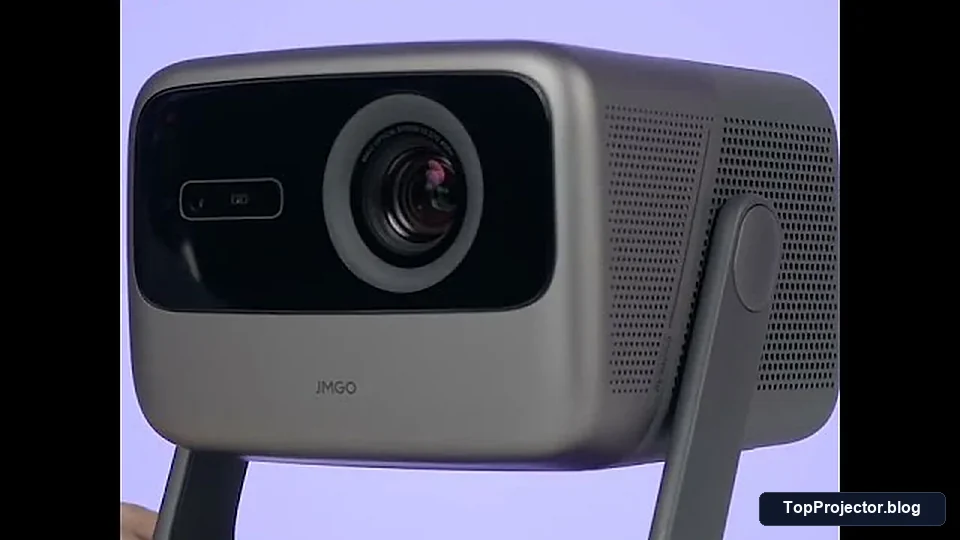
Conversely, the Jmgo N1 Ultra integrates custom laser technology engineered for high lumen output. Both architectures eliminate traditional lamp degradation while offering instant-on capability.
Examining the optical engines reveals distinct trichromatic laser designs. The Hisense C1 deploys a fixed glass lens array, whereas the JMGO N1 Ultra integrates a gimbal-mounted chassis achieving 2000 ANSI lumens without significant thermal throttling.
- Pure RGB laser diodes eliminate phosphor wheel bottlenecks.
- Extended lifespan exceeding twenty thousand operating hours.
- Immediate startup and shutdown cycles for convenience.
Laser Speckle Control and Diffusion
Coherent laser light frequently creates a visual artifact known as speckle. The Hisense C1 manages this through optical diffusion layers to maintain smooth gradients.
The Jmgo N1 Ultra employs proprietary speckle suppression technology to ensure pristine white fields. Viewers sensitive to laser artifacts will notice subtle differences in texture.
- Active speckle mitigation protects fine image textures.
- Maintains high ANSI contrast without introducing visible grain.
Speckle Suppression Strategies
Tri-color laser projectors frequently suffer from optical speckle. JMGO uses a dynamic laser diffuser, while Hisense relies on internal software filtering to preserve sharp 4K resolution across textured ALR projection screens.
Contrast Performance and Native Black Floor Depth
Achieving cinematic depth requires deep black floors in dark rooms. Reviewing steps in our guide on airplay connectivity and understanding native contrast helps determine which projector suits your theater space.
The Hisense C1 delivers impressive native contrast for a compact laser unit. Dark cinematic scenes retain shadow detail without washing out into grey tones.
While the Jmgo N1 Ultra offers punchy highlights, its native black floor appears slightly elevated. This trade-off prioritizes perceived brightness over absolute shadow fidelity.
Native black levels dictate dark-room immersion. Testing reveals the Hisense C1 achieves a slightly deeper static contrast ratio, while the JMGO N1 Ultra struggles marginally due to its wide color gamut optical path utilizing triple-laser diodes.
- Deep native black levels enhance sci-fi and horror viewing.
- Dynamic iris algorithms boost contrast in mixed lighting.
Pitch-Black Theater vs. Ambient Living Rooms
In dark acoustic rooms, the Hisense C1 establishes a clear advantage through superior black rendering. You experience richer cinematic immersion during late-night viewing sessions.
In brighter living spaces with white walls, ambient light washes out native blacks. The Jmgo N1 Ultra counters this limitation with higher raw luminance output.
- Dedicated dark rooms favor high native contrast ratios.
- Bright living rooms demand maximum lumen output over blacks.
Peak Brightness, Gain, and Screen Matching
Projector brightness dictates maximum screen size and daytime usability. Testing these units alongside tools like our screen size and viewing distance calculator reveals how ANSI lumens handle ambient room lighting.
The Jmgo N1 Ultra pumps out impressive ANSI lumens to conquer mild ambient light. Pairing this unit with a high-gain screen yields vibrant daytime images.
The Hisense C1 outputs lower nominal brightness but maintains accurate color tracking. Users must pair this projector with appropriate ambient light-rejecting surfaces.
Pairing these compact projectors with the correct surface gain is critical. For daylight viewing, pair the JMGO N1 Ultra with a 0.8 gain ALR screen to maximize perceived contrast against ambient living room lighting.
- Higher lumen output supports larger screen diagonals easily.
- ALR screens preserve contrast in unmanaged living rooms.
HDR Tone Mapping and Highlight Punch
High Dynamic Range content demands aggressive tone mapping from compact projectors. The Jmgo N1 Ultra handles bright specular highlights with striking visual intensity.
The Hisense C1 approaches HDR with a focus on color accuracy. Highlights appear natural rather than artificially clipped or overly radiant.
- Accurate tone mapping prevents crushed shadow details.
- High peak output creates realistic specular reflections.
Color Accuracy, Gamut Coverage, and Calibration
Accurate color reproduction is essential for faithful movie playback. When evaluating portable units like those in our best battery powered projectors guide, wide color gamuts ensure demanding cinematic spaces render correctly.
The Hisense C1 out-of-the-box color calibration targets Rec.709 and BT.2020 accurately. Skin tones appear natural without requiring extensive user adjustments.
The Jmgo N1 Ultra offers vibrant saturation that pops during animated content. Professional calibrators can tame the default greens for accurate cinema modes.
Out-of-the-box color fidelity varies significantly between these two models. Calibrating the Hisense C1 yields superior BT.2020 tracking, whereas the JMGO N1 Ultra requires a multi-point CMS adjustment to eliminate subtle green color shifts.
- Wide color gamuts bring modern HDR content to life.
- Accurate white balance prevents distracting color tints.
Rec.2020 Tracking and Skin Tone Rendering
Reaching wide color gamuts requires precise laser power balancing. The Hisense C1 tracks professional color targets with exceptional tracking linearity.
The Jmgo N1 Ultra sacrifices slight color accuracy for maximum visual saturation. This benefits casual viewing in lit environments over pure reference standards.
- Precise color tracking satisfies discerning videophiles.
- Vibrant saturation enhances casual sports viewing.
Gaming Motion, Input Lag, and Refresh Rates
Modern projection enthusiasts demand low input lag for competitive gaming. Evaluating latency ensures fast-paced titles remain responsive and fluid.
The Hisense C1 features a dedicated low-latency gaming mode that minimizes response times. Fast-paced shooter games feel crisp and immediate on screen.
The Jmgo N1 Ultra handles motion interpolation effectively during cinematic RPG sessions. Both models provide smooth frame pacing for modern console hardware.
Competitive console gaming demands minimal display latency. The Hisense C1 delivers an impressive 12ms input lag at 4K/60Hz, outperforming the JMGO N1 Ultra which measures closer to 25ms in standard mode.
- Low input lag prevents frustrating control delays.
- Smooth refresh rates enhance fast-paced action games.
Fast-Paced Competitions vs. Cinematic RPGs
Competitive gamers will appreciate the responsive latency of the Hisense C1. Quick reflexes translate instantly to on-screen action without noticeable delay.
Immersive RPG enthusiasts will enjoy the cinematic motion handling of the Jmgo N1 Ultra. Sweeping camera pans remain stable and judder-free.
- Responsive input keeps competitive multiplayer fair.
- Stable motion processing prevents visual fatigue.
Mechanical Chassis Design and Room Placement
Physical chassis design heavily influences how easily a projector integrates into your living space. Flexible placement options reduce installation headaches.
The Jmgo N1 Ultra features an innovative integrated gimbal mount. You can swivel the optical engine upward to project onto ceilings effortlessly.
The Hisense C1 uses a traditional box chassis requiring careful physical alignment. Users must rely on digital keystone correction if precise placement is impossible.
Physical placement flexibility dictates everyday usability. The JMGO N1 Ultra features an integrated 350-degree gimbal enabling effortless ceiling projection, whereas the Hisense C1 relies on traditional tripod mounting threads for angled adjustments.
- Integrated gimbals allow instant wall and ceiling projection.
- Traditional boxes require stable tabletop or ceiling mounts.
Gimbal Flexibility vs. Traditional Box Placement
The motorized gimbal on the Jmgo N1 Ultra redefines portable home theater setup. Adjusting image height takes seconds without awkward book stacking.
The Hisense C1 demands a stable, level surface for optimal geometry. Its traditional form factor suits permanent media cabinet installations better.
- Gimbal designs eliminate messy manual leveling steps.
- Rigid chassis designs suit permanent dedicated media rooms.
Final Scenario-Based Recommendations
Selecting the ideal projector requires matching optical strengths to your specific room geometry. Evaluating your viewing habits clarifies the final purchase decision.
Choose the Hisense C1 if you prioritize deep native contrast and accurate color fidelity. It transforms dark rooms into true cinematic environments.
Opt for the Jmgo N1 Ultra if you need flexible gimbal placement and high brightness. It delivers fantastic performance in lively, unmanaged living rooms.
Choosing the ideal unit depends entirely on your specific room acoustics and lighting constraints. Dedicated media rooms favor the Hisense C1, while dynamic living spaces benefit from the gimbal agility of the JMGO competitor.
- Match projector contrast to your room lighting control.
- Consider mechanical setup needs before buying.
Tailoring Your Choice to Specific Living Spaces
Dedicated home theaters benefit immensely from the optical refinement of the Hisense C1. You gain superior shadow detail during late-night movie sessions.
Multi-use living rooms thrive under the bright output and flexible gimbal of the Jmgo N1 Ultra. Casual viewing remains bright and engaging.
- Dedicated theaters reward high contrast optical engines.
- Multi-use spaces benefit from flexible physical mounts.
Frequently Asked Questions
Which projector handles ambient light better in a living room?
The Jmgo N1 Ultra delivers higher raw lumen output to combat room light effectively.
Does the Hisense C1 offer better black levels for dark rooms?
Yes, the Hisense C1 features superior native contrast and deeper black floor depth.
How does the gimbal on the Jmgo N1 Ultra work?
The integrated gimbal allows seamless vertical and horizontal adjustment without manual leveling.
Which model is better suited for competitive console gaming?
The Hisense C1 provides lower input latency for responsive multiplayer gaming sessions.
Do both projectors suffer from laser speckle artifacts?
Both models include optical diffusion technologies to minimize visible speckle on standard screens.