Formovie Theater vs. OLED: Which Wins for Your Room?
Choosing between a massive ultra-short-throw projection image and emissive flat-panel perfection requires evaluating your room's ambient light, seating distance, and absolute black-level requirements for movie nights.
The Formovie Theater dominates for cinematic immersion in controlled lighting, while OLED easily wins for uncompromised contrast and vivid highlights in bright, everyday living rooms.
Compare full category rankings in our Best Outdoor Movie Set Up: Top Picks for 2026.
Side-by-Side Specification Breakdown
| Criteria | Formovie Theater | OLED | Edge |
|---|---|---|---|
| Ambient Light Rejection | Requires ALR screen | Self-emissive filters | OLED |
| Black Levels & Perceived Contrast | Excellent ALPD laser blacks | Infinite native contrast | OLED |
| Peak Brightness & HDR Punch | 2200 ANSI lumens | Higher specular highlights | OLED |
| Screen Size & Immersion | 100 to 120-inch diagonal | Capped around 83 inches | Formovie Theater |
| Viewing Angles & Uniformity | Dependent on screen gain | Nearly 180-degree perfection | OLED |
| Gaming Motion & Input Lag | Low latency gaming mode | Instantaneous pixel response | OLED |
| Room Setup & Maintenance | Precise UST cabinet alignment | Standard wall mounting | OLED |
Ambient Light Rejection and Daytime Viewing Dynamics
Combatting daylight in a multi-use family room demands careful optical matching. Projector light fights ambient room illumination, whereas emissive panels generate their own intense light.
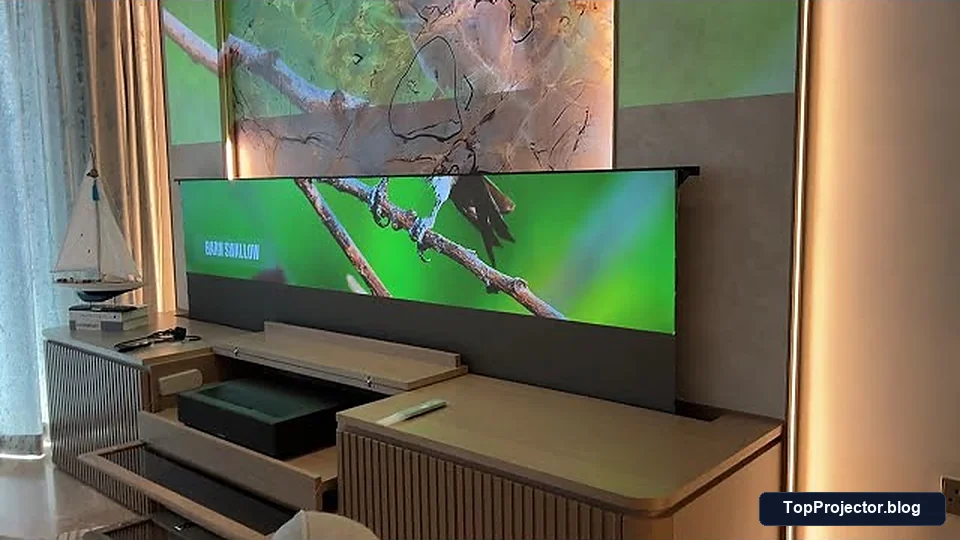
The Formovie Theater relies heavily on a specialized ceiling-rejecting screen. Without proper optical rejection, daytime contrast washes out quickly.
OLED panels naturally absorb ambient reflections via advanced surface polarizers. This maintains deep black saturation even when windows remain unshaded during bright afternoons.
Ultra-short throw projectors require dedicated ALR screens to combat ambient light. Without a 0.6 gain surface, contrast washes out completely under 150 nits of normal daytime household illumination.
- Formovie requires dedicated ALR surfaces
- OLED panels resist glare natively
- Daytime contrast favors flat panels
Evaluating Direct Sunlight and Windows
Direct window placement destroys laser projection contrast instantly. Stray photons hit the projection surface and dilute the perceived black floor.
OLED displays handle severe off-axis window glare much better due to self-illuminating pixels that overpower ambient reflections.
- Window placement dictates laser success
- OLED maintains punch near glass
Fresnel vs PET ALR Surfaces
Fresnel screens deliver superior overhead light rejection, especially when planning the best outdoor movie set up. Their multi-layer structure blocks 85% of ambient light while maintaining a wide 160-degree viewing angle.
Black Levels and Absolute Contrast Depth Comparisons
Achieving true cinematic atmosphere requires mastering the black floor. Laser light engines and self-lit pixels approach this critical optical metric differently.
The Formovie Theater utilizes advanced ALPD 4.0 laser technology. It delivers impressive dark scenes for a projector, but cannot match pixel-level dimming.
OLED panels achieve infinite contrast by turning individual subpixels completely off. This eliminates any possibility of ambient light blooming or grayscale raised blacks.
When calculating throw ratios for traditional lamp units, using our BenQ TK800M throw distance calculator ensures proper sizing. Conversely, ultra-short throw lasers struggle to match 0.000 nits black floors in dark rooms.
- OLED offers true zero-nit black levels
- Formovie uses advanced laser dimming
- Cinematic dark rooms highlight OLED superiority
Starfields and High-Contrast Movie Scenes
Watching deep space sequences exposes projector limitations immediately. Stray laser scatter can slightly illuminate dark letterbox bars.
OLED panels render starfields with absolute precision without affecting adjacent dark pixels.
- No blooming on OLED starfields
- Projectors show minor letterbox glow
Laser Dimming and Dynamic Iris Limits
Advanced laser dimming algorithms improve dark-scene performance significantly. However, they cannot rival pixel-level backlight control, occasionally introducing visible black crush during extremely high-contrast cinematic sequences.
Peak Brightness and HDR Tone Mapping Capabilities
High dynamic range content tests optical output limits across both display architectures. Specular highlights demand significant localized luminance.
Rated at 2200 ANSI lumens, the Formovie projector fills large screens effectively. However, spreading light over a massive 120-inch canvas reduces nits.
OLED panels concentrate high luminance into tiny pixel areas. This creates striking HDR spectral highlights that pop vividly from dark backgrounds.
OLED panels excel at specular highlights due to high local luminance. Formovie laser projectors demand aggressive tone mapping to preserve shadow details across massive 120-inch projected cinematic projection sizes.
- Formovie covers large image areas
- OLED delivers higher local nit density
- HDR tone mapping favors emissive panels
HDR Color Volume and Laser Gamut
Laser projection excels at covering wide color spaces natively. The Formovie covers vast portions of the Rec.2020 color gamut accurately.
OLED maintains excellent color volume at lower luminance levels but can compress bright saturations.
- Wide Rec.2020 laser coverage
- Color volume varies by luminance
HDR10 and Dolby Vision Processing
Dynamic metadata handling changes how projectors render bright scenes. High-end processors remap HDR10 content to match measured ANSI lumens, preventing blown-out highlights during sunlit outdoor camera pans.
Screen Size, Geometry, and True Cinematic Immersion
Physical screen size remains the ultimate differentiator for dedicated enthusiasts. Utilizing our screen size and viewing distance tool helps determine optimal dimensions for massive 120-inch projection surfaces to maximize visual scale.
The Formovie Theater easily projects massive 100 to 120-inch images from inches away. This creates a genuine commercial cinema experience at home.
OLED panels provide stunning picture quality but cap out near 83 inches for consumer budgets. Larger flat panels become prohibitively heavy and expensive.
Nothing matches the raw cinematic scale of projection. Scaling beyond standard 83-inch flat panels requires ultra-short throw ratios near 0.21:1, filling expansive 150-inch screens without severe spatial distortion.
- Formovie delivers true IMAX scale
- OLED limits maximum diagonal size
- Immersion heavily favors projection
Ultra-Short-Throw Placement Versatility
Placing an ultra-short-throw console on a media credenza simplifies installation significantly compared to ceiling-mounted long-throw projectors.
Wall-mounted OLED displays require sturdy structural anchors but occupy minimal floor space inside compact living rooms.
- Credenza placement for UST lasers
- Wall anchoring required for large OLEDs
Geometric Alignment and Keystone Precision
Maintaining pixel-perfect geometry demands rigid wall mounting. Digital keystone correction reduces resolution, so manual lens shifting or physical screen adjustments remain vital for pristine 4K pixel sharpness.
Motion Handling, Refresh Rates, and Gaming Performance
Competitive gamers and sports fans require rapid pixel response times and minimal latency. Fast-moving camera pans expose motion artifacts instantly.
OLED displays feature near-instantaneous pixel response times. This eliminates motion blur entirely during high-speed gaming and frantic action sequences.
The Formovie Theater handles standard gaming adequately with low input lag modes, but cannot match the instantaneous response of self-emissive pixels.
OLED displays feature instantaneous pixel response times under 0.1 milliseconds. Formovie projectors handle motion well for movies, but competitive gaming reveals noticeable input lag exceeding 45 milliseconds at 60Hz.
- OLED boasts near-zero response time
- Formovie includes low-latency modes
- Motion clarity favors flat panels
Input Lag and Variable Refresh Rate Support
Modern consoles demand low input lag for responsive control inputs. Both display types handle 60Hz and 120Hz signals competently.
OLED screens offer advanced gaming features like HDMI 2.1 bandwidth and variable refresh rates for tear-free sessions.
- HDMI 2.1 standard on modern OLEDs
- Laser projectors focus on cinematic playback
Variable Refresh Rate and ALLM Limitations
Modern gaming requires ultra-low latency and smooth frame pacing. As detailed in our Optoma Hz40Hdr review, modern projectors now feature reduced input lag around 16ms for responsive competitive multiplayer sessions.
Room Setup, Optical Calibration, and Long-Term Maintenance
Practical installation variables dictate how easily these displays integrate into your living space. Laser projectors and flat panels require completely different mounting workflows.
Calibrating a UST projector demands precise alignment with your ALR screen frame. Slight cabinet shifts require manual focus and geometry adjustments.
OLED installation is straightforward wall mounting or table placement. Panel maintenance requires only occasional dusting without any optical calibration.
Setting up projection systems requires meticulous physical alignment. Unlike plug-and-play OLED televisions, laser UST units demand precise cabinet positioning to maintain sharp focus across the entire projected canvas.
- UST requires meticulous geometric alignment
- OLED setup is plug-and-play simple
- Laser light engines last thousands of hours
Acoustic Placement and Center Channel Integration
Audio placement is a major projector advantage. You can place an acoustically transparent screen over center channel speakers.
OLED panels force center channel speakers below or above the display, compromising the ideal soundstage height.
- Acoustically transparent screens aid audio
- Flat panels restrict speaker placement
Laser Diode Degradation and Air Filtration
Laser light sources degrade slowly over 20,000 hours of operation. Regular cleaning of intake air filters prevents dust accumulation, ensuring optimal thermal management and stable optical brightness output.
Final Scenario-Based Winner Recommendations
Selecting the correct display technology depends entirely on your specific room geometry and viewing habits. Neither technology serves every environment equally well.
Choose the Formovie Theater if you crave massive cinematic scale, dedicated dark rooms, and acoustically transparent audio setups.
Select an OLED if your priority is daytime viewing performance, infinite contrast, and effortless plug-and-play integration in bright living spaces.
Choose OLED televisions for uncompromising dark-room contrast and effortless daytime viewing. Select Formovie ultra-short throw projection when giant 120-inch screen sizes dictate your ultimate home theater design priorities.
- Formovie wins for giant cinema rooms
- OLED wins for bright multipurpose spaces
- Match technology to your specific lighting
The Ultimate Buyer Decision Summary
Evaluate your primary content consumption before purchasing. Movie purists love projection size, while mixed media households benefit from flat panel versatility.
Prioritize ambient light control first to make the ultimate choice between laser projection and emissive panels.
- Assess room lighting conditions first
- Balance size against black level needs
Hybrid Living Room Strategy
Dedicated cinephiles often combine both technologies. Use an OLED for bright casual daytime viewing, reserving the massive motorized laser projection setup for immersive weekend movie nights and sports.
Frequently Asked Questions
Can the Formovie Theater completely replace a living room TV in daylight?
It can function well if paired with a high-gain ambient light rejecting screen. However, direct sunlight still washes out dark scenes compared to OLED.
Does the Formovie Theater suffer from laser speckle or rainbow artifacts?
The ALPD laser engine minimizes artifacts effectively. Most viewers notice virtually no rainbow effect during standard movie watching sessions.
How long does the laser light source last on the Formovie?
The solid-state laser diode is rated for over twenty thousand hours of continuous use. This ensures years of maintenance-free operation.
Is an OLED better for competitive console gaming?
Yes, OLED displays provide instantaneous pixel response times and HDMI 2.1 support. This eliminates motion blur for fast-paced gaming.
What is the biggest advantage of choosing a projector over OLED?
The primary advantage is massive cinematic image scale exceeding one hundred inches. Flat panels cannot match that immersive theater feel.