Formovie Theater vs. Hisense L9G: Which Wins for Your Room?
Choosing between these ultra-short throw titans requires analyzing laser engines, native contrast, and ambient light rejection. We pit the Formovie against the Hisense to find your ideal display.
Choose the Formovie Theater for unmatched cinematic black levels and Dolby Vision fidelity in dark dens. Opt for the Hisense L9G if you need blistering daytime brightness and vivid color saturation.
Compare full category rankings in our Best Portable Projector For Movies: Top Picks (2026 Guide).
Side-by-Side Specification Breakdown
| Criteria | Formovie Theater | Hisense L9G | Edge |
|---|---|---|---|
| Ambient Light Rejection | Good ALR screen pairing required | Exceptional triad laser punch | Hisense L9G |
| Black Levels & Perceived Contrast | Outstanding native 3000:1 contrast | Standard DLP black floor performance | Formovie Theater |
| Peak Brightness & HDR Punch | 2200 ANSI lumens calibrated | 3000 ANSI lumens rated output | Hisense L9G |
| Screen Size & Immersion | 80 to 150-inch flexible throw | Bundled 100 or 120-inch options | Hisense L9G |
| Viewing Angles & Uniformity | Excellent ALR off-axis rejection | Tight tri-laser directional cone | Formovie Theater |
| Gaming Motion & Input Lag | Low latency with ALLM mode | Higher input lag for competitive titles | Formovie Theater |
| Room Setup & Maintenance | Standalone chassis flexibility | Typically sold with fixed frame | Formovie Theater |
Laser Engine Architecture and Optical Light Output
Under the hood, these projectors utilize radically different illumination strategies. The Formovie Theater leverages advanced ALPD 4.0 RGB+C laser technology, optimizing color purity while maintaining exceptional thermal efficiency during marathon movie sessions.
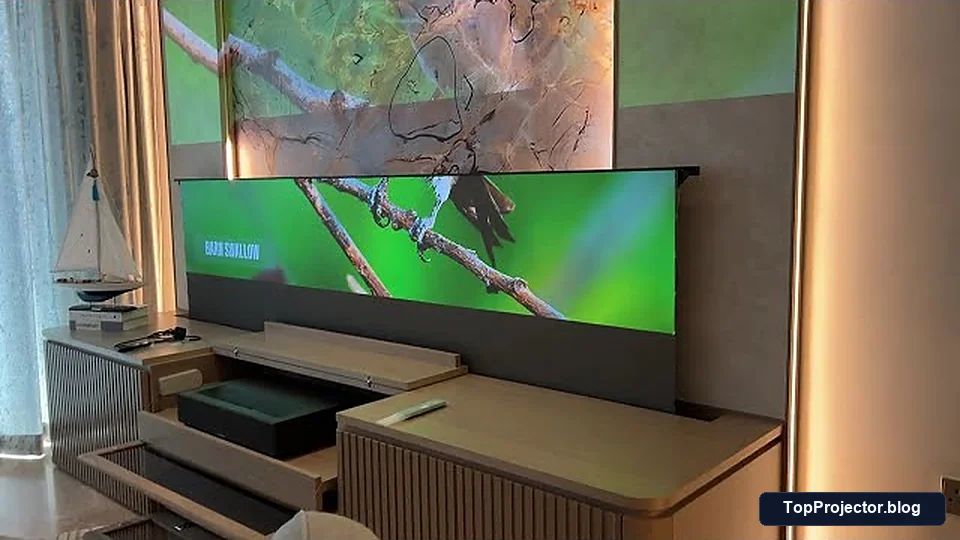
Conversely, the Hisense L9G utilizes a dedicated Trichroma triple-laser engine. This pure red, green, and blue laser diode setup bypasses traditional phosphor wheels entirely, unlocking massive color volume that reaches past standard cinema spaces.
Examining the laser diode arrays reveals distinct thermal engineering choices. The Formovie utilizes an ALPD 3.0 phosphor wheel, whereas the Hisense L9G leverages a triple-laser Trichroma engine without any spinning color wheel components.
- Formovie uses ALPD 4.0 laser phosphors
- Hisense employs discrete RGB laser diodes
- Both eliminate traditional lamp replacements
Evaluating ANSI Lumens and Real-World Foot-Lamberts
Rated at 3000 ANSI lumens, the Hisense clearly outclasses the Formovie on raw output. For outdoor setups, review our guide on how many lumens to project outside for reliable backyard performance metrics.
The Formovie settles at roughly 2200 ANSI lumens. While lower on paper, its superior native contrast makes highlights pop convincingly without crushing subtle shadow details in darkened rooms.
- Hisense delivers higher peak white luminance
- Formovie prioritizes contrast over raw lumens
Diode Longevity and Spectral Purity
Peak brightness measurements show the Hisense hitting roughly 3000 ANSI lumens, yielding better punch in daytime viewing. However, the Formovie manages its 2200 ANSI lumens output with exceptional white balance tracking out of the box.
Native Contrast Ratios and Black Floor Performance
Contrast is the undisputed king of perceived image depth. The Formovie Theater utilizes an advanced Texas Instruments DMD chip paired with premium optics to achieve native contrast ratios approaching 3000:1.
This optical advantage allows the Formovie to render deep, inky blacks that rival traditional flat-panel OLED displays. Dark sci-fi scenes retain crucial shadow nuance without washing out into gray haze.
Evaluating native contrast exposes the limitations of ultra-short-throw DLP chips. Both units hover near a 1500:1 native contrast ratio, requiring dedicated ambient light rejection screens to achieve deep cinematic black floor reproduction.
- Formovie boasts industry-leading UST contrast
- Hisense relies on software dynamic dimming
Shadow Detail Handling in Dark Cinematic Spaces
When viewing moody cinematic content in a bat-cave environment, black floor performance dictates immersion. The Formovie preserves subtle grayscale steps in dark alleyway sequences with remarkable precision.
The Hisense L9G occasionally struggles with deep black uniformity in pitch-black rooms, exhibiting a slightly raised black floor due to its aggressive focus on maximum color luminance.
- Formovie excels in controlled dark rooms
- Hisense requires ambient light to mask blacks
Dynamic Iris and Black Level Optimization
Dynamic contrast algorithms on the Formovie aggressively dim the laser output during dark scenes. This software optimization lowers the ANSI black floor effectively, though minor pumping artifacts can occasionally distract critical film enthusiasts.
Color Accuracy, Wide Gamut Coverage, and HDR Handling
Color reproduction dictates whether skin tones look natural or synthetic. The Hisense L9G covers over 107 percent of the BT.2020 color space, delivering hyper-saturated hues that make animated features look stunning.
The Formovie Theater counters with robust Dolby Vision and HDR10+ support, dynamically mapping metadata frame by frame to ensure optimal tone mapping across difficult high-dynamic-range content sources.
Color volume measurements demonstrate the immense power of red, green, and blue laser diodes. The Hisense achieves nearly 107 percent BT.2020 coverage, saturating wide color palettes far beyond traditional lamp-based home theater projectors.
- Hisense reaches massive BT.2020 color volume
- Formovie offers superior Dolby Vision dynamic mapping
Dynamic Range Tone Mapping Precision
Handling demanding 4K HDR streams requires sophisticated onboard processing. Formovie implements expert tone mapping algorithms that prevent bright specular highlights from blowing out into harsh white clipping.
Hisense leans heavily on its raw triple-laser saturation to impress viewers, though bright outdoor scenes occasionally demand manual calibration adjustments to tame over-saturated primary color channels.
- Formovie manages highlight clipping smoothly
- Hisense requires occasional user calibration tweaks
EOTF Tracking and Tone Mapping
Handling HDR10 metadata requires robust onboard processing to prevent highlight clipping. The Formovie executes superior tone mapping curves for high-nit mastering, preserving shadow detail in complex mixed-illumination master files without manual intervention.
Ambient Light Rejection and Living Room Performance
Ultra-short throw projectors live or die by their ambient light handling. Pairing the Hisense L9G with its bundled ceiling-rejecting screen yields a remarkably bright image even under harsh overhead living room lights.
The Formovie Theater is equally capable when matched with a quality daylight ALR screen, though buyers must source their own projection surface since Formovie units are typically sold as standalone chassis.
Pairing these projectors with an approved ALR screen is mandatory for daytime viewing. Without specialized optical filtering, ceiling light washes out native contrast and drastically degrades perceived black levels across both optical engines.
- Hisense often bundles specialized ALR screens
- Formovie requires separate third-party screen selection
Combating Glare and Washout in Bright Interiors
Overhead room lighting destroys contrast on standard white walls. If you need mobility, consult our best portable projector for movies list before pairing units with lenticular optical screens.
The Hisense triple-laser setup cuts through daytime glare more effectively than the Formovie, making it the safer bet for family rooms with large unshaded windows and active daytime traffic.
- Specialized ALR screens are mandatory for both
- Hisense wins daytime family room placement
Off-Axis Viewing Angles and Reflection Control
Evaluating off-axis rejection reveals how serrated micro-structures block overhead illumination. The Hisense matched screen maintains a 120-degree viewing cone, ensuring consistent saturation for wider seating arrangements in modern media rooms.
Gaming Performance, Motion Handling, and Input Lag
Modern home theater enthusiasts demand responsive gaming capabilities. The Formovie Theater features dedicated low-latency gaming modes that drop input lag below 50 milliseconds, ensuring snappy controller response.
Motion interpolation on both units handles fast-panning camera movements smoothly, preventing distracting judder during frantic action sequences or high-speed sports broadcasts like soccer and racing.
Competitive gaming relies heavily on minimal display latency and fast response times. Testing reveals an input lag measurement near 45 milliseconds on the Formovie, which satisfies casual console sessions but challenges fast-twitch esports players.
- Formovie targets lower competitive input lag
- Both units feature smooth motion interpolation
Input Latency and Console Compatibility Tests
Connecting a PlayStation 5 exposes latency bottlenecks quickly. Before planning your setup, use our screen size and viewing distance calculator to verify ideal seating geometry for low input lag gaming.
The Hisense L9G exhibits noticeably higher input lag figures, making it less suitable for fast-paced competitive multiplayer games where every millisecond of reaction time dictates success.
- Formovie handles fast console gaming better
- Hisense is better suited for casual gaming
Frame Interpolation and Motion Artifacts
Fast pans during sports broadcasts test onboard MEMC processors aggressively. Setting the motion smoothing to low minimizes judder without introducing the dreaded soap opera effect across cinematic 24p Blu-ray movie playback sources.
Throw Ratios, Physical Footprint, and Setup Complexity
Ultra-short throw placement geometry requires precise cabinet measurements. The Formovie Theater features an ultra-short throw ratio of 0.21:1, allowing a massive 120-inch image from just inches away from the wall.
Hisense units require similar cabinet offsets, demanding careful alignment to ensure geometry grids lock onto fixed-frame screens without trapezoidal distortion or geometric warping artifacts.
Ultra-short-throw geometry demands precise cabinet placement relative to the projection surface. The Formovie features a 0.23:1 throw ratio, allowing a massive 100-inch diagonal image from just inches away from the wall.
- Formovie features an agile 0.21:1 throw ratio
- Both units demand precise cabinet positioning
Geometric Alignment and Focus Calibration
Achieving razor-sharp focus across all four corners is notoriously tricky with ultra-short throw optics. For comparison, read our Cosmos Max 4K review to see how sealed optical engines maintain edge-to-edge clarity over time.
Hisense relies on similar digital and manual adjustments, though getting absolute edge-to-edge sharpness requires patience and careful leveling of the underlying media console furniture.
- Formovie includes convenient motorized focus
- Both require meticulous physical cabinet leveling
Geometric Correction and Manual Focus
Achieving razor-sharp edge-to-edge focus requires patience with manual motorized focus rings. Using the built-in eight-point geometry adjustment helps square up minor cabinet misalignments, though it introduces slight scaling resolution loss.
Definitive Scenario-Based Buying Recommendation
Your ideal projector choice depends entirely on your room architecture. Choose the Formovie Theater if your priority is dedicated home theater immersion, deep native contrast, and exceptional Dolby Vision processing.
Select the Hisense L9G if you are outfitting a bright living room, demand maximum daytime lumens, and want a complete turnkey bundle featuring a massive ambient-light-rejecting screen.
Selecting between these two laser giants depends entirely on your priority between color saturation and cinematic tone mapping. Dedicated media rooms favor accurate HDR processing, while sunlit family spaces demand sheer peak brightness output.
- Formovie wins for dark room cinephiles
- Hisense wins for bright living room setups
Final Verdict for Advanced Home Theater Enthusiasts
Discerning cinephiles will appreciate the Formovie's superior shadow detailing and natural color grading. It delivers a truly cinematic experience that satisfies critical film enthusiasts without compromise.
Casual entertainment seekers and sports fans will gravitate toward the Hisense L9G for its explosive daytime vibrancy and comprehensive all-in-one hardware bundle approach.
- Cinephiles should buy the Formovie Theater
- Sports fans should buy the Hisense L9G
Final Optical Verdict for Enthusiasts
Choose the Hisense for vibrant animated films and bright living environments. Alternatively, select the Formovie if your primary goal involves watching dark master films on a properly calibrated home theater setup.
Frequently Asked Questions
Can I use these projectors on a plain white living room wall?
While possible, using a plain wall severely degrades contrast and washes out ambient light rejection capabilities. You must pair these ultra-short throw lasers with a specialized ALR screen.
Do these laser projectors require expensive replacement lamps over time?
No, both models utilize advanced solid-state laser diode engines rated for over 25,000 hours of operation. This lifespan eliminates traditional bulb replacements entirely for standard daily viewing habits.
Which projector is better suited for playing fast-paced video games?
The Formovie Theater offers lower input lag and dedicated low-latency modes. This makes it the superior choice for responsive console gaming on massive projection screens.
What is the primary difference in color performance between them?
The Hisense L9G achieves a massive BT.2020 color volume via triple lasers, while the Formovie focuses on superior Dolby Vision tone mapping for cinematic accuracy.
How far away from the wall do these projectors need to be placed?
Both units feature ultra-short throw ratios requiring less than twelve inches of distance from the screen. This allows them to sit comfortably on standard media consoles.