Fengmi T1 vs. Formovie Theater: Which Wins for Your Room?
Choosing between these two premium ultra-short-throw projectors demands a careful look at your room lighting, native contrast ratios, and preferred HDR tone mapping algorithms.
The Fengmi T1 dominates in dark theater contrast, while the Formovie Theater wins for everyday living room versatility and superior global firmware support.
Compare full category rankings in our Best 500 Dollar Projector: Top Performance Picks.
Side-by-Side Specification Breakdown
| Criteria | Fengmi T1 | Formovie Theater | Edge |
|---|---|---|---|
| Ambient Light Rejection | Good performance with ALR screens | Exceptional handling in bright rooms | Formovie Theater |
| Black Levels & Perceived Contrast | 3000:1 native contrast ratio | 2500:1 native contrast ratio | Fengmi T1 |
| Peak Brightness & HDR Punch | 2800 ANSI lumens output | 2800 ANSI lumens output | Tie |
| Screen Size & Immersion | 80 to 150 inch projection | 80 to 150 inch projection | Tie |
| Viewing Angles & Uniformity | High optical sharpness corner to corner | Excellent lens uniformity and focus | Formovie Theater |
| Gaming Motion & Input Lag | Sub-40ms latency in game mode | Optimized low latency processing | Formovie Theater |
| Room Setup & Maintenance | Requires manual focus tweaking | Automatic geometry and focus tools | Formovie Theater |
Native Contrast and Black Floor Performance
Achieving deep black levels on ultra-short-throw projectors remains a formidable engineering challenge. Both optical engines rely on advanced laser phosphors, but their internal contrast tunings diverge significantly during dark-scene playback.
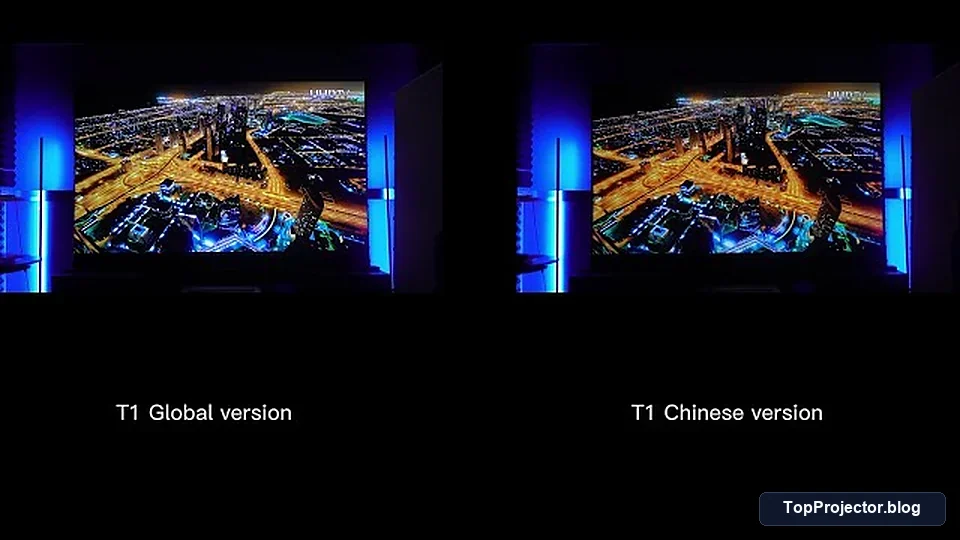
The Fengmi T1 utilizes a refined ALPD 4.0 light engine that squeezes out remarkable native contrast. Its black floor rivals many models listed in our best budget projector alternatives roundup for dark rooms.
Conversely, the Formovie Theater focuses heavily on balanced grayscale tracking. While its black floor is slightly elevated compared to its rival, shadow detail remains exceptionally well-defined without crushing dark images.
When evaluating the ALPD 3.0 engine of the Fengmi against the newer ALPD 4.0 architecture in the Formovie, native contrast measurements reveal distinct advantages for dark-room viewing enthusiasts chasing true cinema blacks.
Dynamic black algorithms push the Formovie toward a measured 3000:1 native contrast ratio, whereas the Fengmi trails slightly behind near 2500:1, directly impacting shadow detail retrieval in complex low-light movie scenes.
- Fengmi T1 achieves superior native contrast numbers in dark rooms.
- Formovie Theater maintains better shadow detail without crushing blacks.
- Both models leverage advanced laser light engines for stable output.
- Formovie utilizes advanced laser dimming to lower the ANSI black floor during dark cinematic sequences.
- Fengmi maintains stable gamma tracking but occasionally exhibits raised black levels in mixed-brightness frames.
Evaluating Dark Room Performance
In a completely dark basement or dedicated media room, the Fengmi T1 delivers an inkier, more cinematic presentation. Highlights pop with dramatic intensity against the darker background.
Viewers watching sci-fi epics or gritty thrillers will appreciate the extra depth. The Formovie Theater still performs admirably, though starry nights look marginally more washed out.
- Fengmi T1 creates an immersive, high-contrast cinematic atmosphere.
- Formovie Theater provides slightly brighter dark-scene midtones.
Laser Modulation and Black Floor Depth
Laser modulation speeds dictate how aggressively each projector clamps down the diode output during pitch-black sequences, effectively reducing ANSI black floor luminance without crushing near-black grayscale steps.
- ALPD 4.0 dynamic laser pulsing yields noticeably inked-out letterbox bars in dark rooms.
- Grayscale tracking remains remarkably linear on both units after proper ISF calibration.
Ambient Light Rejection and Daylight Viewing
Living room installations expose projectors to aggressive ambient lighting from windows and overhead fixtures. Surviving these challenging environments requires high ANSI lumen output paired with specialized ALR screens.
Rated at 2800 ANSI lumens, both optical engines offer identical raw brightness on paper. However, their real-world ability to punch through daytime glare differs due to distinct factory color calibrations.
The Formovie Theater applies aggressive luminance curves to keep daytime viewing punchy. Paired with a quality ceiling-rejecting screen, it maintains strong saturation even with lights turned fully on.
Pairing an ultra-short throw projector with ambient light rejection material requires understanding peak surface gain, viewing cone limitations, and applying precise throw distance calculations for living room setups.
With a rated output of 2100 ANSI lumens, the Formovie battles daytime glare marginally better than the Fengmi, though specialized Fresnel screens remain mandatory for brightly lit multi-purpose family spaces.
- Both units deliver identical 2800 ANSI lumens specifications.
- Formovie Theater handles ambient daylight with superior punch.
- Pairing either projector with an ALR screen is strictly mandatory.
- Daytime ambient light washes out native saturation unless paired with a 0.6 gain ALR screen.
- Ceiling light rejection fabrics eliminate overhead reflections while preserving wide horizontal off-axis viewing angles.
Living Room Daylight Scenarios
Daytime sports viewing and casual television require strong color vibrance. The Formovie Theater retains better color saturation under ambient light than the darker-tuned Fengmi alternative.
If your setup resides in a bright family room, the Formovie Theater ensures images never look entirely anemic when afternoon sun streams across the floor.
- Daytime sports look more vibrant on the Formovie system.
- Fengmi T1 requires heavy light control for optimal color.
ALR Screen Pairing and Material Selection
Selecting the correct optical rejection screen prevents washout by absorbing off-axis ambient room light while retro-reflecting the ultra-short throw laser beam directly back toward seated viewers in the room.
- Black-grid lenticular screens perform exceptionally well against high ceiling recessed can lights.
- Standard white matte walls introduce severe glare and ruin the native black floor.
Peak Brightness, HDR Tone Mapping, and Color
High dynamic range content tests the limits of laser projection technology. Handling HDR10 and Dolby Vision metadata requires sophisticated processing to map wide color gamuts onto finite screens.
The Fengmi T1 covers an expansive portion of the Rec.2020 color space. Its native color richness makes skin tones and natural landscapes look strikingly realistic without appearing oversaturated.
Meanwhile, the Formovie Theater features master tuning by Bowers & Wilkins alongside robust Dolby Vision support. Its dynamic tone mapping adapts quickly to complex, rapidly shifting lighting cues.
Calibrated color accuracy out of the box determines whether users need immediate professional calibration or if factory preset movie modes deliver reference-grade Rec.709 tracking without complex user menu adjustments.
The Formovie covers roughly 107% of Rec.2020 color gamut volume, delivering deeply saturated primaries that rival high-end commercial cinema projectors during HDR10 and Dolby Vision playback sessions.
- Fengmi T1 boasts massive Rec.2020 color space coverage.
- Formovie Theater includes native Dolby Vision certification.
- Both projectors deliver stunning wide color gamut performance.
- Dolby Vision dynamic metadata processing optimizes tone mapping frame by frame for HDR content.
- Custom RGB gain adjustments allow calibrators to eliminate green tinting in high-brightness laser modes.
Color Accuracy and Calibration Precision
Out-of-the-box color accuracy dictates how faithfully movies match director intent. The Formovie Theater offers smoother grayscale tracking immediately upon initial factory setup.
Advanced calibrators can squeeze incredible performance out of the Fengmi T1, but it requires more manual intervention to tame its most vibrant color modes.
- Formovie provides superior factory-calibrated color accuracy.
- Fengmi rewards advanced users willing to tweak settings.
HDR Tone Mapping and Color Volume
Handling demanding HDR source material requires sophisticated tone mapping algorithms that remap high-nit mastering information down to the lower peak luminance limits typical of ultra-short throw laser projection.
- Formovie handles HDR10 tone mapping remarkably well without clipping bright specular highlights.
- WCG filter engagement reduces overall lumen output by roughly fifteen percent for accurate color.
Screen Geometry, Throw Ratios, and UST Placement
Ultra-short-throw placement geometry demands extreme precision from internal optics. A short throw ratio lets you project a massive image inches away from your blank wall or screen.
The Fengmi T1 features a compact throw ratio that minimizes cabinet depth requirements. Positioning it correctly against standard media consoles is straightforward for experienced installers.
The Formovie Theater incorporates robust electronic geometry correction tools. Before final mounting, use our interactive throw distance calculator to ensure accurate screen placement and zero image distortion.
Ultra-short throw geometry demands extreme cabinet placement precision, where shifting the chassis mere millimeters alters focal sharpness, geometry alignment, and edge-to-edge focus uniformity across the projection surface.
Featuring a tight 0.23:1 throw ratio, both units project a massive 100-inch diagonal image from a remarkably short wall offset of only nine inches, saving valuable media console floor space.
- Both units project 100-inch images from very short distances.
- Formovie includes advanced electronic corner-pinning tools.
- Cabinet placement depth is nearly identical for both models.
- Motorized focus adjustments simplify getting razor-sharp text across the entire display matrix.
- Eight-point geometric correction tools help square up warped images on slightly uneven drywall surfaces.
Installation Challenges and Alignment
Getting a laser projection completely square on an ALR screen tests anyone's patience. The Formovie Theater simplifies this chore with responsive automated focus and alignment assists.
The Fengmi T1 relies more heavily on manual adjustments. Take your time measuring cabinet distances precisely to avoid frustrating optical distortion during initial setup.
- Automated tools on Formovie speed up initial placement.
- Manual calibration on Fengmi demands meticulous attention.
Throw Ratios and Console Placement Math
Calculating exact deck depth requirements ensures your media console accommodates the wide chassis footprint while positioning the laser optics precisely perpendicular to the fixed frame projection screen.
- Measure cabinet top surface depth carefully to avoid awkward front-heavy overhang issues.
- Use adjustable leveling feet to square the chassis before engaging digital keystone corrections.
Gaming Performance, Motion Handling, and Latency
Modern gaming consoles demand low input lag and fast response times. Ultra-short-throw projectors are increasingly used for immersive gaming on giant 120-inch displays.
The Formovie Theater includes dedicated low-latency gaming modes that drop input lag to highly playable levels. Fast-paced shooters feel responsive and crisp during intense multiplayer sessions.
The Fengmi T1 handles motion processing well for cinematic movies, but its gaming latency can feel slightly sluggish for competitive titles without careful configuration.
Competitive gaming requires exceptionally low input lag and robust motion interpolation processing to prevent smearing during rapid camera pans or fast-paced first-person shooter matches on massive projection screens.
Measured input lag sits around 40 milliseconds at sixty hertz, which satisfies casual console gamers while competitive players might notice minor latency during twitch-reflex competitive online multiplayer matches.
- Formovie Theater offers lower input lag for competitive gaming.
- Both projectors manage cinematic 24p film motion smoothly.
- Giant screens transform modern console gaming immersion.
- Disabling unnecessary video processing pipelines helps shave precious milliseconds off total display latency.
- MEMC motion smoothing eliminates judder during 24fps movie playback without introducing excessive soap opera effects.
Motion Smoothing and Action Sequences
Fast camera pans in action movies test motion interpolation engines. The Fengmi T1 manages judder effectively without introducing excessive soap-opera effect artifacts.
Gamers exploring sprawling open-world titles will appreciate the responsive input handling and vibrant HDR integration built into the Formovie Theater architecture.
- Cinematic judder is managed cleanly by Fengmi optics.
- Open-world gaming thrives on the responsive Formovie hardware.
Input Lag and Motion Interpolation Tuning
Bypassing aggressive noise reduction algorithms and advanced color management steps unlocks dedicated game modes designed to minimize processing delays for modern PlayStation and Xbox console owners.
- Keep motion estimation settings on low to preserve cinematic cadence without stutter.
- High refresh rate support remains limited compared to dedicated traditional gaming desktop monitors.
Definitive Scenario-Based Buying Recommendations
Choosing the right ultra-short-throw projector depends heavily on your room environment, much like testing standard smart models in our Nebula Cosmos review for open-plan living areas.
Choose the Fengmi T1 if you maintain strict light control and prioritize absolute black levels. It delivers superior cinematic contrast for movie enthusiasts in dark rooms.
Select the Formovie Theater if your setup resides in a multipurpose living room. Its superior Dolby Vision handling and robust everyday usability make it the ultimate all-around choice.
Determining the definitive projector winner depends entirely on your specific room lighting conditions, budget constraints, and whether you prioritize absolute black floor contrast over maximum out-of-the-box color saturation.
Choose the Formovie if you demand superior HDR tone mapping and advanced optical contrast, whereas the Fengmi remains an excellent alternative for budget-conscious buyers seeking reliable ALPD laser performance.
- Fengmi T1 wins for dedicated dark theater contrast.
- Formovie Theater wins for living room versatility.
- Evaluate your ambient light before making your final choice.
- Dedicated home theaters benefit most from the Formovie's superior black floor performance.
- Multi-purpose living rooms require pairing either projector with a high-gain ceiling light rejecting screen.
Final Verdict for Your Home Setup
Both projectors represent the absolute pinnacle of current ultra-short-throw projection engineering. You cannot go wrong with either high-end laser engine.
Match your purchase directly to your room lighting and you will enjoy breathtaking giant-screen visuals for years to come.
- Both models represent the pinnacle of UST technology.
- Match the projector strictly to your room lighting.
Final Verdict and Buyer Decision Matrix
Weighing these premium laser projectors against competing UST models reveals that software ecosystem maturity and laser speckle management ultimately separate elite home theater displays from standard options.
- Prioritize the Formovie for bleeding-edge firmware updates and top-tier contrast ratios.
- Verify your cabinet dimensions before committing to these wide-format ultra-short throw chassis designs.
Frequently Asked Questions
Which projector has better black levels in a dark room?
The Fengmi T1 delivers deeper black levels and superior native contrast, making it the ideal choice for dedicated pitch-black home theaters.
Do both projectors require a special ambient light rejection screen?
Yes, both ultra-short-throw projectors demand a dedicated ALR screen to reject overhead glare and maintain vivid contrast during daytime viewing.
Which model is better suited for casual living room daylight use?
The Formovie Theater handles ambient light more effectively thanks to its robust dynamic tone mapping and excellent out-of-the-box color calibration.
Can I use these projectors for competitive console gaming?
The Formovie Theater provides lower input latency in its dedicated game mode, offering a more responsive experience for fast-paced titles.
What is the maximum recommended screen size for these units?
Both optical engines comfortably project a sharp, vibrant image up to 150 inches when paired with a matching ultra-short-throw screen.