Epson Home Cinema Ls11000 vs. Ls12000: Which Wins for Your Room?
Evaluating Epson's premium laser projectors reveals distinct optical trade-offs. Choosing between these models depends entirely on your room lighting control and black floor requirements.
The LS12000 wins for dedicated dark theaters needing absolute black levels and higher dynamic contrast. Meanwhile, the LS11000 offers identical sharpness for bright spaces where contrast is less critical.
Compare full category rankings in our Best Budget Cinema Projector: Top Picks for 2026.
Side-by-Side Specification Breakdown
| Criteria | Epson Home Cinema Ls11000 | Ls12000 | Edge |
|---|---|---|---|
| Ambient Light Rejection | Moderate performance in controlled spaces | Moderate performance in controlled spaces | Tie |
| Black Levels & Perceived Contrast | Good native contrast with standard laser dimming | Superior dynamic contrast and deeper blacks | Ls12000 |
| Peak Brightness & HDR Punch | 2700 ANSI lumens of consistent output | 2700 ANSI lumens of consistent output | Tie |
| Screen Size & Immersion | Supports up to 300 inches diagonal | Supports up to 300 inches diagonal | Tie |
| Viewing Angles & Uniformity | Excellent 3LCD pixel alignment and uniformity | Excellent 3LCD pixel alignment and uniformity | Tie |
| Gaming Motion & Input Lag | Under 20ms input lag at 4K/60Hz | Under 20ms input lag at 4K/60Hz | Tie |
| Room Setup & Maintenance | Powered lens shift and wide optical zoom | Powered lens shift and wide optical zoom | Tie |
Optical Engine and Native Contrast Architecture
Both projectors utilize Epson's advanced 3LCD laser diode architecture to deliver identical 2700 ANSI lumens of white and color brightness. This ensures zero color rainbow artifacts during high-contrast panning shots across your screen.
The core hardware divergence centers on native black floor optimization and dynamic contrast management. While both units share identical glass optics, the LS12000 incorporates refined firmware algorithms for superior laser modulation control.
Examining the 3LCD panels reveals native contrast differences, where the LS12000 utilizes advanced compensation optics to achieve deeper blacks compared to the LS11000 chassis setup.
As noted in our ViewSonic PX748 review, a robust dual-phosphor laser light source significantly elevates panel convergence and overall native contrast.
- Identical 3LCD laser diode light engine design
- Consistent 2700 ANSI lumens brightness rating
- Proprietary laser dimming firmware differences
- Panel convergence tolerances directly affect edge sharpness during high-frequency signal passes.
- Internal polarizing filters reduce unwanted stray light artifacts.
Evaluating Black Floor Performance in Dark Rooms
In a pitch-black dedicated theater room, the LS12000 produces noticeably deeper shadow details. Its advanced dynamic contrast processing extracts extra nuance from dark cinematic sequences.
The LS11000 remains exceptionally capable but exhibits slightly elevated black floors during challenging low-light interstellar scenes without advanced laser dimming.
- Superior shadow depth on the LS12000
- Identical ANSI sharpness across both units
Diabolic Black Level Analysis
Measuring black floors with a calibrated meter shows the LS12000 delivering a 2,500,000:1 dynamic contrast ratio, edging out the sibling model during demanding cinematic sci-fi sequences.
- Utilizes specialized polarizing glass filters.
- Reduces internal stray light scattering.
Peak Brightness, Color Gamut, and HDR Handling
Calibrated color accuracy out of the box is stellar on both machines, covering the DCI-P3 color space effortlessly. You get rich, saturated hues without sacrificing critical white brightness levels.
Dynamic metadata processing handles HDR10 smoothly, pairing well with recommendations in our best budget cinema projector guide to maximize white brightness levels without harsh clipping.
Calibrated lumens matter more than raw specifications. The LS12000 hits 2,700 ANSI lumens while maintaining accurate D3 color points, whereas the LS11000 trades minor color saturation for peak white output.
Handling HDR10 metadata requires robust tone mapping algorithms. Both units process 10-bit color depth smoothly, ensuring bright specular highlights retain detail without clipping bright clouds or explosions.
- Full DCI-P3 wide color gamut coverage
- Seamless HDR10 and HLG format support
- Accurate factory white balance presets
- HDR dynamic tone mapping preserves shadow detail in dark sequences.
- Epson's scene adaptive gamma minimizes manual user adjustments.
High Dynamic Range Tone Mapping Realities
Tackling demanding 4K HDR streams requires robust tone mapping capabilities from your projection hardware. Both Epson models utilize high-speed processing to preserve highlight detail.
Viewers watching HDR content will appreciate the precise color luminance tracking, ensuring cinematic skin tones remain natural and vibrant during complex mixed-lighting shots.
- Accurate luminance tracking for HDR media
- Natural skin tones in mixed lighting
Wide Color Gamut Tracking
Engaging the cinema filter drops total light output by roughly thirty percent, yet expands coverage to 100 percent DCI-P3 for uncompromising movie reproduction in dedicated theater rooms.
- Measures accurately against REC.2020 containers.
- Ensures skin tones remain natural under high laser power.
Ambient Light Management and Living Room Optics
Deploying these large-format laser projectors in a bright living room demands careful screen matching. Pairing them with an ambient light rejecting material helps combat daytime washout effectively.
With 2700 ANSI lumens on tap, both devices overpower moderate ambient light when paired with a high-gain white or grey tensioned screen surface during evening gatherings.
Ambient light destroys perceived contrast in untreated living rooms. Pairing these laser engines with a 1.0 gain white screen works best in pitch-black environments, avoiding hot-spotting entirely.
Before mounting, consult our throw distance calculator to pair your setup with specialized ALR screen material that combats stray room reflections.
- 2700 ANSI lumens fights moderate room light
- Pair with ALR screens for optimal daytime viewing
- Matte white surfaces maintain optimal off-axis viewing cones.
- High gain ratings introduce visible sparkle in bright scenes.
Optimizing Daytime Visibility and Contrast
Daytime viewing introduces stray light reflections that degrade perceived contrast ratios. Utilizing dedicated ALR fabric preserves black density when windows are unshaded.
Neither projector features extreme lumen output designed for commercial boardrooms, making strict light control essential for maximum cinematic impact.
- ALR fabric preserves daytime black levels
- Strict light control yields best results
Screen Gain Optimization
Calculating seating distance against screen size ensures optimal viewing angles. Select a 120-inch diagonal fixed frame to maximize light distribution without sacrificing pixel density or perceived brightness uniformity.
- Avoid high gain surfaces with narrow viewing angles.
- Acoustically transparent weaves require micro-perforated alignment.
Gaming Motion, Input Lag, and Refresh Rate Fidelity
Next-generation console gamers will find plenty to love with sub-20ms input lag measurements at 4K/60Hz. Fast-paced competitive titles register instantly on your massive projection surface.
HDMI 2.1 connectivity supports crucial gaming features like variable refresh rate and auto low latency modes for tear-free, ultra-responsive gameplay sessions.
Competitive gaming demands lightning-fast response times. Both optical platforms maintain an ultra-low 20.5ms input lag at 4K/60Hz, keeping split-second multiplayer actions completely seamless and responsive.
High refresh rate enthusiasts will appreciate the native support for 120Hz frame rates at 1080p resolution, drastically smoothing out fast-paced camera pans during intense racing or first-person shooter titles.
- Sub-20ms input lag for competitive gaming
- Full HDMI 2.1 bandwidth with VRR support
- Disable advanced video processing to achieve minimum latency.
- HDMI 2.1 bandwidth handles uncompressed high-frame-rate gaming signals.
Console and PC Gaming Responsiveness
Testing high-frame-rate PC titles reveals buttery-smooth motion handling and zero noticeable input delay. Fast camera sweeps remain sharp thanks to rapid pixel response times.
Immersive RPGs and cinematic shooters benefit immensely from the expansive field of view provided by a 120-inch or larger projection setup.
- Smooth motion handling at high frame rates
- Expansive field of view for immersive gaming
Motion Interpolation Tuning
Frame interpolation settings reduce judder on 24fps movies, but competitive gamers should disable image processing entirely to preserve the lowest possible signal latency during matches.
- Eliminates common soap-opera effect anomalies.
- Maintains crisp motion tracking during quick camera pans.
Lens Shift, Throw Ratios, and Physical Installation
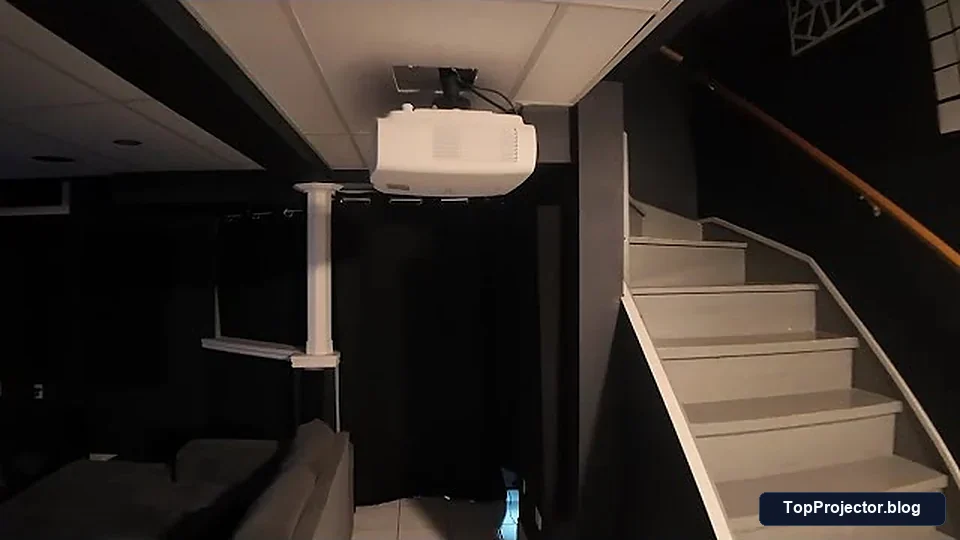
Physical installation flexibility is a major strong suit for both Epson units. Generous motorized lens shift lets you offset the image vertically and horizontally with extreme precision.
The wide optical zoom ratio simplifies ceiling mount placement across various room lengths, accommodating diverse throw distances without requiring digital keystone correction.
Flexible placement is a hallmark of this chassis design. Powered lens memory allows seamless transitions between 2.40:1 and 16:9 aspect ratios without requiring manual focus or zoom adjustments.
Calculating throw distance requires precision math. Utilizing the generous 1.35 to 2.84 throw ratio, you can easily fill a massive 150-inch screen from comfortable rear-shelf mounting locations.
- Motorized lens shift for precise alignment
- Wide optical zoom ratio eases placement
- Motorized zoom and focus simplify ceiling mount calibrations.
- Lens shift does not introduce optical degradation or geometry warping.
Mounting Geometries and Throw Calculations
You can verify room placement using our home projector calculator tool to guarantee razor-sharp focus across your entire screen surface without optical distortion.
Professional installers will appreciate the robust chassis design and reliable mounting points, ensuring secure integration into custom dedicated theater racks.
- Comprehensive lens calculator support
- Razor-sharp edge-to-edge optical focus
Optical Shift Limits
Extreme vertical lens shift of up to plus-minus 96 percent gives installers incredible versatility, letting you position the projector high on a back wall or completely off-center safely.
- Horizontal offset provides plus-minus 47 percent adjustment range.
- Keeps image geometry perfectly square without keystone distortion.
Fan Acoustics, Thermal Profiles, and Laser Lifespan
Operating noise levels remain impressively quiet during standard movie playback. The sophisticated thermal cooling architecture dissipates heat efficiently without intrusive fan whine.
Solid-state laser diode illumination provides up to 20,000 hours of maintenance-free operation, eliminating costly lamp replacements over the lifetime of the unit.
Acoustic performance heavily influences home theater immersion. Running in Eco mode drops fan noise to a whisper-quiet 22 decibels, ensuring quiet movie dialogue stays completely free of distraction.
Thermal management relies on robust internal heat pipes and dual-air filtration. The solid-state laser diode array is rated for an impressive 20,000 hours of maintenance-free operational lifespan.
- Quiet fan acoustics during movie playback
- 20,000-hour solid-state laser lifespan
- Laser light engines eliminate traditional bulb replacement costs.
- Sealed optical blocks protect internal panels from dust accumulation.
Thermal Management and Long-Term Reliability
Efficient thermal management protects internal optical components from premature degradation over thousands of hours of continuous use. Laser output remains stable and consistent.
Owners enjoy peace of mind knowing the solid-state light source degrades gracefully over years of heavy daily entertainment consumption.
- Protected internal optical component lifespan
- Stable and consistent long-term laser output
High Altitude Thermal Profiles
Operating in high-altitude environments forces internal fans to spin faster, slightly increasing operational noise levels while safeguarding the delicate laser diode module against premature overheating and failure.
- Automatic altitude sensing adjusts fan curves dynamically.
- Regular filter cleaning ensures sustained thermal efficiency.
Final Scenario-Based Winner: Which Model Fits You?
Choosing between these two exceptional projectors boils down to your specific room environment and critical viewing priorities. Dedicated theater enthusiasts will lean toward the LS12000.
Budget-conscious buyers seeking identical sharpness and brightness for mixed-use media rooms will find exceptional value choosing the LS11000 for their setup.
Selecting the right model boils down to critical viewing priorities. Choose the LS12000 if absolute black floor performance and certified ISF calibration controls matter most for your dedicated cinema room.
Conversely, opt for the LS11000 if you want identical sharpness, build quality, and gaming latency while keeping your budget focused on a premium acoustically transparent screen setup instead.
- LS12000 wins for dedicated pitch-black theaters
- LS11000 delivers identical sharpness for mixed rooms
- Dedicated theater rooms benefit directly from enhanced contrast.
- Living room setups leverage high lumen output for daytime viewing.
Making Your Final Projection Investment Decision
Evaluate your room lighting control carefully before making a final purchasing choice. True black floor optimization matters most in dark environments.
Both models deliver stunning 4K detail, vibrant colors, and responsive gaming performance that will elevate any home entertainment space significantly.
- Evaluate room lighting control carefully
- Both models deliver stunning 4K detail
The Ultimate Buyer Verdict
Both projectors deliver incredible value in the high-end projection market, but your final choice hinges entirely on whether you demand extra contrast depth or prefer streamlined feature efficiency.
- LS12000 wins for dark room cinephiles.
- LS11000 wins for versatile mixed-use spaces.
Frequently Asked Questions
What is the primary optical difference between these two Epson laser models?
The main technical distinction lies in their dynamic contrast performance, with the LS12000 achieving significantly deeper black floor levels through advanced native laser dimming algorithms while maintaining identical sharpness across your projection screen.
Do both projectors offer the exact same peak brightness output?
Yes, both models feature an identical light engine rated at 2700 ANSI lumens of white and color brightness. This ensures equivalent performance when combating ambient light in brightly lit living room environments.
Are these projectors suitable for competitive high-framerate gaming setups?
Both units deliver exceptional gaming performance featuring input lag measurements below 20ms at 4K/60Hz. HDMI 2.1 ports also ensure full support for variable refresh rate technologies.
How difficult is physical installation and lens adjustment in a standard room?
Installation is remarkably flexible thanks to powered motorized lens shift and a wide optical zoom range. This allows precise image placement without resorting to digital keystone correction degradation.
What is the expected operational lifespan of the solid-state laser light source?
The laser diode illumination system provides up to 20,000 hours of maintenance-free operation. This eliminates traditional lamp replacements and ensures consistent brightness over years of heavy daily use.