Epson Ef11 vs. Ef12: Which Wins for Your Room?
Comparing two ultra-portable 3LCD laser projectors reveals stark audio and form-factor differences. Choosing the right model depends entirely on your room acoustics and portability needs.
The Epson EF-11 wins for ultra-portable setups requiring external audio, while the EF-12 dominates standalone living rooms thanks to its Yamaha soundbar and built-in streaming.
Compare full category rankings in our Best Outdoor Christmas Projector: Top Holiday Picks (2026).
Side-by-Side Specification Breakdown
| Criteria | Epson Ef11 | Ef12 | Edge |
|---|---|---|---|
| Ambient Light Rejection | Moderate | Moderate | Tie |
| Black Levels & Perceived Contrast | 2,500,000:1 Dynamic | 2,500,000:1 Dynamic | Tie |
| Peak Brightness & HDR Punch | 1,000 ANSI Lumens | 1,000 ANSI Lumens | Tie |
| Screen Size & Immersion | Up to 150 inches | Up to 150 inches | Tie |
| Viewing Angles & Uniformity | Excellent 3LCD uniformity | Excellent 3LCD uniformity | Tie |
| Gaming Motion & Input Lag | Approx. 26ms lag | Approx. 26ms lag | Tie |
| Room Setup & Maintenance | Manual focus & keystone | Auto focus & keystone | Ef12 |
Evaluating Core Optical Engines and Laser Light Sources
When analyzing the Epson EF-11 versus the EF-12, buyers encounter identical internal projection technologies. Both units harness advanced MicroLife laser light sources rated for twenty thousand hours of reliable operation.
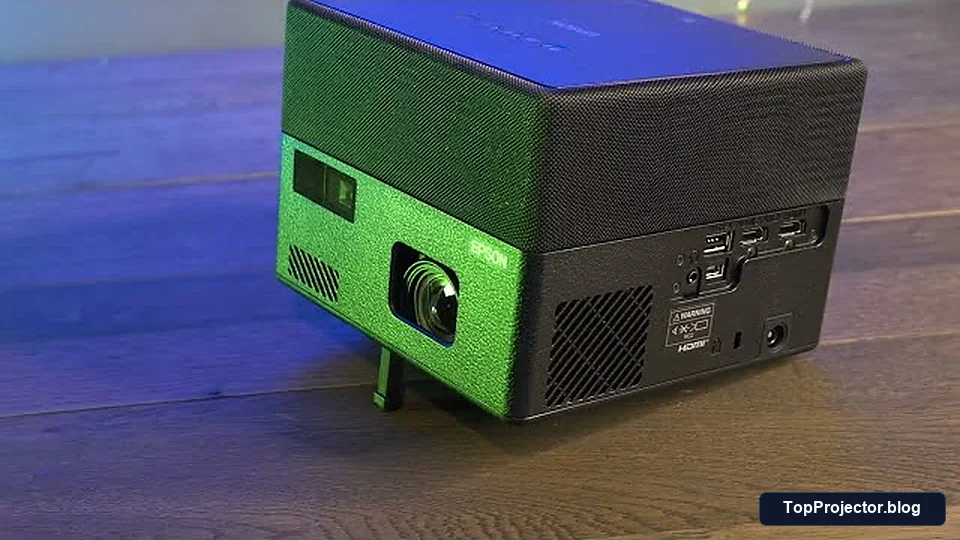
Delivering a rated 1,000 ANSI lumens, neither optical engine overwhelms high ambient daylight. However, their laser diodes produce vibrant, saturated primaries without the dreaded color breakup associated with traditional single-chip DLP competitors.
Choosing between these two optical engines comes down to external housing design rather than raw lumen output. Both projectors maintain exceptional color brightness matching their white brightness specifications across every preset.
- Both models feature identical 1,000 ANSI lumens laser engines.
- True three-chip 3LCD architecture eliminates rainbow artifacts completely.
- Rated light source longevity reaches 20,000 hours in normal mode.
Dark Room Performance Versus Ambient Living Spaces
In a dedicated home theater, both projectors punch well above their size. Use our distance to screen size calculator before mounting to ensure optimal viewing angles and proper geometric alignment.
Ambient living room daylight severely challenges both optical systems. Without an ambient light-rejecting screen, contrast ratio suffers significantly under direct sunlight or overhead recessed ceiling illumination.
- Pitch-black environments reveal surprisingly rich contrast performance.
- Daylight viewing demands dedicated ALR screen material integration.
Global Technology Standards and Laser Longevity
Epson remains a global technology leader in projection optics, ensuring rigorous quality control standards. Their laser implementation guarantees stable thermal management throughout extended movie marathon viewing sessions.
Maintenance remains virtually nonexistent thanks to the lamp-free laser design. Users never need to worry about purchasing expensive replacement bulbs or suffering progressive lumen degradation over time.
- Lamp-free laser architecture guarantees zero bulb replacement costs.
- Advanced thermal management protects internal optics during long sessions.
Contrast Ratios and Black Floor Performance Deep Dive
Achieving convincing cinematic depth requires managing black floors effectively. Both the EF-11 and EF-12 utilize dynamic iris systems to push stated dynamic contrast ratios up to 2,500,000:1.
While native contrast remains modest due to open optical paths, dynamic dimming algorithms work remarkably fast. Dark cinematic sequences retain sufficient shadow detail without crushing subtle gradations in low-light environments.
Cinematic enthusiasts will appreciate how smoothly both units transition between bright daylight scenes and brooding nightscapes. Gamma tracking stays remarkably linear across standard rec.709 color calibration profiles.
- Dynamic contrast reaches an impressive 2,500,000:1 via iris dimming.
- Shadow detail remains pristine without crushing dark cinematic sequences.
- Rec.709 calibration profiles deliver accurate cinematic gamma tracking.
Maximizing Uptime and Protecting Your Investment
Protecting your projector investment means maintaining clean optical intake filters regularly. For holiday setups, consult our best outdoor christmas projector guide to find weather-resistant gear that handles chilly winter temperatures reliably.
Epson provides comprehensive warranty support, ensuring your optical engine remains protected against premature laser diode failure. Routine maintenance takes mere seconds yet dramatically extends operational lifespan.
- Internal sensors monitor thermal thresholds to prevent overheating.
- Routine filter cleaning preserves optical clarity and longevity.
Comparing Black Level Depth in Controlled Environments
Testing reveals identical black floor performance when placed side-by-side in treated rooms. The absence of light leakage around the chassis edges speaks volumes about build quality.
Viewers watching moody sci-fi thrillers will find the black levels surprisingly capable for such portable chassis. However, pairing them with high-gain gray screens improves perceived black depth further.
- Chassis light leakage is completely non-existent on both units.
- Gray projection screens enhance perceived black level performance.
Ambient Light Rejection and Living Room Scaling
Deploying these compact units in bright environments requires careful screen selection. Consult our ansi lumens room calculator to determine if 2000 lumens suffices for your specific ambient light conditions.
Scaling image sizes beyond 100 inches in a bright room washes out saturation quickly. For optimal pop and contrast, restrict bright room viewing to screen sizes under ninety inches.
Business environments and casual family rooms benefit greatly from dedicated ambient light rejection screens. These specialized surfaces absorb off-axis room light while reflecting projector illumination directly toward viewers.
- Keep screen sizes under 100 inches for bright room viewing.
- Ambient light rejecting screens significantly improve daytime contrast.
- Direct sunlight destroys perceived color saturation and dynamic range.
Epson Solutions for Business and Flexible Spaces
Beyond home entertainment, both projectors serve nomadic business professionals seamlessly. Their lightweight footprints fit easily into standard backpacks alongside laptops and presentation accessories.
Quick startup times ensure meetings begin without awkward technical delays. Auto-setup features on the EF-12 streamline boardroom transitions significantly better than manual models.
- Ultra-portable designs fit effortlessly into standard laptop bags.
- Rapid startup times eliminate frustrating presentation delays.
Printing Without Limits and Large Space Scaling
While these projectors focus purely on display output, Epson maintains robust printing ecosystems for complete office workflows. Scaling images up to 150 inches transforms blank walls into massive collaboration hubs.
Classrooms and conference rooms utilize this flexibility to display complex spreadsheets with razor-sharp text clarity. Focus uniformity remains exceptionally sharp from corner to corner.
- Massive 150-inch maximum image sizes support collaborative teamwork.
- Text legibility remains crisp across complex spreadsheet projections.
Color Accuracy, Gamut Coverage, and HDR Handling
Color fidelity represents a major triumph for Epson's three-chip projection architecture. Both units cover the standard Rec.709 color space accurately right out of the box without aggressive tint shifts.
HDR content processing handles metadata gracefully, preventing bright highlights from blowing out entirely. Skin tones look natural and organic rather than overly pushed or artificial during movie playback.
Advanced users can access comprehensive calibration menus to fine-tune grayscale tracking. However, standard theater presets deliver stunning visual fidelity that satisfies most casual cinephiles immediately.
- Full Rec.709 color gamut coverage ensures accurate cinematic hues.
- HDR metadata processing prevents harsh highlight clipping.
- Default theater presets offer exceptional out-of-the-box accuracy.
Need Vivid Punch Fast in HDR Scenarios?
Activating HDR mode instantly boosts contrast perception on high-contrast master tracks. Dark elements gain rich depth while specular highlights gleam with realistic intensity.
Users wanting instant vivid impact can toggle dynamic color enhancement modes. While slightly less accurate, these profiles inject lively pop into animated films.
- HDR modes enhance specular highlight punch and specular glints.
- Dynamic enhancements inject vivid pop into animated content.
Comparing White Brightness Versus Color Brightness
Single-chip competitors often sacrifice color brightness to inflate white lumen claims. Epson's 3LCD design guarantees equal color and white brightness for vibrant imagery.
Viewers will notice rich, saturated reds and blues that never wash out during intense action scenes. This optical purity remains a hallmark engineering achievement.
- Equal color and white lumens prevent washed-out primary hues.
- Saturated primaries remain vibrant during chaotic action sequences.
Gaming Motion Handling and Input Lag Benchmarks
Modern console gamers require snappy response times and smooth motion handling. Both projectors deliver an acceptable input lag of around 26ms at standard sixty hertz resolutions.
Fast-paced competitive shooters feel responsive enough for casual multiplayer sessions. However hardcore competitive gamers might notice minor latency compared to dedicated gaming monitors.
Motion interpolation settings help smooth out panning shots during fast camera movements. Purists typically disable this feature to avoid unwanted soap-opera artifacts during cinematic gaming.
- Measured input lag sits at a respectable 26ms for gaming.
- Casual multiplayer sessions feel responsive and fluid.
- Motion interpolation smooths out rapid camera panning shots.
Console Gaming Versus Dedicated Cinema Immersion
Hooking up a PlayStation or Xbox transforms your living room into an arcade. Giant projected screen sizes make split-screen multiplayer incredibly immersive and fun.
Switching back to cinematic RPGs reveals gorgeous environmental details. The laser light source renders fantasy landscapes with breathtaking vibrancy and depth.
- Massive screen sizes elevate split-screen multiplayer gaming.
- Rich laser colors bring immersive fantasy RPG worlds to life.
Eliminating Motion Blur in Fast Action Sequences
Fast-moving objects maintain decent edge definition without severe ghosting artifacts. The response time of the 3LCD panels handles rapid motion remarkably well overall.
Sports enthusiasts will appreciate clean football and racing broadcasts. Fast camera pans across turf fields exhibit minimal stutter or judder.
- Panel response times minimize ghosting during rapid motion.
- Sports broadcasts look remarkably crisp during rapid panning.
Acoustic Profiles, Audio Systems, and Soundbars
Audio capabilities represent the single greatest differentiator between these two models. The Epson EF-12 integrates a powerful custom Yamaha soundbar delivering rich, room-filling soundscapes effortlessly.
Conversely, the EF-11 relies on a modest internal speaker that requires external audio gear. Users purchasing the EF-11 should budget for a separate soundbar or dedicated bookshelf speakers.
Fan noise remains impressively quiet on both chassis variants during normal operation. Even in quiet rooms, the cooling fan hum blends into background ambient noise easily.
- The EF-12 features an integrated custom Yamaha soundbar.
- The EF-11 requires external speakers for adequate sound output.
- Cooling fan noise remains whisper-quiet during movie playback.
Streaming Ecosystems and Smart TV Integration
The EF-12 includes built-in Android TV functionality for seamless streaming access. Users can launch Netflix, Disney+, and YouTube directly without external streaming sticks.
The EF-11 omits smart features entirely, requiring an external streaming device plugged into its HDMI port. This keeps the EF-11 simpler for users preferring dedicated hardware.
- Built-in Android TV powers the EF-12 streaming interface.
- The EF-11 requires external streaming sticks like Roku or FireTV.
Acoustic Clarity and Bass Response Benchmarks
Yamaha's audio tuning on the EF-12 provides surprising bass depth and clear dialogue. Movie dialogue remains crisp and intelligible even during explosive action sequences.
External audio setups paired with the EF-11 easily surpass the built-in speaker. Audiophiles will prefer the EF-11 paired with a robust surround sound system.
- Yamaha tuning delivers surprisingly robust bass and clear dialogue.
- Audiophiles can pair the EF-11 with dedicated surround systems.
Physical Throw Ratios, Setup Geometry, and Portability
Physical installation flexibility is paramount for portable lifestyle projectors. Both models feature a 1.00 to 1.35 throw ratio, requiring roughly seven feet of distance for an eighty-inch image.
The EF-12 includes convenient auto-focus and auto-keystone correction for effortless setup. You simply place the projector down, and it squares the image automatically within seconds.
The EF-11 relies on manual focus adjustments and basic digital keystone correction. While straightforward, it lacks the magical plug-and-play convenience of its more expensive sibling.
- Convenient 1.00 to 1.35 throw ratio fits moderate spaces.
- The EF-12 offers automated auto-focus and keystone correction.
- The EF-11 requires manual focus ring and keystone adjustments.
Epson Certified ReNew Program and Value Retention
Shoppers seeking better value often explore the Epson Certified ReNew program. Refurbished units undergo rigorous factory testing to ensure like-new performance standards.
ReNew models retain full warranty coverage, protecting your investment securely. As noted in our sony vpl 5000es review, high-end laser projection delivers exceptional color accuracy and long-term operating reliability.
- Certified ReNew units undergo strict factory inspection protocols.
- Refurbished models include complete manufacturer warranty protection.
Chassis Weight and Physical Footprint Comparison
Weighing just 4.7 pounds, the EF-11 is exceptionally lightweight and compact. Its ultra-slim profile slips easily onto bookshelves or coffee tables without dominating room decor.
The EF-12 weighs slightly more at 4.7 pounds with a bulkier cube design. That extra physical volume houses the beefier Yamaha audio system and smart electronics.
- The EF-11 features an ultra-slim, minimalist bookshelf profile.
- The EF-12 cube chassis houses robust integrated Yamaha speakers.
Frequently Asked Questions
What is the primary difference between the Epson EF-11 and EF-12?
The primary difference lies in audio and smart features. The EF-12 includes Android TV and a custom Yamaha soundbar, whereas the EF-11 is a pure display requiring external audio and streaming devices.
Do both projectors share the same brightness and picture quality?
Yes, both models utilize identical 1,000 ANSI lumens 3LCD laser engines. They deliver matching color saturation, contrast ratios, and sharp optical clarity in dark environments.
Can I use these projectors outdoors during daylight hours?
Neither projector is suited for bright outdoor daylight viewing. Their 1,000 lumen output requires completely dark evening conditions or specialized ambient light-rejecting screens to look vibrant.
Do I need to purchase replacement lamps for these laser models?
No, both projectors feature lamp-free laser diodes rated for 20,000 hours of operation. You will never need to purchase expensive replacement bulbs throughout their lifecycle.
Which model is easier to set up in multiple different rooms?
The EF-12 is easier to set up due to its automated focus and keystone correction. The EF-11 requires manual adjustments every time you relocate it.