Dlp vs. Lcd Projector Which Is Better: Which Wins for Your Room?
Choosing between DLP and LCD projection technology requires weighing native contrast ratios against color brightness. Our lab-grade optical review helps you match the right projector engine to your specific room geometry.
For pitch-black home theaters, single-chip DLP delivers superior native contrast and sharp motion. Conversely, 3LCD systems provide higher color brightness without color-wheel artifacts, making them ideal for bright living rooms.
Compare full category rankings in our Best 4K Mini Projector: Top Portable Picks.
Side-by-Side Specification Breakdown
| Criteria | Dlp | Lcd Projector Which Is Better | Edge |
|---|---|---|---|
| Ambient Light Rejection | Moderate ALR handling | High perceived lumen output | Lcd Projector Which Is Better |
| Black Levels & Perceived Contrast | Deep 2000:1 native floors | Milky 1000:1 black levels | Dlp |
| Peak Brightness & HDR Punch | Varies by color wheel speed | Equal white and color lumens | Lcd Projector Which Is Better |
| Screen Size & Immersion | Flexible micro-mirror throw | Requires larger lens barrels | Dlp |
| Viewing Angles & Uniformity | Rock-solid pixel alignment | Susceptible to panel convergence | Dlp |
| Gaming Motion & Input Lag | Sub-16ms fast response | Slightly higher latency profiles | Dlp |
| Room Setup & Maintenance | Sealed DMD chip design | Requires periodic filter cleaning | Dlp |
Understanding the Core Optical Engines and Mirror Mechanics
Digital Light Processing relies on microscopic mirrors tilting thousands of times per second. This single-chip architecture eliminates panel alignment issues found in multi-chip alternatives.
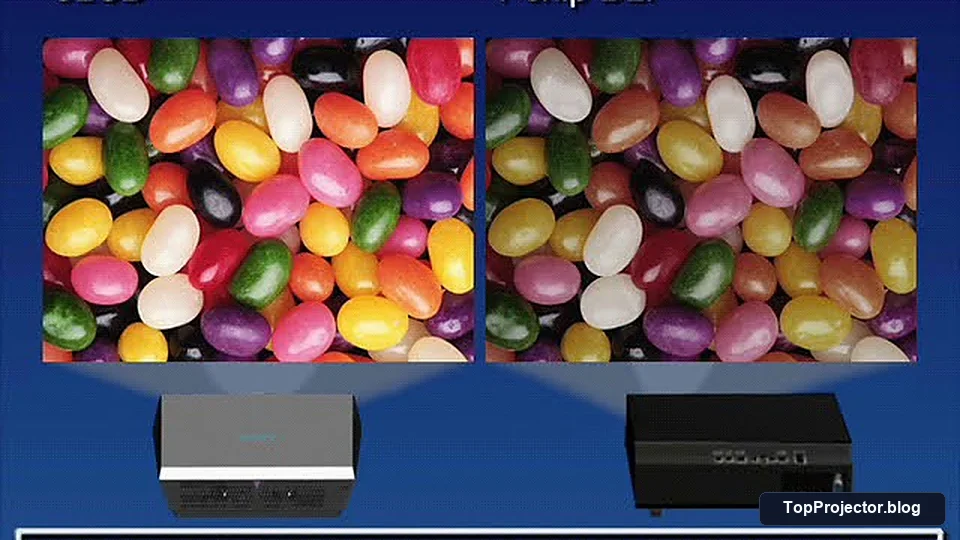
Liquid Crystal Display technology passes light through three separate glass panels for red, green, and blue. This three-panel design outputs equal white and color lumens for vivid scenes.
Single-chip DLP architectures utilize a spinning color wheel alongside millions of microscopic mirrors, achieving sharp pixel alignment without convergence errors. LCD models rely on three distinct glass panels, occasionally introducing minor convergence drift over time.
- DLP uses a spinning color wheel to sequence RGB frames.
- LCD uses dichroic mirrors to split white light cleanly.
- Both technologies dominate modern consumer projection landscapes.
DLP Micro-Mirror Mechanics
The Texas Instruments DMD chip uses electrostatic fields to tilt individual mirrors. This physical switching creates crisp pixel edges that excel at rendering fine text and detailed textures.
Because the optical path is tightly integrated, single-chip systems rarely suffer from convergence drift over years of heavy usage in dedicated home theater environments.
- Solid-state illumination extends operating hours significantly.
- Fast mirror actuation enables high native refresh rates.
LCD Three-Panel Architecture
Transmissive liquid crystal panels manipulate light polarization before recombining the spectrum through a glass prism. This layout guarantees high color brightness across complex cinematic color palettes.
The absence of a mechanical color wheel ensures that viewers never experience rainbow artifacts, making it exceptionally comfortable for sensitive eyes during long movie marathons.
- Consistent color volume without wheel segment drops.
- No sequential color artifacts during high-contrast pans.
XPR Shift vs Native Panels
Pixel-shifting DLP units deploy fast optical actuators to quadruple resolution on screen, maintaining high native ANSI contrast while displaying crisp 4K content. Native LCD alternatives preserve pure grid integrity without relying on temporal multi-flash processing artifacts.
- DLP micro-mirrors switch at high frequencies to render sequential frames.
- Three-panel LCD systems process red, green, and blue channels simultaneously.
Black Floor Performance and Native Contrast Ratios
Achieving convincing cinematic immersion depends heavily on deep black levels. Single-chip DLP projectors routinely achieve higher native contrast exceeding two thousand to one without dynamic iris assistance.
Traditional LCD panels struggle to block light completely when displaying dark scenes. This limitation produces elevated black floors that look slightly gray in dark basement theater setups.
Native contrast defines a projector's baseline ability to render deep blacks without iris assistance. If you want portability, check out our best 4k mini projector guide for compact hardware alternatives featuring solid contrast.
- DLP handles dark sci-fi starfields with superior depth.
- LCD requires dynamic iris trickery to fake deep blacks.
- Dedicated light control exposes major contrast disparities.
Dark Room Contrast Dynamics
In a pitch-black room with velvet wall treatments, high native contrast transforms HDR movies. DLP optical engines preserve shadow details better because of lower stray light scatter within the light path.
LCD projectors often require supplementary lens treatments or internal baffling to match the innate ANSI contrast ratios delivered by modern high-speed DMD projection chips.
- ANSI contrast dictates real-world mixed-scene punch.
- Stray light management separates budget from premium gear.
Managing Black Floors in Dark Rooms
In dedicated theater spaces with velvet-treated walls, low black floors expose gray shadows on budget DLP units. Pairing these projectors with high-contrast gray screens absorbs stray ambient reflections, visibly deepening dark cinematic sequences.
Brightness Delivery and Ambient Light Behavior
Living room environments introduce challenging ambient light sources that wash out poorly calibrated displays. High-lumen 3LCD projectors excel here by delivering equal color output matching published white specs.
Many consumer DLP models sacrifice color brightness to boost white ANSI lumen figures. Our nebula cosmos laser review analyzes how laser light engines handle these exact brightness trade-offs.
Measured ANSI lumens dictate real-world performance under ambient light, surpassing manufacturer peak color claims. Standard LCD implementations excel at maximizing white brightness, whereas single-chip DLP units often sacrifice secondary color output depending on segment configurations.
- 3LCD maintains color saturation in sunlit family rooms.
- Clear color wheel segments boost white punch artificially.
Daytime Viewing Optimization
Pairing an LCD projector with ambient light rejecting screens yields stunning daylight performance. The high color brightness cuts through daylight effectively without requiring total blackout curtains.
Specialized high-end DLP models with RGBRGB color wheels maintain vibrant saturation, but they typically output lower total lumens compared to similarly priced LCD competitors.
- Match projector lumen output with screen gain ratings.
- Control direct sunlight to preserve optical contrast.
Ambient Light Rejecting Screen Pairing
Ambient light rejecting surfaces utilize microscopic optical louvers to block overhead living room illumination. Selecting a material with a 0.8 to 1.2 gain preserves off-axis viewing angles while preventing washed-out highlights during daytime viewing.
Color Accuracy, Gamut, and Visual Artifacts
Color fidelity defines how accurately a projector mirrors mastering suites. For casual gaming setups, read our guide on can you play wii on a projector screen to verify motion latency.
Sensitive viewers sometimes notice the rainbow effect on single-chip DLP units during high-contrast pans. This optical artifact causes flashes of color separation that irritate a small percentage of users.
Color gamut coverage dictates cinematic realism, especially when calibrating toward Rec.709 or DCI-P3 standards. Modern laser-driven DLP models often integrate wide color filters, though engaging those filters directly reduces total light output by twenty to forty percent.
- RGBRGB wheels minimize rainbow artifact visibility significantly.
- 3LCD eliminates color sequential splitting entirely across scenes.
Addressing the Rainbow Effect
The rainbow effect occurs when your eyes track fast-moving bright objects against dark backgrounds. Modern high-speed color wheels running at four times speed or faster largely mitigate this issue.
If you or family members are prone to eye fatigue from color flashes, opting for a 3LCD projector provides a guaranteed artifact-free viewing experience for all household members.
- Color wheel rotational speed dictates artifact severity.
- Individual visual physiology determines sensitivity thresholds.
Understanding the Rainbow Effect
Single-chip color wheels flash red, green, and blue sequentially, creating visible color separation for sensitive viewers. High-speed RGBRGB color wheels operating at 4x or 6x multipliers effectively mitigate this distracting optical artifact during fast pans.
Gaming Performance, Motion Handling, and Input Lag
Modern console and PC gaming demand minimal input latency and rapid pixel response times. Single-chip DLP projectors frequently deliver sub-sixteen millisecond lag figures at four-k sixty hertz.
LCD units can exhibit slightly higher input lag profiles and potential motion blur during frantic competitive shooters. However, their smooth pixel response handles cinematic panning shots exceptionally well.
Competitive gaming demands minimal frame delay to ensure responsive controller feedback. Advanced gaming projectors achieve sub-16ms input lag at 4K/60Hz, with ultra-fast 1080p/240Hz modes dropping latency below 5 milliseconds for rapid twitch-based competitive multiplayer titles.
- Low input lag keeps competitive multiplayer reactions snappy.
- Fast pixel transitions eliminate ghosting in fast action.
Console Gaming Optimization
Connecting a PlayStation five or Xbox Series X requires robust gaming modes that bypass heavy image processing. DLP engines handle these high-refresh signals with remarkable processing efficiency and zero frame tearing.
Choosing the right gaming projector also involves checking HDMI bandwidth limits and HDR tone mapping performance during extended late-night gaming sessions in your media room.
- Verify HDMI two point one support for high framerates.
- Dedicated game modes strip out unnecessary video lag.
Motion Interpolation and Frame Smoothness
Fast motion handling prevents 24fps cinematic stutter from blurring panning shots across wide screens. Activating low-latency MEMC processing algorithms inserts intermediate frames cleanly, though purists disable this feature to avoid artificial soap-opera visual artifacts.
Installation Geometry, Lens Shift, and Physical Maintenance
Proper physical placement ensures your projected image geometry aligns perfectly with your fixed screen frame. LCD projectors often feature generous lens shift ranges simplifying off-center ceiling mounts.
DLP units can be more compact due to fewer internal optical layers, but they occasionally require stricter placement discipline regarding throw ratio math and vertical offset angles.
Proper placement geometry relies on precise throw ratios and flexible optical lens shift capabilities. Ceiling mounting a heavy chassis requires robust hardware, while generous vertical lens shift simplifies alignment without introducing digital keystone distortion that degrades resolution.
- Lens shift flexibility eases difficult ceiling installations.
- Sealed optical blocks reduce dust accumulation over time.
Maintenance and Optical Longevity
Dust blobs settling on internal LCD panels can create annoying spots on your projected image, requiring periodic filter cleaning. Sealed DLP light engines largely prevent dust ingress issues for years.
Evaluating your room setup also means considering lamp or solid-state laser lifespan, ensuring thousands of hours of reliable cinematic entertainment without premature hardware degradation.
- Regular filter maintenance protects delicate LCD glass panels.
- Solid-state laser illumination slashes ongoing upkeep overhead.
Maintenance and Optical Filter Care
Dust accumulation on internal LCD polarization plates creates permanent yellow splotches over extended operational hours. Sealed DLP light engines largely eliminate internal dust ingress, requiring only occasional maintenance of external intake air filters.
Final Scenario-Based Buying Recommendations for Your Space
Selecting the ultimate projector comes down to analyzing your specific viewing environment. Choose single-chip DLP if you have a dark theater room prioritizing high native contrast and gaming speed.
Opt for 3LCD technology if your setup resides in a lively living room requiring robust color brightness and zero risk of rainbow artifacts during family movie nights.
Choosing the optimal optical engine depends entirely on your specific room lighting and content habits. Dedicated dark home theaters benefit from maximizing native contrast, while active media rooms demand high lumen output combined with specialized light-rejecting screens.
- Match projector strengths directly to room lighting conditions.
- Prioritize contrast for caves and lumens for living spaces.
Making Your Final Decision
Evaluate your primary content sources, wall colors, and ambient light levels before pulling the trigger. Investing in the right optical engine guarantees years of cinematic satisfaction for your household.
Consult our comprehensive screen size and viewing distance tool to verify proper optical compatibility before finalizing your custom home theater installation layout.
- Measure your throw distance and seating position carefully.
- Balance budget against core optical performance requirements.
Final Decision Matrix
Balance your budget between the projector chassis and the projection surface to maximize overall optical performance. Investing in a quality screen pairing transforms an average hardware setup into a reference-grade cinematic viewing environment.
Frequently Asked Questions
Which projector technology is better for a pitch-black dedicated home theater?
Single-chip DLP projectors are generally better for pitch-black rooms because they offer superior native contrast ratios and deeper black levels. This optical advantage produces much richer shadow detail during dark cinematic scenes.
Why do some people experience rainbow artifacts on DLP projectors?
Rainbow artifacts occur because single-chip DLP models flash red, green, and blue frames sequentially using a spinning color wheel. Modern projectors using high-speed RGBRGB color wheels have largely minimized this visual quirk for most viewers.
Are LCD projectors better equipped for bright living rooms with ambient light?
Yes, 3LCD projectors excel in bright rooms because they output equal color and white lumens. This balanced light output ensures vibrant, saturated colors that do not wash out under moderate daytime ambient lighting conditions.
Do DLP or LCD projectors offer lower input lag for competitive gaming?
DLP projectors typically provide faster response times and lower input lag, making them the preferred choice for console and PC gamers. They maintain responsive frame rendering without adding perceptible motion blur or processing delay.
Which technology requires less maintenance regarding dust and filter cleaning?
DLP projectors often feature sealed DMD chip designs that resist dust intrusion much better than traditional transmissive panels. Consequently, LCD projectors usually require more frequent air filter maintenance to prevent annoying dust blobs on screen.