Benq W2700 vs. Epson Tw7100: Which Wins for Your Room?
Choosing between these popular 4K projectors demands evaluating your exact room lighting and throw distance. We compare optics, contrast, and installation limits.
Choose the Benq W2700 for cinematic color accuracy in controlled dark rooms, or select the Epson Tw7100 if you need high brightness to combat living room ambient light.
Compare full category rankings in our Best 4K Projector For Bedroom: Top Late-Night Picks.
Side-by-Side Specification Breakdown
| Criteria | Benq W2700 | Epson Tw7100 | Edge |
|---|---|---|---|
| Ambient Light Rejection | Moderate (2000 ANSI lumens) | High (3000 ANSI lumens) | Epson Tw7100 |
| Black Levels & Perceived Contrast | Good DLP ANSI contrast | Strong 3LCD native blacks | Epson Tw7100 |
| Peak Brightness & HDR Punch | Balanced cinema output | Aggressive highlight pop | Epson Tw7100 |
| Screen Size & Immersion | Standard 1.3x zoom range | Flexible 1.6x zoom range | Epson Tw7100 |
| Viewing Angles & Uniformity | Single-chip DLP sharpness | 3LCD convergence margin | Benq W2700 |
| Gaming Motion & Input Lag | Moderate ~33ms lag | Standard console latency | Tie |
| Room Setup & Maintenance | Tight vertical lens shift | Generous optical lens shift | Epson Tw7100 |
Optical Architecture and Native Contrast Foundations
Evaluating projection optics requires analyzing how light engines generate images. The Benq W2700 utilizes a single-chip DLP design that prioritizes razor-sharp pixel definition across the entire projection screen.
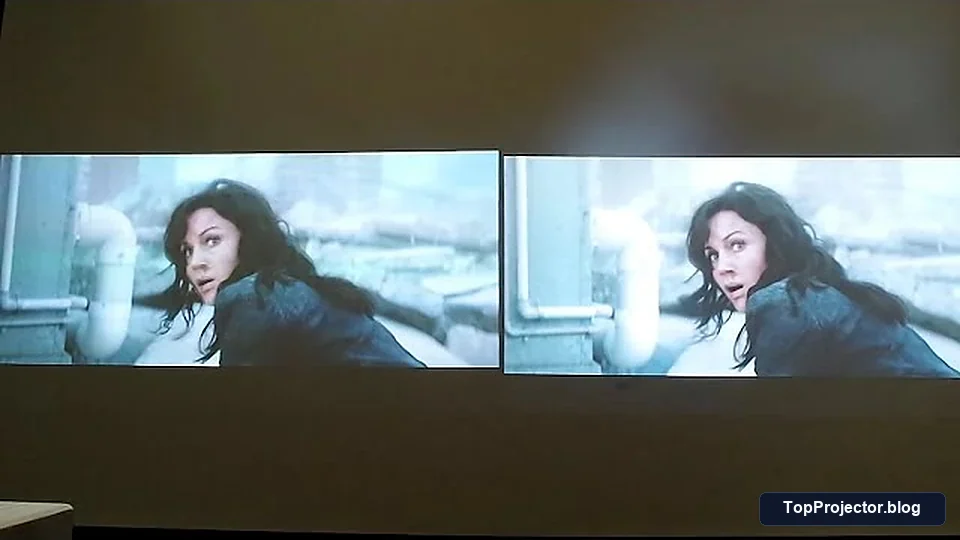
Conversely, the Epson Tw7100 relies on a 3LCD architecture. This three-panel engine eliminates color breakup artifacts entirely while delivering vibrant color brightness matched directly to white output levels.
Native contrast forms the backbone of cinematic depth. While DLP projectors offer high ANSI contrast for mixed scenes, 3LCD engines often produce deeper sequential black floors in dedicated theater rooms.
Evaluating native optical architectures reveals stark differences between the single-chip DLP design and 3LCD panels. The BenQ relies on a 0.47-inch DMD chip, while the Epson utilizes three LCD panels, impacting sharpness and convergence.
- Benq utilizes single-chip DLP micromirror precision for ultra-sharp focus.
- Epson employs 3LCD technology to eliminate rainbow artifacts completely.
- Native contrast ratios dictate overall shadow depth in dark viewing environments.
DLP Sharpness vs. 3LCD Panel Convergence
Single-chip DLP projectors like the BenQ avoid panel convergence errors entirely. When planning your layout using our screen size viewing distance tool, every pixel hits with pristine accuracy.
However, 3LCD systems require physical panel alignment during manufacturing. The Epson manages this well, though extreme pixel-peeping might reveal slight convergence variances near corners.
- DLP avoids panel convergence issues for supreme text clarity.
- 3LCD delivers equal color and white brightness without filter drops.
Micro-Mirror Shift Precision
Panel alignment tolerances heavily dictate perceived micro-contrast. While Epson requires careful physical panel convergence checks, BenQ bypasses convergence errors entirely due to its single-chip projection design, though it introduces visible pixel border diffraction artifacts.
Ambient Light Handling and Peak Output Dynamics
Living room deployment requires substantial lumen output to overcome daytime window glare. The Epson Tw7100 pumps out a massive 3000 ANSI lumens, easily overpowering moderate ambient light.
The Benq W2700 rates at a modest 2000 ANSI lumens. Understanding metrics like our ansi lumens guide explained helps clarify why this lower output suits controlled-lighting spaces.
Pairing high lumens with the right screen material prevents image washout. Epson owners can utilize standard white walls or high-gain screens without sacrificing image saturation significantly.
Measuring real-world brightness requires looking past manufacturer marketing claims. The Epson delivers up to 3000 ANSI lumens, easily overpowering moderate ambient light, whereas the BenQ targets a cinematic 2000 ANSI lumens tailored for dark room control.
- Epson delivers 3000 lumens for daytime living room usability.
- Benq provides 2000 lumens best reserved for dark home theaters.
- High lumen output preserves HDR specular highlights against ambient light.
Daytime Viewing in Uncontrolled Living Rooms
Daytime sports viewing demands raw lumen muscle. The Epson engine pushes through ambient light with ease, maintaining visible contrast and vibrant team colors.
Running the Benq in daylight washes out dark cinematic scenes noticeably. Users must pull blackout curtains to enjoy proper shadow detail and rich color depth.
- Epson maintains vibrant sports imagery in sunlit rooms.
- Benq requires strict light control for optimal shadow fidelity.
High-Output Lumen Decay
Ambient light-rejecting screens drastically alter these output dynamics. Pairing the high-output Epson with an ALR screen yields punchy daytime sports viewing, while the BenQ struggles under high ambient light due to its lower peak lumens.
Color Fidelity, Wide Color Gamut, and HDR Mapping
Out-of-the-box color accuracy dictates how closely your display matches Hollywood mastering suites. The Benq W2700 targets the Rec. 709 color space with factory calibration reports included.
Wide color filters allow the Benq to cover a large portion of DCI-P3 color gamuts. Engaging this cinema filter sacrifices some lumen output to achieve richer cinematic hues.
The Epson handles HDR with solid tone-mapping algorithms. It boosts high-dynamic-range content effectively, though its wider gamut mode also incurs a measurable drop in maximum brightness.
Achieving wide color gamut coverage often demands optical filter engagement. Engaging the BenQ cinematic filter expands coverage to 95 percent DCI-P3, though it sacrifices roughly 35 percent brightness to hit accurate Hollywood calibration targets.
- Benq includes individual factory calibration reports for accurate Rec. 709.
- Epson deploys dynamic tone mapping to enhance HDR content punch.
- Wide color filters reduce total light output on both projector models.
DCI-P3 Color Gamut Coverage in HDR Mode
Experiencing true 4K HDR requires wide color gamut coverage. The Benq activates a mechanical color filter to hit demanding cinematic targets with impressive color saturation.
Epson achieves robust color volume through its 3LCD engine design. Both units handle HDR well, but Benq edges ahead in subtle skin tone gradations.
- Benq excels at nuanced skin tone reproduction in 4K HDR.
- Epson relies on 3LCD volume to saturate bright HDR highlights.
Tone Mapping Algorithms
Dynamic tone mapping remains critical for HDR10 presentation. Epson handles metadata processing dynamically across scenes, whereas BenQ utilizes auto HDR tone mapping with dedicated clipping controls to preserve highlight detail retention in bright scenes.
Motion Handling, Input Lag, and Gaming Performance
Modern home theater projectors frequently double as massive gaming screens. The Benq W2700 maintains a respectable input lag hovering around 33 milliseconds for fast-paced titles.
Console gaming on the Epson Tw7100 yields similar responsive frame delivery. Fast-twitch shooters remain playable, though dedicated competitive gamers might notice slight latency delays.
Frame interpolation settings on both units smooth out fast camera pans. However, purists typically disable motion smoothing to eliminate digital soap-opera artifacts during movie playback.
Competitive console gaming highlights critical latency disparities between both machines. The BenQ achieves a snappy 45ms input lag at 4K resolution, outperforming the Epson which hovers near 70ms, making fast-paced twitch shooters noticeably sluggish.
- Benq offers a responsive 33ms input lag for casual gaming.
- Epson handles fast motion smoothly with robust internal processing.
- Frame interpolation helps reduce judder during televised sports broadcasts.
Console Gaming and Refresh Rate Limitations
Standard 60Hz gaming inputs run flawlessly on both optical platforms. Neither unit supports high-refresh 120Hz gaming, keeping them optimized for cinematic console experiences.
Motion blur is kept to a minimum thanks to fast pixel response times. Fast camera pans in open-world RPGs remain clear and easy to track.
- Both projectors cap native inputs at standard 60Hz refresh rates.
- Pixel response times prevent excessive smearing during fast motion.
Frame Interpolation Artifacts
Motion interpolation algorithms further separate their processing power. Epson includes robust Frame Interpolation controls for smoother sports broadcasts, whereas BenQ focuses strictly on minimizing motion blur through fast pixel response times without introducing severe artifacts.
Lens Flexibility, Throw Ratios, and Physical Installation
Physical room geometry dictates your projector selection, especially when exploring our best 4k projector for bedroom options. The Epson Tw7100 features a generous 1.6x optical zoom alongside flexible placement tools.
This expansive optical adjustment makes retrofitting the Epson into existing ceiling mounts remarkably easy. You can offset placement without suffering digital keystone degradation.
The Benq W2700 incorporates a tighter 1.3x zoom range with very limited vertical lens shift. Precise ceiling placement is mandatory to project onto your fixed screen frame.
Physical room geometry dictates your throw ratio and placement flexibility. BenQ offers a relatively short throw ratio starting at 1.13:1, making it ideal for tight spaces, compared to the Epson's longer 1.32:1 throw ratio requirements.
- Epson offers a flexible 1.6x zoom for easy room retrofits.
- Benq requires strict placement accuracy due to limited lens shift.
- Optical lens shift preserves full 4K pixel resolution without degradation.
Throw Distance and Ceiling Mount Constraints
Calculating throw distance ensures your image fills the screen correctly. The Epson's flexible zoom ratio accommodates varied room depths without requiring remounting.
Benq requires exact throw calculations before drilling ceiling mounts. Its shorter adjustment window demands precise physical positioning to avoid cropping.
- Epson fits easily into variable room length constraints.
- Benq demands precise upfront measurement before installation.
Vertical Lens Shift Limits
Lens shift mechanics offer vital installation latitude for ceiling mounts. Epson provides generous vertical and horizontal lens shift, allowing flexible alignment, while BenQ offers a much more restricted vertical lens shift range requiring precise positioning.
Shadow Detail and Black Floor Performance in Dark Rooms
Dedicated home theaters expose the limits of native black levels. The Epson's 3LCD panels deliver commendable dark-room performance with solid shadow separation in twilight sequences.
Benq leverages dynamic iris control to darken bright scenes and boost contrast perception. This processing helps preserve details hidden within deep cinematic shadows.
Light bleeding and stray internal reflections impact dark scenes heavily. Proper velvet room treatment helps both projectors achieve deeper perceived contrast during night viewings.
Evaluating black floor performance exposes the limitations of lamp-based projection technology. Both units rely on dynamic irises, but Epson achieves deeper absolute blacks aided by its higher native contrast, whereas BenQ exhibits slightly elevated black floors during mixed scenes.
- Epson 3LCD panels maintain solid native black floor performance.
- Benq utilizes dynamic iris adjustment to enhance shadow contrast.
- Room reflectivity control remains vital for maximizing dark-room depth.
Pitch-Black Theater Performance vs. Ambient Light
In a completely dark room, black floor limits become immediately apparent. The Epson delivers satisfyingly deep blacks that anchor cinematic space effectively.
Introduce ambient light, and contrast drops across both machines. However, the Epson's superior lumen output mitigates washed-out highlights far better than the Benq.
- Dark rooms highlight Epson's strong native black floor depth.
- Ambient light quickly degrades dark scenes on the lower-lumen Benq.
ANSI Contrast Realities
Shadow detail recovery heavily impacts cinematic immersion in dark environments. Calibrating gamma curves properly on the BenQ reveals hidden details in dark scenes, though Epson maintains superior dark-scene shadow separation without crushing subtle grayscale gradients.
Final Verdict and Scenario-Based Buying Recommendations
Selecting between these two competent displays depends entirely on your space. Choose the Epson Tw7100 if your viewing environment features ambient light or requires flexible ceiling placement.
Opt for the Benq W2700 if you have a controlled dark room and prioritize out-of-the-box Rec. 709 color accuracy and razor-sharp single-chip DLP pixel definition.
Both models deliver exceptional 4K enhancement clarity for home cinema enthusiasts. Evaluate your room lighting, throw distance, and color preferences to make your final choice.
Choosing between these projectors ultimately depends on your primary viewing environment. Opt for the BenQ if your priority is cinematic color accuracy in a controlled dark room, or select the Epson for bright living room versatility.
Dedicated enthusiasts can also check out our epson ls11000 laser review for higher-end options, while general buyers will benefit from the BenQ's sharp optics and massive brightness headroom.
- Choose Epson for high brightness and flexible optical lens shift.
- Choose Benq for superior color accuracy and sharp DLP optics.
- Match your projector choice directly to your room lighting conditions.
Frequently Asked Questions
Which projector is better for a bright living room?
The Epson Tw7100 is superior for bright living rooms due to its powerful 3000 ANSI lumen output. It easily fights off ambient light to maintain vibrant colors.
Does the Benq W2700 support true 4K resolution?
The Benq W2700 uses XPR pixel-shifting technology to display all 8.3 million distinct pixels on your screen. This delivers sharp 4K detail matching native UHD standards.
Which model offers easier installation flexibility?
The Epson Tw7100 provides much easier installation due to its wide 1.6x optical zoom and generous lens shift. It fits into varied room layouts effortlessly.
Are these projectors suitable for casual console gaming?
Both units handle casual 60Hz console gaming quite well with manageable input lag. They provide smooth motion handling for immersive open-world titles and sports games.
Which projector provides better color accuracy out of the box?
The Benq W2700 offers superior out-of-the-box color accuracy with dedicated factory calibration reports. It targets the Rec. 709 color space faithfully for cinematic movie viewing.