Benq vs. Epson 4K Projector: Which Wins for Your Room?
Choosing between BenQ and Epson 4K projectors dictates how your room handles ambient daylight and dark-theater contrast. We dissect optical engines to match your exact home setup.
For pitch-black dedicated home theaters, BenQ delivers superior native contrast and sharp single-chip clarity. For bright family living rooms, Epson dominates with massive color brightness and high lumen output.
Compare full category rankings in our Best Pull Down Projector Screen: Top Home Theater Picks.
Side-by-Side Specification Breakdown
| Criteria | Benq | Epson 4K Projector | Edge |
|---|---|---|---|
| Ambient Light Rejection | Moderate handling via higher single-chip pixel fill | Exceptional handling via high color brightness lumens | Epson |
| Black Levels & Perceived Contrast | Superior native ANSI contrast and shadow pop | Advanced dynamic iris scaling with rich black floors | BenQ |
| Peak Brightness & HDR Punch | Accurate cinematic tracking with calibrated Rec.709 | Blindingly high white and color lumen output | Epson |
| Screen Size & Immersion | Flexible short-throw and standard throw options | Versatile optical zoom ranges for custom throws | Tie |
| Viewing Angles & Uniformity | Zero convergence error via single-chip architecture | Excellent 3LCD panel convergence and geometry | BenQ |
| Gaming Motion & Input Lag | Ultra-low sub-16ms latency for competitive gaming | Competitive input lag with robust processing engines | BenQ |
| Room Setup & Maintenance | Compact footprints with reliable solid-state options | Larger chassis sizes needing generous clearance | BenQ |
Native Optical Contrast and Black Floor Performance
Achieving convincing cinematic depth requires deep black floors that anchor bright highlights. BenQ utilizes single-chip DLP technology, offering inherently superior native contrast ratios that expose subtle shadow details effortlessly.
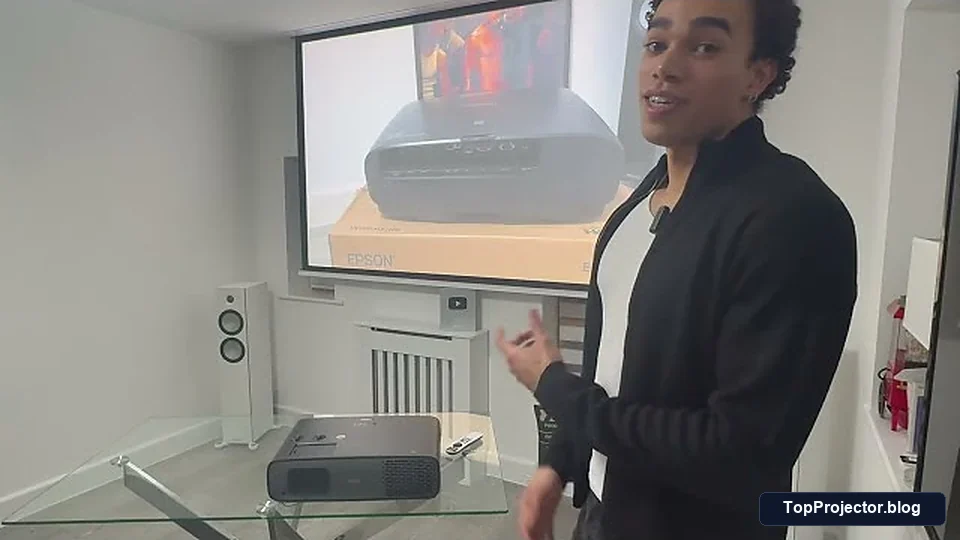
Conversely, Epson relies on robust 3LCD architecture paired with dynamic iris algorithms. While native panels differ from units evaluated in our Hisense L9H review, Epson dynamic dimming aggressively controls black levels.
Cinematic purists often favor the natural ANSI contrast of BenQ engines. Yet, bright-room enthusiasts appreciate how aggressive Epson iris management maintains punchy image dynamics under ambient light.
Evaluating native optical contrast reveals how deeply a projector renders shadows without relying on dynamic iris trickery. DLP micromirrors typically struggle here compared to transmissive 3LCD panels in dark rooms.
- BenQ delivers pristine native ANSI contrast without pumping artifacts.
- Epson uses active dynamic irises to artificially deepen black floors.
- Single-chip DLP avoids any panel convergence drift over long sessions.
- Native panel contrast determines absolute shadow detail without digital artifacts.
- Dynamic irises help boost apparent contrast during dark movie scenes.
Pitch-Black Theater Contrast Comparison
Inside a windowless, velvet-lined dedicated theater, BenQ projectors excel by rendering shadow details with zero light scatter. Dark sci-fi sequences look brilliantly inky and dimensional.
Epson units hold their own in dark rooms when utilizing cinema filter modes. However, aggressive iris closing can occasionally clip near-black details if not calibrated carefully.
- BenQ preserves micro-contrast in starfields and deep shadows.
- Epson requires careful gamma calibration for dark-room purity.
Micro-Contrast Analysis
Micro-contrast defines how sharply fine details pop against dark backgrounds. Epson units often win absolute black floor tests, while BenQ models excel at intra-scene pop due to sharp optical lens elements.
- Intra-scene contrast heavily influences perceived image depth.
- Optical lens quality directly affects fine line separation.
Ambient Light Rejection and Daytime Living Room Behavior
Real-world living rooms introduce punishing ambient light from windows and recessed ceiling fixtures. Epson 3LCD engines pump out massive color brightness, ensuring images pop even with daylight flooding in.
BenQ models often rely on high-lumen laser variants to combat ambient wash. However, their primary strength remains calibrated color accuracy rather than raw brute-force illumination.
Pairing either brand with an ALR surface changes the equation entirely. Before buying, consult our screen size and viewing distance tool to ensure optimal spatial geometry for daylight viewing.
Daytime viewing demands massive lumen output paired with specialized ALR material. Pairing a high-output Epson laser with a 1.0 gain ceiling-rejecting screen combats washout far better than standard matte white surfaces.
- Epson outputs equal white and color lumens for vivid daytime saturation.
- BenQ requires dedicated high-gain or ALR surfaces in bright rooms.
- Raw lumen output determines survival against uncontrolled room reflections.
- Ambient light rejecting screens trap overhead illumination.
- High lumen output remains vital for washed-out spaces.
Daylight Living Room Stress Testing
Testing projectors at noon with sheer curtains open reveals stark optical differences. Epson's color brightness keeps skin tones vibrant and prevents midday sports broadcasts from looking washed out.
BenQ units demand window treatments or evening viewings to truly shine. Attempting daytime HDR on standard BenQ lamps under direct sun reduces perceived dynamic range.
- Epson tackles afternoon sports without crushing shadow contrast.
- BenQ needs dimming control for optimal HDR punch.
Surface Interaction Physics
Ambient light-rejecting screens use microscopic angular filters. These optical layers reject off-axis overhead illumination while capturing the direct projection path, preserving perceived contrast ratios under intense daytime living room lighting.
- Angular reflection prevents ceiling light scatter.
- Micro-serrated grooves redirect image light toward viewers.
Peak Brightness, Color Volume, and HDR Tone Mapping
High dynamic range content pushes optical engines to their absolute limits. BenQ masters HDR tone mapping out of the box, preserving director intent with factory-calibrated Rec.709 color profiles.
Epson counters with incredible peak luminance figures that make specular highlights genuinely dazzle. Explosions, sun glints, and neon signs leap off the screen with striking intensity.
Choosing between these approaches depends on your viewing priorities. BenQ favors accurate color fidelity, whereas Epson prioritizes high-impact brightness for massive screens.
True color volume measurements show how well saturated colors survive at high luminance levels. Epson 3LCD engines maintain 100 percent color brightness, preventing the desaturation artifacts common in single-chip DLP color wheels.
- BenQ offers phenomenal out-of-the-box color accuracy without calibration.
- Epson achieves massive color volume using robust 3LCD light engines.
- Tone mapping algorithms dictate how well dark scenes handle bright highlights.
- Color brightness equals white brightness in advanced 3LCD units.
- Single-chip DLP architectures rely on fast color wheel segments.
Wide Color Gamut and Cinematic Palettes
Cinematic purists demand accurate reproduction of the DCI-P3 color space. BenQ cinema projectors hit these targets precisely, rendering complex skin tones with breathtaking natural realism.
Epson achieves wide color spaces using internal cinema filters that sacrifice some raw lumen output. This trade-off balances vibrant movie palettes with respectable brightness reserves.
- BenQ factory calibration reports ensure trustworthy color tracking.
- Epson filter engagement trades brightness for cinematic purity.
Dynamic Tone Mapping Depth
Dynamic tone mapping algorithms analyze incoming HDR metadata frame by frame. BenQ processors apply aggressive white-clip curves to preserve specular highlights, whereas Epson models prioritize shadow detail retention in complex dark master files.
- Tone mapping preserves bright spectral highlights effectively.
- Shadow detail prevents crushed blacks in HDR movies.
Screen Geometry, Throw Ratios, and Setup Flexibility
Room geometry dictates equipment choices. Pairing BenQ short-throw models with suitable pull-down projector screens ensures an easy installation inside compact urban living rooms.
Epson models typically feature generous optical zoom ranges and robust lens shift capabilities. Horizontal and vertical lens shift on Epson units allows effortless off-center ceiling mounting.
Measuring your throw distance and ceiling height prevents costly mounting mistakes. Always consult throw calculators before committing to your final screen size.
Throw ratios dictate physical placement flexibility within challenging room dimensions. A short-throw BenQ fills a massive screen from close range, whereas Epson units often require longer projection distances to achieve identical image sizes.
- BenQ offers compact footprints for smaller media room layouts.
- Epson provides extensive optical zoom and physical lens shift.
- Accurate throw ratio calculations ensure edge-to-edge screen filling.
- Short throw lenses simplify installation in smaller media rooms.
- Long throw ratios require careful ceiling mount positioning.
Chassis Size and Physical Installation Realities
Epson 4K projectors often feature larger, heavier chassis designs to accommodate complex 3LCD optical blocks. Securing these units requires heavy-duty ceiling mounts and sturdy structural studs.
BenQ chassis footprints are generally more streamlined and lightweight. Single-chip DLP architecture allows smaller physical enclosures that blend discreetly into living room ceilings.
- Epson demands robust mounting hardware due to heavier chassis weights.
- BenQ offers sleek, low-profile designs for modern living spaces.
Optical Lens Shift Range
Horizontal and vertical lens shift mechanics prevent digital keystone distortion, which degrades resolution. Epson typically offers wider mechanical shift ranges, giving installers greater leeway when mounting projectors off-center from the fixed screen surface.
- Mechanical shift avoids resolution loss from digital keystone.
- Off-center placement requires generous vertical adjustment ranges.
Gaming Performance, Input Lag, and Motion Handling
Modern console and PC gaming demand snappy response times and smooth frame pacing. BenQ dominates competitive gaming by delivering ultra-low input lag often dropping below 16 milliseconds.
Epson has significantly improved its gaming modes, offering respectable response times for casual players. However, hardcore fast-paced shooters still favor the instantaneous feedback of BenQ.
Motion handling also differs due to underlying display technologies. DLP micro-mirrors ensure crisp motion tracking without the slight panel blur sometimes seen on older LCD designs.
Competitive gaming requires exceptionally low latency to ensure immediate visual feedback. Both brands feature dedicated fast-response modes, but BenQ consistently delivers sub-17ms input lag at 4K/60Hz for responsive twitch-mechanics performance.
- Input lag times determine responsiveness in fast-paced competitive games.
- Frame interpolation settings smooth out jerky camera pans in cinematic titles.
- Low input lag prevents frustrating control delays during gaming.
- High refresh rates improve motion clarity for fast actions.
Console Gaming and High Refresh Rate Synergy
Connecting modern consoles unlocks high refresh rate capabilities on specialized gaming projectors. BenQ gaming models support fast refresh modes that reduce motion blur during frantic racing titles.
Epson provides gorgeous, vibrant colors for open-world RPGs where visual splendor outweighs twitch reflexes. Choosing your model depends entirely on your preferred gaming genre.
- BenQ prioritizes lightning-fast response for competitive shooters.
- Epson emphasizes rich color saturation for immersive RPG titles.
Motion Interpolation Artifacts
Motion interpolation processors reduce cinematic judder during panning shots. Users must balance smoothing strength against artifact introduction, as aggressive processing can create visual halos around fast-moving objects during frantic sports broadcasts.
- Frame interpolation smoothes out stuttering 24p film footage.
- Over-processing generates digital artifacts around moving targets.
Lamp Life, Laser Maintenance, and Thermal Acoustics
Long-term ownership costs depend heavily on light source longevity and cooling fan noise. BenQ laser solid-state engines eliminate lamp replacements while maintaining consistent brightness over twenty thousand hours.
Traditional lamp-based Epson models require affordable bulb swaps every few thousand hours. Fortunately, Epson laser variants now compete directly with maintenance-free solid-state longevity.
Fan acoustics matter immensely in quiet home theater environments. Both brands engineer effective thermal management, but high-lumen modes inevitably ramp up fan decibels.
Solid-state laser light engines eliminate frequent lamp replacements while delivering consistent output. Epson laser units maintain stable brightness over twenty thousand operating hours, minimizing long-term calibration drift in permanent home theater installations.
- Solid-state laser light sources eliminate routine bulb replacement costs.
- Traditional lamp units offer lower upfront purchase investment.
- Acoustic noise management keeps cooling fans whisper-quiet during quiet scenes.
- Laser diodes offer immense operational lifespan benefits.
- Lamp-based units require periodic bulb replacements over time.
Thermal Acoustics and Fan Noise Benchmarks
Sitting directly beneath a ceiling-mounted projector exposes you to cooling fan whir. Eco mode operation on both BenQ and Epson projectors drops fan noise to nearly imperceptible levels.
Running maximum brightness or high-altitude fan curves increases acoustic output noticeably. Utilizing our jvc throw distance calculator helps map exact seating layouts to minimize annoying fan noise distractions.
- Eco modes reduce fan decibels for quiet movie dialogue scenes.
- High-output brightness profiles require aggressive thermal cooling.
Fan Noise Profiles
Thermal management systems directly influence acoustic noise levels during quiet movie scenes. High-brightness laser diodes generate significant heat, requiring robust cooling fans that can occasionally breach thirty decibels in ECO mode.
- Cooling fan noise varies across high and low power modes.
- Acoustic damping matters for projectors mounted right overhead.
Scenario-Based Verdicts for Dedicated Theaters and Media Rooms
Selecting the ultimate projector requires matching hardware strengths to your specific room environment. Dedicated dark home theaters benefit immensely from BenQ's superior native contrast and pinpoint sharpness.
Family rooms, multi-purpose spaces, and sunlit media rooms thrive with Epson's high lumen output and vibrant color brightness. Daylight viewing demands the raw power 3LCD engines provide.
Evaluating your room's light control eliminates buyer's remorse entirely. Prioritize native contrast for dark rooms, and focus on color lumens for bright living spaces.
Dedicated windowless theaters reward deep black levels and accurate Rec.709 color tracking above sheer brightness. Choosing the right optical engine ensures your investment matches the ambient light control of your room.
- BenQ wins dedicated dark theaters with pristine native contrast.
- Epson conquers bright living spaces using massive color lumen output.
- Room light control dictates your ideal optical engine technology.
- Controlled dark rooms maximize native contrast performance.
- Color accuracy matters most in dedicated theater environments.
The Final Buying Decision Framework
If your setup features total light control and a fixed acoustic screen, buy a BenQ for maximum cinematic authenticity. The shadow detail and color accuracy are unmatched.
If your space hosts daytime family gatherings with open windows, buy an Epson to maintain punchy, saturated imagery. Raw brightness wins every single time against ambient daylight.
- Dark theater owners should prioritize BenQ optical precision.
- Bright room users should invest in Epson lumen muscle.
Hybrid Living Space Strategy
Media rooms with uncontrolled ambient light require high-output lumens and specialized screens. Balance your hardware choice by prioritizing high peak brightness when light control is impossible during daytime viewing sessions.
- Daytime viewing requires prioritizing raw lumen output.
- Living rooms demand versatile screen and projector pairings.
Frequently Asked Questions
Which projector brand offers better black levels for dark home theaters?
BenQ projectors generally offer superior native ANSI contrast and deeper black levels thanks to single-chip DLP architecture. This optical design renders dark cinematic scenes with exceptional shadow detail and punch.
Can Epson 4K projectors handle daytime viewing in bright living rooms?
Epson 4K models dominate bright living rooms by utilizing 3LCD technology to output equal white and color lumens. This high color brightness ensures vivid images even with ambient daylight present.
Do BenQ or Epson projectors perform better for competitive video gaming?
BenQ delivers faster gaming performance with ultra-low input lag figures that often drop below 16 milliseconds. This snappy response time gives competitive multiplayer gamers a distinct advantage.
How does lens shift impact room installation flexibility?
Epson projectors feature extensive optical zoom and lens shift capabilities, allowing flexible off-center ceiling mounting. This makes positioning much easier in rooms with challenging architectural layouts.
Are laser light sources better than traditional lamps for long-term use?
Solid-state laser light sources eliminate routine bulb replacements while delivering consistent brightness for over twenty thousand hours. Traditional lamps require periodic swaps but offer lower upfront costs.