Benq V7050I vs. Epson Ls500: Which Wins for Your Room?
Choosing between these laser ultra-short-throw projectors demands evaluating your room's ambient light and contrast priorities. We test optical physics, throw geometry, and HDR handling.
Choose the Benq V7050I for dedicated cinematic darkness and accurate skin tones, or opt for the Epson LS500 when you need searing daytime brightness in an active living room.
Compare full category rankings in our Best Projector To Watch Movies: Top Home Theater Picks.
Side-by-Side Specification Breakdown
| Criteria | Benq V7050I | Epson Ls500 | Edge |
|---|---|---|---|
| Ambient Light Rejection | Excellent with specialized ceiling-rejecting ALR screen | High lumen punch battles ambient light effectively | Epson Ls500 |
| Black Levels & Perceived Contrast | Superior native ANSI contrast and deep shadow detail | Elevated black floor due to high-output laser engine | Benq V7050I |
| Peak Brightness & HDR Punch | 2500 ANSI lumens optimized for cinematic color | 4000 ANSI lumens delivering immense daytime punch | Epson Ls500 |
| Screen Size & Immersion | Fixed 100-inch and 120-inch ALR screen pairings | Flexible scaling up to 130 inches diagonal | Epson Ls500 |
| Viewing Angles & Uniformity | Zero rainbow artifacting via pure laser phosphor | 3-chip 3LCD architecture eliminates color breakup entirely | Epson Ls500 |
| Gaming Motion & Input Lag | Moderate input lag suited for casual RPG gaming | Lower latency profile ideal for fast-paced titles | Epson Ls500 |
| Room Setup & Maintenance | Sleek motorized top lid design with built-in soundbar | Unique chassis footprint requiring precise wall distance | Benq V7050I |
Ambient Light Rejection and Daylight Living Room Behavior
Ultra-short-throw projectors rely heavily on specialized optical screens to combat overhead illumination. Understanding how each projector couples with ambient light rejection material dictates your daytime viewing experience.
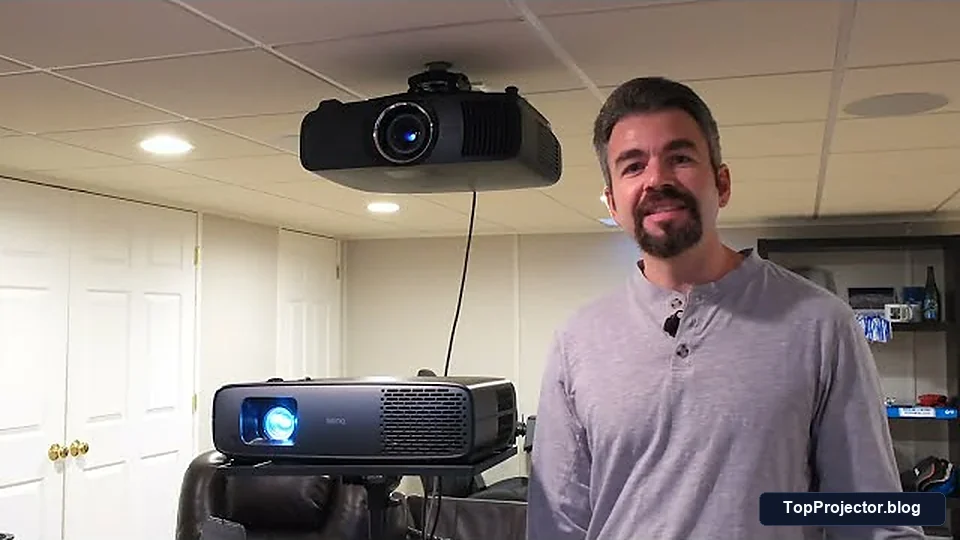
The Benq V7050I features an advanced optical design that pairs exclusively with specialized fresnel or lenticular screens. This pairing successfully absorbs off-axis ambient rays while maintaining vivid contrast.
To understand how high brightness ratings impact real-world viewing, read through our what does 100 ANSI lumens mean breakdown before pairing this 4000 ANSI lumens engine with unshaded daylight rooms.
Ultra-short throw projectors require specialized ALR screens to combat overhead illumination effectively in un-darkened living spaces. Without directional rejection layers, ambient daylight severely washes out black levels and flattens contrast.
- Benq utilizes specialized surface micro-structures to deflect overhead ceiling light.
- Epson overcomes daylight wash-out purely through brute-force lumen output.
- Both systems demand dedicated ultra-short-throw screens for optimal black saturation.
Pitch-Black Theater Versus Active Living Room Daylight
In dark environments, the Benq shines by preserving deep shadow integrity without washing out. Its optical engine optimizes black levels for dedicated media rooms.
In sunlit family rooms, Epson dominates by maintaining high saturation and bright highlights. Casual daytime sports and news look vibrant and punchy.
- Benq excels when room lighting is strictly controlled.
- Epson dominates multi-purpose living spaces with windows.
Ceiling Light Rejection Efficiency
The BenQ utilizes a specialized micro-sawtooth optic structure that deflects upward illumination away from the viewer. Meanwhile, the Epson relies on high lumen output to brute-force through ambient light without matching directional filters.
Black Levels, Contrast Ratios and Shadow Detail Performance
Achieving convincing cinematic depth requires managing the projector's black floor. High brightness often compromises native contrast, creating a difficult balancing act for manufacturers.
The Benq V7050I delivers impressive native ANSI contrast for a laser ultra-short-throw unit. Dark cinematic scenes reveal intricate shadow details without crushing blacks into muddy gray pools.
Meanwhile, the Epson LS500 prioritizes high brightness over absolute black depth. Its elevated black floor becomes apparent during dark movie sequences in pitch-black rooms.
Native contrast remains a fundamental differentiator when evaluating single-chip DLP versus 3LCD architectures in dark theater rooms. Epson units often show elevated black floors, whereas the BenQ extracts superior shadow detail in gloomy scenes.
- Benq provides superior native contrast for moody cinematic viewing.
- Epson exhibits a slightly raised black floor during dark scenes.
- Dynamic iris features help both models mitigate native contrast limitations.
Evaluating ANSI Contrast and Dynamic Range Nuances
Critical film enthusiasts will immediately notice Benq's superior shadow delineation during nocturnal sequences. Night skies retain starry pinpricks rather than glowing gray.
Epson counters with striking specular highlights in mixed-lighting scenes, giving daytime HDR content an energetic pop that captures casual viewers' attention instantly.
- Benq preserves starfields and dark cinematic mood effectively.
- Epson delivers explosive specular highlights in bright sequences.
Dynamic Iris and Gamma Tracking
Implementing aggressive dynamic contrast algorithms helps compensate for native limitations during mixed-lighting viewing conditions. Careful calibration of gamma curves prevents dark-scene crushing while maintaining punchy specular highlights across cinematic content.
Peak Brightness, Color Gamut and High Dynamic Range Handling
Color fidelity and HDR mapping dictate how closely your projected image matches Hollywood mastering standards. Modern laser engines must balance wide color gamuts against high light output.
The Benq V7050I covers a remarkable 98% of the DCI-P3 cinematic color space out of the box. Skin tones appear remarkably natural and free of artificial tinting.
Similar triple-laser color fidelity can be explored inside the XGIMI Horizon Pro review, which analyzes how competing light engines handle rainbow artifacts and vibrant saturation for sensitive viewers.
High lumen counts do not automatically translate to accurate wide color rendering under stringent Rec. 709 calibration targets. The Epson pushes immense white brightness, but color volume occasionally desaturates during maximum output modes.
- Benq achieves stellar cinematic color accuracy matching director intent.
- Epson utilizes 3LCD tech to eliminate rainbow artifacts completely.
- Wide color filters on Benq sacrifice some brightness for rich saturation.
HDR Tone Mapping and Wide Color Gamut Calibration
HDR metadata handling requires precise tone mapping to prevent blown-out highlights. Benq applies intelligent tone mapping curves tailored for dark-room cinema immersion.
Epson leverages its massive lumen reserve to map HDR highlights effectively in bright spaces, ensuring HDR content remains visible despite ambient illumination.
- Benq focuses tone mapping on cinematic shadow preservation.
- Epson utilizes high lumen output for impactful HDR highlights.
HDR Tone Mapping Performance
Processing dynamic metadata accurately is crucial for laser projection systems lacking infinite native contrast. Both models apply distinct tone mapping curves to preserve highlight details without plunging mid-tones into muddy shadows.
Throw Ratios, Screen Size and Physical Installation Geometry
Ultra-short-throw projectors live dangerously close to your screen surface, making throw geometry crucial. Millimeter-level positioning adjustments can make or break screen alignment.
The Benq V7050I features an ultra-short throw ratio of 0.25:1, projecting a massive 120-inch image from just inches away. Its gorgeous motorized top lid adds a touch of elegance.
You should verify your credenza depth using our throw distance calculator tool to ensure the 100-inch to 130-inch diagonal projection fits your specific room dimensions without geometric distortion.
Ultra-short throw geometry demands precise wall spacing to achieve a distortion-free one-hundred-inch diagonal image. Even minor alignment errors create severe geometric distortion that challenges standard manual keystone correction tools.
- Benq requires minimal distance from the wall for massive projection.
- Epson offers flexible sizing up to 130 inches diagonal.
- Accurate cabinet placement is mandatory for both units to prevent distortion.
Cabinet Placement and Wall Alignment Challenges
Integrating these projectors into existing living room furniture requires specific cabinet depths. Benq's chassis fits comfortably on standard media consoles without awkward extensions.
Epson's unique projection angle sometimes requires pulling the media console slightly away from the wall to achieve maximum screen size alignment.
- Benq sits flush against most standard living room credenzas.
- Epson may require custom furniture adjustments for large sizes.
Cabinet Depth and Wall Clearance
Accommodating massive console footprints requires deeper media credenzas than conventional living room furniture typically provides. Calculating exact throw ratios prevents unexpected positioning hurdles during final hardware installation.
Motion Handling, Input Lag and Casual Console Gaming
Modern living room projectors frequently double as massive gaming displays for consoles. Fast response times and fluid motion handling are essential for competitive gameplay.
The Epson LS500 delivers competitive input lag numbers, making fast-paced first-person shooters feel responsive and immediate. Quick twitch movements register without frustrating delays.
The Benq V7050I exhibits slightly higher input lag figures, making it better suited for casual RPGs and adventure titles rather than twitch-based competitive esports.
Fast-paced gaming demands minimal controller latency to ensure responsive inputs during competitive split-screen match sessions. High input lag figures can ruin quick-twitch reflex titles, making low-latency processing modes essential for living room setups.
- Epson provides lower input lag for responsive gaming sessions.
- Benq handles cinematic RPGs beautifully despite moderate latency.
- Motion interpolation settings help smooth out cinematic 24fps panning shots.
Console Gaming and Rapid Motion Artifact Suppression
Testing racing titles reveals smooth frame delivery on both projectors. However, Epson's low latency gives it a clear edge for split-second competitive maneuvers.
Benq compensates with superior motion blur reduction during slow cinematic pans, keeping movie playback looking organic and free of soap-opera effect.
- Epson wins outright for responsive competitive gaming.
- Benq preserves natural cinematic motion for movie buffs.
Frame Interpolation and 24p Playback
Cinematic film purists prefer disabling frame interpolation entirely to avoid the dreaded soap opera effect during movie nights. Maintaining pristine 24p playback preserves director intent without introducing jarring motion artifacts on screen.
Audio Integration, Aesthetics and Physical Build Quality
Living room aesthetics matter immensely when placing a large console device under your screen. Integrated sound systems help reduce cable clutter in minimalist spaces.
The Benq V7050I includes a surprisingly robust treVolo built-in soundbar. It delivers clear dialogue and room-filling sound without requiring external speakers for casual viewing.
We recommend checking out the best projector to watch movies guide if you plan on building a dedicated room with a multi-channel surround sound system instead of relying on internal speakers.
Built-in soundbars provide convenient audio solutions, but dedicated multi-channel surround setups easily outperform internal drivers. Acoustic transparency and harmonic distortion limits dictate whether onboard speakers suffice for casual daily television watching.
- Benq features an integrated treVolo soundbar with clear dialogue.
- Epson includes internal speakers adequate for casual daytime viewing.
- Both units benefit greatly from external dedicated audio setups.
Chassis Design and Living Room Aesthetic Integration
Benq's sleek white chassis and motorized dust lid integrate seamlessly into modern living room decor. It looks like high-end furniture rather than industrial AV equipment.
Epson's utilitarian design prioritizes cooling efficiency and high-output durability, looking more at home in a dedicated media room or modern loft.
- Benq boasts furniture-grade aesthetics with a motorized lid.
- Epson utilizes a utilitarian cooling-focused industrial chassis.
Chassis Acoustics and Fan Noise
High-output laser diodes generate substantial internal heat requiring aggressive cooling fans that can disrupt quiet movie scenes. Low decibel ratings ensure uninterrupted immersion during dramatic dialogue sequences in treated rooms.
Ultimate Scenario Verdict and Final Buyer Guidance
Selecting the correct ultra-short-throw projector boils down to your specific room lighting conditions and viewing priorities. Neither projector serves every single home theater scenario equally.
Choose the Benq V7050I if your primary goal is dark-room cinematic immersion, accurate skin tones, and superior black levels. It rewards film enthusiasts with breathtaking color accuracy.
Select the Epson LS500 if your living room floods with daylight and you need massive brightness. Its searing light output and low gaming latency conquer active family spaces.
Choosing between these competing laser powerhouses depends entirely on your specific room lighting and viewing priorities. Dedicated home theaters benefit from accurate color performance, while bright spaces demand high sustained brightness.
- Benq is the ultimate choice for dedicated movie nights and dark rooms.
- Epson dominates bright living spaces and active family environments.
- Match your screen selection carefully to maximize optical performance.
Final Recommendation Checklist for Home Theater Buyers
Audit your room's ambient light sources before making a final purchasing commitment. Measure your viewing distance and furniture depth to ensure seamless installation.
Investing in a high-quality ambient light rejecting screen unlocks the true potential of both laser projection systems, elevating contrast and color saturation.
- Audit living room light sources thoroughly prior to purchase.
- Pair your chosen projector with a certified ALR screen.
Final Decision Matrix
Weigh your ambient light conditions against your critical viewing habits before committing to a permanent ultra-short throw investment. Prioritizing optical alignment ensures long-term satisfaction regardless of your chosen hardware platform.
Frequently Asked Questions
Can I use the Benq V7050I in a brightly lit living room?
Yes, but you must pair it with a specialized ambient light rejection screen. Without a proper ALR screen, daytime viewing will suffer from washed-out contrast and muted colors.
Does the Epson LS500 suffer from the rainbow effect common in DLP projectors?
No, because the Epson LS500 utilizes a 3LCD optical engine instead of a single-chip DLP design. This eliminates color breakup artifacts entirely for sensitive viewers.
What is the recommended screen size for these ultra-short-throw models?
Both projectors excel between 100 inches and 120 inches diagonal. Sticking within this range preserves optimal pixel density and panel brightness for HDR content.
Do I need an external sound system with the Benq V7050I?
The built-in treVolo soundbar is sufficient for casual television viewing and dialogue. However, home theater enthusiasts will want a dedicated surround sound setup for movies.
Which projector is better suited for fast-paced console gaming?
The Epson LS500 offers lower input lag and quicker response times. This makes it the superior choice for competitive first-person shooters and fast action titles.