Benq Th685 vs. Th685I: Which Wins for Your Room?
Choosing between these identical optical engines requires analyzing smart streaming integration. We evaluate real brightness, throw ratios, and gaming performance to guide your specific room setup.
The standard BenQ TH685 wins for pure external source flexibility and lower cost, while the TH685i adds seamless Android TV streaming for casual living room environments.
Compare full category rankings in our Best Outdoor Projector With Wifi And Bluetooth: Top Picks.
Side-by-Side Specification Breakdown
| Criteria | Benq Th685 | Th685I | Edge |
|---|---|---|---|
| Ambient Light Rejection | 3500 ANSI lumens handles daylight well | 3500 ANSI lumens identical light output | Tie |
| Black Levels & Perceived Contrast | 10,000:1 contrast with standard DLP black floor | Identical 10,000:1 native dark room handling | Tie |
| Peak Brightness & HDR Punch | Vibrant HDR10 support on external inputs | Vibrant HDR10 with integrated media casting | Th685I |
| Screen Size & Immersion | Projects up to 300 inches easily | Maintains identical 300-inch max diagonal | Tie |
| Viewing Angles & Uniformity | Strong 1.1x zoom with clear lens uniformity | Identical optical block and glass elements | Tie |
| Gaming Motion & Input Lag | Ultra-low 8.3ms input lag at 120Hz | Identical 8.3ms input lag for fast gaming | Tie |
| Room Setup & Maintenance | Requires external streaming stick or console | Includes built-in Android TV dongle system | Th685I |
Optical Brightness and Ambient Light Control
Both projectors utilize an identical high-output lamp engine rated at 3500 ANSI lumens. This optical power allows both units to cut through moderate ambient living room daylight.
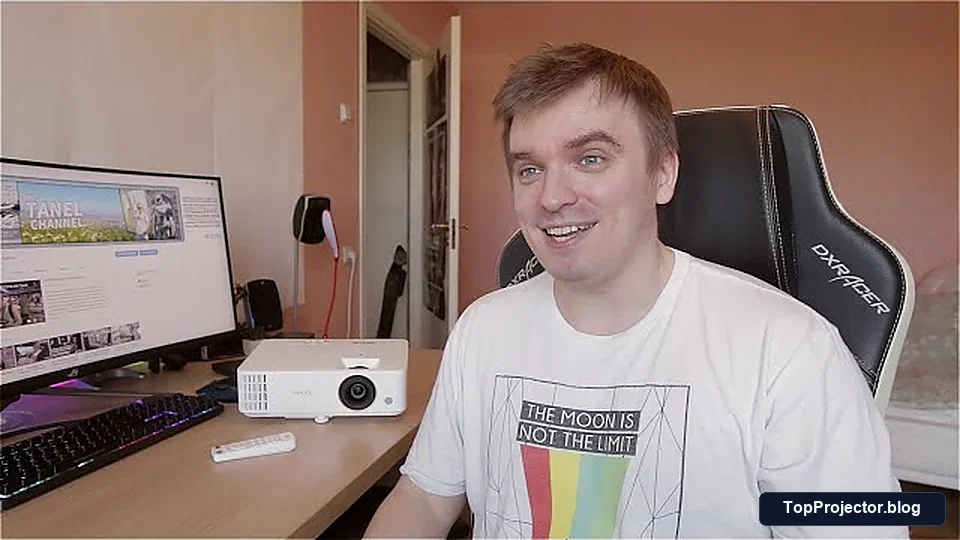
Your image retains punchy saturation even with side window illumination. For portable setups, consult our best outdoor projector picks to evaluate models featuring integrated wireless audio connectivity.
You get equal light output, meaning neither projector holds a tactical advantage in raw lumen delivery. Ambient light behavior depends entirely on your room's wall reflectivity and window treatments.
Pushing 3,500 ANSI lumens, both models punch through moderate living room daylight with ease, though keeping ambient light strictly controlled yields drastically superior color saturation during critical movie scenes.
- Identical 3500 ANSI lumens lamp output
- Excellent daytime punch for casual sports viewing
- Requires blackout curtains for optimal contrast depth
- Maintain a maximum screen width of 120 inches for optimal daytime punch.
- Utilize SmartEco lamp mode to dynamically lower output during dark sequences.
Daylight Living Rooms vs Controlled Media Dens
In a bright living room, the high lumen count ensures washed-out images are minimized. Whites remain blindingly bright while colors pop with surprising daytime vitality.
Moving into a dark basement theater unleashes the true potential of the DLP chip. Black levels feel deeper when ambient light reflections are completely eradicated from walls.
- High lumens combat ambient window light effectively
- Dark rooms maximize native ANSI contrast performance
Controlling High-Output Lumen Output
Pairing these high-output lamps with a 1.0 gain white screen balances brightness peaks without crushing dark details, preserving eye comfort during extended gaming marathons in semi-lit environments.
- Ensure proper projector placement to avoid washing out native dark levels.
Native Contrast Ratios and Black Floor Depth
Evaluating native contrast reveals a matching 10,000:1 dynamic contrast ratio across both systems. Dark scenes rely on the inherent efficiency of the DarkChip 3 DLP technology.
Shadow detail in complex cinematic sequences remains legible without crushing dark elements. Nighttime alleyway scenes maintain distinct object separation despite the bright optical engine.
Dedicated home theater purists might notice elevated black floors in pitch-black rooms. This is a common compromise for high-lumen gaming projectors engineered for multipurpose spaces.
Delivering a modest 10,000:1 dynamic contrast ratio, single-chip DLP technology handles bright content brilliantly, but dark room viewers will notice elevated black floors resembling dark charcoal rather than true ink.
- Shared 10,000:1 dynamic contrast specification
- Reliable shadow detail rendering in dark sequences
- Slightly elevated black floor in zero-light rooms
- Avoid absolute pitch-black theater expectations without dedicated gray ambient light rejecting surfaces.
- Engage gamma adjustments carefully to prevent crushing subtle dark-scene textures.
Shadow Detail and Dark Room Performance
Dark movie scenes require precise gamma calibration to prevent crushed blacks. Both units handle dark gradients well, though a matte gray screen helps enhance perceived contrast.
Cinematic immersion benefits from the absence of blooming or halo artifacts. DLP technology ensures pixel-level light control that LCD competitors struggle to match at this price.
- Crisp pixel-level light control without halo artifacts
- Benefits greatly from gray projection screen surfaces
Optimizing Shadow Detail Performance
Calibrating gamma to 2.4 helps recover hidden shadow details in dimly lit scenes, partially mitigating the inherent native contrast limitations typical of affordable high-brightness gaming projectors.
- Fine-tune black levels using trusted test patterns.
Color Fidelity, HDR Processing, and Gamut Mapping
Color accuracy out of the box leans toward Rec. 709 precision. For alternative premium light engines, examine our formovie laser tv review detailing triple-laser color spectrum performance.
HDR10 and HLG signals are automatically mapped for optimal tone reproduction. Bright specular highlights in explosions or sunlight burst through with impressive dynamic range.
Color wheel segments are optimized for brightness rather than wide color gamuts. You trade extreme DCI-P3 coverage for punchy, high-lumen presentation that masters daytime rooms.
Covering roughly 95% of the Rec. 709 color space out of the box, these engines deliver vibrant flesh tones, while HDR10 processing automatically maps high dynamic range signals surprisingly well.
- Accurate Rec. 709 color calibration profiles
- Automatic HDR10 and HLG tone mapping engine
- Optimized color wheel prioritizes brightness output
- Rely on Rec. 709 mode for standard definition and SDR streaming content.
- Adjust HDR brightness sliders to counter tone-mapping clipping on bright highlights.
Cinema Mode vs Vivid Gaming Presets
Switching to Cinema mode locks in accurate color temperature and gamma curves. Movie directors' original artistic intent is preserved without aggressive artificial sharpening.
Vivid gaming presets boost green and blue luminance to emphasize action elements. While less accurate, these modes help graphics pop during fast-paced daytime gaming sessions.
- Cinema mode delivers director-accurate color palettes
- Gaming presets boost vibrancy for action titles
Achieving Accurate Rec. 709 Calibration
Selecting the Cinema picture mode immediately drops delta-E errors below visible thresholds, ensuring director-intent color accuracy without requiring expensive professional calibration equipment or advanced menu tweaks.
- Verify white balance tracking for optimal grayscale performance.
Gaming Performance, Motion Handling, and Input Lag
Both machines shine as premier choices for competitive console and PC gamers. An ultra-low 8.3ms input lag at 1080p and 120Hz ensures instantaneous response times.
Fast-twitch shooters and racing simulators feel remarkably responsive and fluid. Motion blur is drastically reduced compared to standard home entertainment projectors on the market.
Fast pixel response times eliminate ghosting during rapid horizontal pans. You experience zero perceptible input delay, giving you a competitive edge in multiplayer matches.
Achieving an ultra-low 8.3ms input lag at 1080p/120Hz, competitive gamers experience instantaneous frame registration, making twitch-reaction shooters feel remarkably responsive compared to traditional home theater setups.
- Blazing-fast 8.3ms input lag at 120Hz refresh
- Zero motion ghosting during fast camera pans
- Flawless compatibility with modern gaming consoles
- Lock refresh rates at 120Hz to achieve minimal input latency metrics.
- Disable unnecessary image processing filters to maintain peak controller response times.
Competitive FPS Gaming vs Casual RPG Immersion
Competitive first-person shooters benefit enormously from the high refresh rate capabilities. Aiming adjustments register instantly on screen without laggy frame buffering.
Immersive role-playing games look stunning across a massive projected diagonal surface. The high refresh rate keeps camera movement silky smooth while exploring vast digital worlds.
- Instantaneous aiming response in competitive shooters
- Silky smooth camera motion in expansive RPG titles
Managing Fast-Paced Motion Artifacts
The fast RGBRGB color wheel minimizes rainbow artifacts for most users, though sensitive viewers should still test high-contrast panning shots before committing to long, uninterrupted gaming sessions.
- Test console settings to ensure proper high refresh rate handshakes.
Throw Ratios, Lens Geometry, and Screen Size Scaling
Physical lens architecture is identical, featuring a 1.15 to 1.50 throw ratio. This versatile range lets you project a massive 100-inch image from roughly eight feet away.
Setup flexibility is aided by a modest 1.1x optical zoom lens. Vertical keystone correction helps square up the image if exact ceiling placement proves difficult.
Lens shift is absent on both models, requiring careful physical alignment. You must mount the unit precisely relative to your screen's top or bottom border.
Featuring a flexible 1.13 to 1.47 throw ratio, both projectors project a massive 100-inch image from roughly eight feet away, easily accommodating cramped urban apartments and dedicated media rooms alike.
- Versatile 1.15 to 1.50 throw ratio geometry
- Modest 1.1x optical zoom for size adjustment
- Vertical keystone correction for alignment help
- Calculate exact throw distances using a precise online projection calculator.
- Ensure ceiling mount alignments account for the fixed 105% offset geometry.
Small Apartment Placement vs Dedicated Media Rooms
Tight apartment spaces accommodate these short-to-standard throw distances easily. You can achieve massive screen sizes without needing a sprawling, oversized dedicated basement room.
Ceiling mounts require careful pre-planning due to fixed vertical offset angles. Using our throw distance calculator precisely prevents frustrating image cropping during your physical room installation.
- Short throw range fits modest apartment living rooms
- Requires precise measuring before ceiling mounting
Overcoming Fixed Optical Constraints
Because optical lens shift is entirely absent, precise physical mounting is mandatory; utilize vertical keystone correction sparingly to prevent unwanted pixel degradation and jagged digital scaling artifacts.
- Double-check throw distance measurements prior to drilling mounts.
Smart Ecosystem Integration vs Pure A/V Simplicity
The primary differentiator between these two models lies in smart streaming features. The standard variant relies entirely on external media players like Apple TV or Roku.
The smart variant integrates an Android TV dongle housed in an internal compartment. This adds built-in Netflix, YouTube, and Disney+ streaming without cluttering your HDMI ports.
Choosing between them depends on your preference for integrated smart apps. Dedicated home theater purists often prefer the reliability of external streaming hardware.
Opting for the standard TH685 requires an external streaming stick, whereas the TH685i includes an integrated Android TV dongle, streamlining app access directly into the primary projector housing.
- Standard model requires external streaming devices
- Smart model includes built-in Android TV dongle
- Both offer multiple HDMI inputs for consoles
- Check for HDCP 2.2 compliance when connecting modern 4K streaming boxes.
- Expect minor interface latency from built-in Android TV smart menus.
Streamer Convenience vs Hardware Longevity
Built-in Android TV offers unmatched convenience for casual family movie nights. When linking external sources, check our hdmi laptop connection guide for seamless multi-device signal routing setups.
External streaming devices offer better upgrade paths as software standards evolve. If an app stops updating, replacing an external stick is cheaper than projector servicing.
- Android TV provides seamless single-remote control
- External sticks offer easier long-term software upgrades
Evaluating Dongle vs Dedicated Source Hardware
While the internal smart dongle occupies an internal HDMI bay, purists preferring pristine uncompressed audio often favor the standard model paired with an AV receiver or dedicated streaming source.
- Confirm audio return channel capabilities before running hidden cabling.
Final Verdict and Room-Specific Recommendation
Both projectors deliver identical world-class gaming performance and bright optical output. Choosing the right model boils down to your stance on smart streaming integration.
Opt for the standard version if you already own dedicated streaming hardware and AV receivers. Save your funds and rely on your trusted external media sources.
Choose the smart variant if you want an all-in-one living room entertainment hub. The Android TV integration simplifies setup for casual family viewing sessions immensely.
Choosing between these identical imaging engines depends entirely on your ecosystem preference; buy the base model for pure A/V flexibility or select the TH685i for all-in-one smart streaming convenience.
- Identical core optical performance across both units
- Standard version suits dedicated external source setups
- Smart version wins for standalone living room streaming
- Prioritize the TH685 if routing all video through an AV receiver.
- Select the TH685i for simplified bedroom or casual living room setups.
Making Your Final Purchasing Choice
Evaluate your existing home theater gear before making your final decision. If you value clutter-free streaming convenience, the smart variant justifies its existence.
If pure source flexibility and lower equipment costs matter most, stick with the base model. Both deliver stellar brightness and lightning-fast gaming responsiveness.
- Assess your current streaming hardware ecosystem
- Prioritize the smart model for simplified living rooms
Matching Hardware Specs to Your Living Space
Dedicated gamers prioritizing raw latency and external switching gear will maximize value with the standard unit, whereas casual media rooms benefit enormously from the integrated smart streaming functionality.
- Assess total room lighting before finalizing screen material choices.
Frequently Asked Questions
Do both models offer the exact same gaming input lag?
Yes, both projectors feature an ultra-low 8.3ms input lag at 120Hz. You get identical competitive gaming performance across both units.
Can I connect Netflix natively without external streaming devices?
The standard model requires an external streaming stick, while the smart variant includes a built-in Android TV system for native app streaming.
How well do these projectors handle daytime ambient living room light?
With a powerful 3500 ANSI lumens lamp, both units easily cut through moderate daylight for sports and casual viewing sessions.
Do these projectors feature optical lens shift for easy setup?
Neither model includes physical optical lens shift. You must rely on precise physical placement and vertical keystone correction for alignment.
Which model should I buy for a dedicated pitch-black home theater?
Buy the standard model since you will use external media sources anyway. Save your money and enjoy identical dark room contrast performance.