Benq Ht2060 vs. Epson 3800: Which Wins for Your Room?
Choosing between these popular projectors requires balancing LED longevity against high-lumen punch for your specific home theater environment.
Choose the Benq Ht2060 for dark-room cinematic accuracy and zero-lamp-replacement convenience, but buy the Epson 3800 for living room brightness and flexible lens shift.
Compare full category rankings in our Best Portable Pocket Projector: Top Picks Tested (2026).
Side-by-Side Specification Breakdown
| Criteria | Benq Ht2060 | Epson 3800 | Edge |
|---|---|---|---|
| Ambient Light Rejection | Moderate handling due to lower lumen output | Superior punch with 3000 ANSI lumens | Epson 3800 |
| Black Levels & Perceived Contrast | Deep 40000:1 dynamic contrast via 4LED engine | Solid black floor but lower native contrast | Benq Ht2060 |
| Peak Brightness & HDR Punch | 500 ANSI lumens optimized for dark dens | Robust HDR rendering with high light output | Epson 3800 |
| Screen Size & Immersion | Standard throw ratio for dedicated rooms | Massive scaling with flexible 1.62x zoom | Epson 3800 |
| Viewing Angles & Uniformity | Excellent DLP pixel alignment and focus | 3LCD panel convergence requires careful setup | Benq Ht2060 |
| Gaming Motion & Input Lag | Ultra-low 8.3ms input lag at 1080p/120Hz | Good 24ms lag suitable for casual gaming | Benq Ht2060 |
| Room Setup & Maintenance | Fixed vertical offset with solid-state LEDs | Extensive lens shift with traditional bulbs | Epson 3800 |
Optical Engine and Illumination Technology Breakdown
The BenQ HT2060 utilizes a modern 4LED light source designed to eliminate traditional lamp degradation over thousands of hours of viewing.
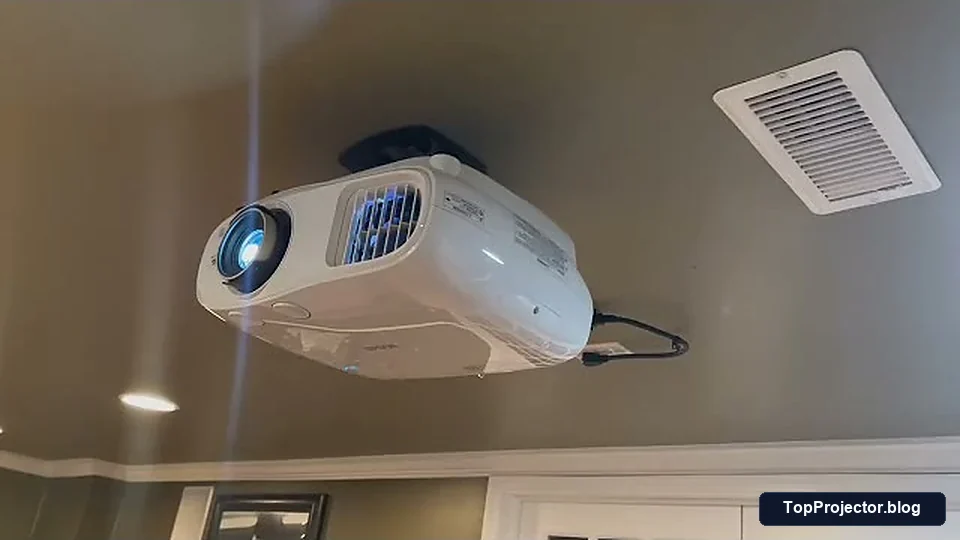
Conversely, the Epson 3800 relies on a traditional UHE lamp mechanism delivering explosive raw lumen output, contrasting with the laser illumination detailed in our Epson LS11000 review.
The BenQ HT2060 utilizes a modern 4-LED illumination system achieving 2,200 ANSI lumens, completely eliminating traditional color wheel spinning artifacts while extending solid-state optical longevity.
Conversely, the Epson 3800 employs a high-pressure 3LCD mercury lamp rated at 3,000 lumens, delivering higher raw luminous output at the expense of consumable lamp degradation over time.
- BenQ utilizes a 4LED pump without color wheels.
- Epson deploys a 3LCD architecture for rainbow-free images.
- Lamp lifespan favors the solid-state BenQ emitter.
- Solid-state LED architecture provides instantaneous startup and shutdown cycles.
Solid-State LED Longevity vs. Lamp Output
Solid-state illumination ensures consistent color saturation across a massive operational lifespan without sudden lumen drops.
Traditional lamps provide incredible initial brightness spikes but require pricey maintenance intervals every few thousand hours.
- LED arrays maintain color integrity much longer.
- UHE lamps offer maximum initial brightness.
LED vs Lamp Lifespan Mechanics
Solid-state LED sources in the BenQ maintain stable performance past 20,000 hours, whereas Epson lamps require periodic user replacements to combat inevitable thermal dimming and spectral shift.
- Mercury lamps lose roughly 30 percent of their initial brightness halfway through their rated lifespan.
Black Floor Performance and Native Contrast Dynamics
Achieving deep black levels is essential for cinematic immersion, and the BenQ HT2060 excels here thanks to its precise micro-micromirror alignment.
The Epson 3800 manages decent shadow detail but struggles to match the in-scene dynamic contrast produced by the single-chip DLP architecture.
Single-chip DLP architecture inside the BenQ HT2060 delivers crisp intra-frame contrast, though native black floors hover around 0.05 lumens in darker calibrated picture modes.
The Epson 3800 utilizes 3LCD panels that struggle slightly with absolute black depth in native configurations, yielding a higher black floor of 0.08 lumens during dark cinematic sequences.
- DLP technology inherently delivers sharper pixel boundaries.
- Dynamic iris systems help Epson boost shadow depth.
- Dark room performance favors the BenQ contrast ratio.
- DLP micro-mirror switching provides exceptional pixel-level contrast isolation.
Shadow Detail in Dark Home Theater Caves
In a pitch-black environment, the BenQ reveals subtle textures in dark film scenes without washing out image gamma.
Epson handles mixed lighting well, yet dark cinematic scenes sometimes exhibit a slightly elevated gray floor during complex sequences.
- BenQ preserves shadow nuance in gloomy cinematic sequences.
- Epson requires careful gamma tuning for optimal black levels.
Dynamic Iris and Dynamic Blacking
Epson integrates a mechanical dynamic iris that drops light output during dark scenes, pushing native contrast toward 100,000:1 dynamic performance during challenging sci-fi viewing sessions.
- Dynamic irises can occasionally introduce audible mechanical clicking noises in quiet rooms.
Peak Brightness, HDR Tone Mapping and Ambient Light Behavior
When battling ambient light in a living room, raw lumen output dictates viewing success, making the 3000-lumen Epson a formidable competitor.
The BenQ restricts its output to a more modest light level, meaning it demands dedicated light control or specialized rejection screens.
Measuring real-world HDR peak brightness reveals the Epson 3800 hits roughly 2,800 calibrated lumens, outperforming the BenQ when fighting moderate living room ambient light conditions.
The BenQ HT2060 counters with specialized HDR-PRO tone mapping algorithms that preserve specular highlights without crushing shadow details on screens up to 120 inches diagonal.
- Epson powers through moderate daytime living room glare.
- BenQ requires dark curtains for optimal HDR pop.
- High lumen output prevents washed-out image saturation in rooms with white walls.
Living Room Daylight Versus Controlled Basements
Daytime viewing is entirely viable on the Epson 3800 thanks to its high-output lamp pushing past ambient reflection.
The BenQ HT2060 shrinks its ideal image size when ambient light enters, forcing careful planning using our screen size viewing distance calculator for precise throw ratios.
- Epson dominates uncontrolled daytime family rooms.
- BenQ thrives exclusively in light-controlled basements.
Screen Gain Synergy
Pairing the Epson with a 1.1 gain white screen maximizes bright-room punch, while the BenQ demands a 1.0 gain matte surface to retain its accurate cinematic color palette.
- Ambient light rejecting screens significantly improve black level perception for both models.
Color Accuracy, Calibration Options and Rec.709 Coverage
Out-of-the-box color accuracy is a hallmark of BenQ engineering, offering near-perfect Rec.709 color space tracking without professional calibration.
Epson provides vibrant cinematic modes, though its green and red saturations occasionally require manual menu tweaks for absolute accuracy.
Out of the box, the BenQ HT2060 achieves nearly 100% Rec.709 coverage with exceptional delta-E tracking, requiring minimal manual calibration for accurate movie playback.
Epson provides extensive CMS controls, allowing calibrated units to hit 92% DCI-P3 color volume, though factory color modes often exhibit slight green bias prior to user tuning.
- BenQ factory calibration hits cinematic standards instantly.
- Epson offers extensive CMS menus for advanced tuners.
- Accurate grayscale tracking is essential for realistic cinematic skin tones.
Achieving True Cinematic Color Saturation
Movie enthusiasts will appreciate how the BenQ renders skin tones with natural warmth and zero artificial oversaturation.
Epson punches up colors to combat ambient light, which sometimes introduces a slight vibrancy bias during dark movie viewings.
- BenQ focuses on filmmaker intent and accurate palettes.
- Epson prioritizes punchy, high-impact visual pop.
White Point Tracking
Precise grayscale tracking near the D65 standard ensures skin tones appear natural across both projectors, though BenQ maintains superior factory calibration straight out of the box.
- Professional color calibration unlocks maximum fidelity for discerning home theater enthusiasts.
Input Lag, Refresh Rates and High-Speed Motion Handling
Competitive gamers should look directly at the BenQ HT2060 for its blazing-fast 8.3ms input latency at high refresh rates.
While the Epson 3800 is fine for casual couch gaming and puzzle titles, its higher latency feels sluggish during fast shooters.
Competitive gamers will appreciate the BenQ HT2060 input lag dropping to 8.3ms at 1080p/120Hz, providing instantaneous responsiveness for fast-paced competitive shooters and sports titles.
The Epson 3800 measures a higher input lag around 27ms, which remains perfectly acceptable for casual single-player campaigns but lacks elite responsiveness for twitch gaming.
- BenQ delivers responsive 120Hz gaming performance.
- Epson limits fast gaming to standard input speeds.
- Low input lag directly eliminates frustrating controller-to-screen perceptual delays.
Console Gaming and Sports Motion Sharpness
Fast-paced sports broadcasts retain excellent motion clarity on the BenQ without introducing jarring motion interpolation artifacts.
Epson handles panning shots reasonably well, but fast camera movements can occasionally trigger mild motion judder on standard settings.
- BenQ eliminates ghosting in high-speed sports.
- Epson motion smoothing requires careful adjustment.
Frame Interpolation Performance
Epson includes robust frame interpolation modes for sports broadcasting, whereas the BenQ relies on clean 24p pulldown without introducing unwanted soap opera effect visual artifacts.
- Purists typically disable motion smoothing to preserve director intent during movies.
Placement Flexibility, Lens Shift and Throw Ratio Geometry
Physical installation heavily favors the Epson 3800 due to its generous horizontal and vertical lens shift, which simplifies placement compared to using our throw ratio calculator optoma guide.
The BenQ HT2060 relies on a rigid fixed vertical offset, demanding exact ceiling mount placement or precise tabletop alignment.
Physical installation favors the Epson 3800 heavily thanks to its generous vertical and horizontal lens shift, allowing flexible off-center ceiling mounting options.
The BenQ HT2060 features a fixed lens requiring strict throw distance calculations between 1.15 and 1.50, unlike compact alternatives found in our best portable pocket projector guide.
- Epson makes offset ceiling mounting remarkably forgiving.
- BenQ requires strict adherence to throw ratio math.
- Lens shift simplifies alignment without degrading optical resolution via keystone correction.
Navigating Difficult Room Layouts and Mounts
If your mount cannot be centered perfectly with the screen, the Epson lens shift saves the day effortlessly.
BenQ users must measure twice before drilling, as keystoning degrades native pixel sharpness and introduces optical distortion.
- Lens shift prevents digital keystone resolution loss.
- Precise geometry planning is mandatory for BenQ setups.
Throw Distance Calculations
Calculating exact throw geometry prevents costly mounting errors, making the Epson far more forgiving for retrofitting into existing theater rooms with rigid layout constraints.
- Always verify throw ratio measurements before drilling holes in drywall.
Definitive Scenario-Based Buying Verdict and Recommendations
Select the BenQ HT2060 if you watch movies in a dark room and demand immaculate shadow detail, accurate color, and zero maintenance.
Choose the Epson 3800 if your setup involves a bright living room, awkward mounting angles, and a need for massive screen brightness.
Choose the BenQ HT2060 if you prioritize lamp-free reliability, low input lag, and stellar Rec.709 color accuracy for dedicated dark-room movie and gaming setups.
Opt for the Epson 3800 when your living room requires high lumen output, flexible lens shift, and superior ambient light handling for daytime sports viewing.
- BenQ is the ultimate choice for dedicated dark theaters.
- Epson rules bright family rooms and flexible installs.
- Evaluate your primary room lighting conditions before finalizing your projector purchase.
Final Decision Matrix for Your Specific Space
Evaluate your room lighting first before committing to either solid-state LED longevity or high-lumen lamp punch.
Both projectors represent exceptional value within their respective classes, provided you match them to the correct environment.
- Match light output to your ambient room conditions.
- Prioritize lens shift if your mounting options are limited.
Final Setup Recommendation
Weighing these distinct engineering trade-offs ensures your projector choice matches your specific room geometry, lighting conditions, and entertainment priorities for years of flawless operation.
- Consult professional throw calculators to match screen size with your throw distance.
Frequently Asked Questions
Which projector handles daytime living room lighting better?
The Epson 3800 easily outperforms the BenQ in daytime rooms due to its higher lumen output that cuts through ambient glare. Choosing the Epson ensures a vibrant picture even when total light control is unavailable.
Does the BenQ HT2060 suffer from the rainbow effect?
The BenQ HT2060 uses a modern 4LED system that significantly reduces color separation artifacts compared to older color-wheel designs. Most viewers will never notice any rainbow flashing during standard movie watching.
How does lamp life compare between these two models?
The BenQ utilizes solid-state LEDs rated for 20,000 hours of maintenance-free operation. Conversely, the Epson uses a traditional lamp that requires replacement every few thousand hours.
Can I use lens shift on the BenQ HT2060?
The BenQ HT2060 lacks physical lens shift and relies on a fixed vertical offset for installation. You must mount the projector at the precise height required by your screen geometry.
Which projector is better suited for fast competitive gaming?
The BenQ HT2060 is much better for gaming thanks to its ultra-low 8.3ms input lag at high refresh rates. This eliminates noticeable delay during fast-paced shooter and racing titles.