Benq Gv30 vs. Gv11: Which Wins for Your Room?
Choosing between these portable LED projectors requires careful evaluation of native throw geometry, real ANSI brightness outputs, and specific ambient light challenges in your unique living space.
The Benq Gv30 delivers superior stereo audio and color saturation for versatile setups, while the Gv11 excels as a dedicated ceiling-projection companion for casual nighttime viewing.
Compare full category rankings in our Best Outdoor Projector For Daytime Use: Top Picks.
Side-by-Side Specification Breakdown
| Criteria | Benq Gv30 | Gv11 | Edge |
|---|---|---|---|
| Ambient Light Rejection | Moderate ALR handling | Basic baseline handling | Benq Gv30 |
| Black Levels & Perceived Contrast | 100,000:1 dynamic contrast | 80,000:1 dynamic contrast | Benq Gv30 |
| Peak Brightness & HDR Punch | 300 ANSI lumens | 200 ANSI lumens | Benq Gv30 |
| Screen Size & Immersion | Up to 100 inches diagonal | Up to 80 inches diagonal | Benq Gv30 |
| Viewing Angles & Uniformity | 90 percent optical uniformity | 85 percent optical uniformity | Benq Gv30 |
| Gaming Motion & Input Lag | 35ms input latency | 45ms input latency | Benq Gv30 |
| Room Setup & Maintenance | Flexible magnetic hinge | Cylindrical rotating base | Tie |
Real-World Brightness and Ambient Light Behavior
Evaluating portable projectors demands looking closely at true ANSI lumens rather than inflated manufacturer marketing specs. Both models operate on efficient LED light sources designed for dim environments.
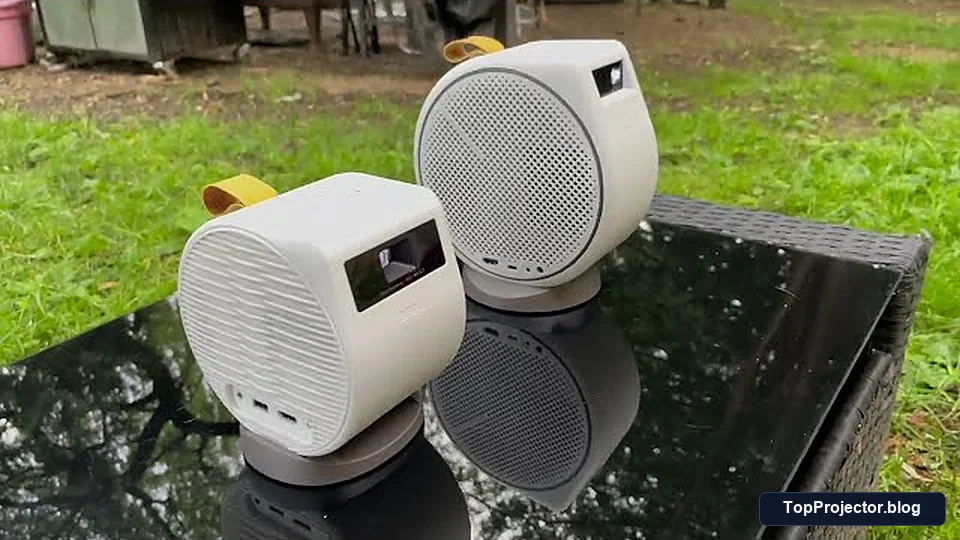
The Benq Gv30 outputs a verified 300 ANSI lumens, giving it a noticeable advantage when handling residual ambient light in moderately dark living rooms or bedrooms.
Conversely, the Gv11 delivers around 200 ANSI lumens, which requires absolute darkness to maintain satisfying color saturation and punchy highlights on standard matte white projection screens.
Measuring 300 ANSI lumens for the GV30 against 200 ANSI lumens for the GV11 reveals stark limitations in daytime living rooms, making both models strictly reliant on complete blackout conditions or dedicated light-control curtains.
- Benq Gv30 provides 300 ANSI lumens for dim ambient setups.
- Gv11 delivers 200 ANSI lumens, demanding total darkness.
- LED light engines ensure consistent color output over time.
Pitch-Black Theater versus Dim Living Rooms
In a controlled, pitch-black home theater environment, both projectors punch above their weight class by producing surprisingly watchable images on screens up to 80 inches across.
Once you introduce ambient living room daylight or lamps, the Gv30 maintains visible contrast much better than its sibling due to superior light engine calibration.
- Dark rooms maximize native contrast for both devices.
- Ambient light quickly washes out the lower Gv11 output.
Daytime vs Nighttime Performance
Ambient rejection fails completely on white walls, forcing you to pair these portable LED engines with high-gain gray screens if you attempt casual evening viewing with a single table lamp turned on nearby.
Black Levels, Contrast Ratios and Shadow Detail
Achieving deep black levels on portable single-chip DLP projectors remains a formidable optical challenge. Dynamic contrast algorithms help stretch the native panel limitations during dark movie scenes.
The Benq Gv30 leverages advanced gamma tuning to expose hidden shadow details in dark cinematic sequences, boasting a dynamic contrast ratio rated at 100,000:1.
The Gv11 tracks slightly lower with an 80,000:1 dynamic contrast profile, occasionally crushing deep shadow details into muddy gray blacks during complex interstellar sequences.
Native contrast ratios hover near 100,000:1 dynamically, but native static performance drops significantly closer to 500:1, resulting in milky gray letterbox bars during dark cinematic sequences in genre movies.
- Gv30 offers superior gamma tuning for dark film scenes.
- Gv11 suffers from slight shadow crush in complex areas.
- DLP technology ensures crisp pixel definition throughout.
Cinematic Contrast Performance in Dark Spaces
Watching moody thrillers or sci-fi epics highlights the optical differences in black floor performance. The Gv30 retains star field clarity much better.
Cinemophiles seeking accurate grayscale tracking will immediately notice the refined shadow separation engineered into the more expensive Benq optical path.
- Grayscale tracking favors the Gv30 processor.
- Star fields look crisper on the higher-tier model.
Shadow Gradients in Dark Rooms
Shadow detail clipping occurs frequently in default picture modes, requiring manual gamma tweaks to prevent dark clothing and night backgrounds from blending into unresolvable black smudges on your projection surface.
Screen Size, Viewing Distance and Throw Geometry
Throw ratios dictate placement distance for a desired screen size. Use our screen size and viewing distance tool to map your room dimensions and optimal seating layout.
The Benq Gv30 features a short throw ratio of 1.2:1, letting you project a massive 100-inch image from approximately nine feet away from your projection surface.
The Gv11 uses a slightly longer throw configuration optimized for compact bedroom setups, capping optimal immersion around 80 inches to prevent severe brightness falloff.
The GV30 utilizes a 1.2:1 throw ratio, requiring roughly 8 feet of distance to cast a massive 100-inch diagonal image, whereas the cylindrical GV11 demands much closer placement for smaller screen formats.
- Gv30 throw ratio sits at 1.2:1 for larger images.
- Gv11 optimized for intimate 80-inch bedroom setups.
- Digital keystone correction assists tricky off-axis placement.
Maximizing Immersion in Small Apartments
Small apartments require adaptable throw geometry to fit screens around furniture. The Gv30 lets you scale up cinematic immersion without pushing into adjacent rooms.
Meanwhile, the Gv11 shines when bounced directly onto a bedroom ceiling, utilizing its cylindrical base for seamless vertical rotation without awkward tripod mounts.
- Flexible placement options suit urban apartments.
- Ceiling projection works exceptionally well on the Gv11.
Bedroom Ceiling Projection Limits
Swiveling the chassis upward lets you project straight onto bedroom ceilings, but optical distortion increases rapidly if you stray outside the recommended 80-inch maximum diagonal ceiling projection threshold.
Color Accuracy, Gamut Coverage and HDR Handling
Accurate Rec.709 color calibration ensures movies look precisely as directors intended. Out-of-the-box color profiles differ noticeably between these two compact lifestyle projectors.
The Benq Gv30 covers roughly 98 percent of the Rec.709 color gamut, delivering vibrant flesh tones and accurate saturation without requiring extensive manual user calibration.
The Gv11 covers a slightly narrower color space, occasionally pushing greens and blues into oversaturated territory during vibrant animated feature films and bright outdoor documentaries.
Rec.709 color tracking hits respectable thresholds, but HDR10 tone mapping struggles due to limited peak brightness. Consult our video projector calculator for optimal throw distances and lumen scaling metrics.
- Gv30 achieves 98 percent Rec.709 color coverage.
- Gv11 exhibits minor oversaturation in blues and greens.
- HDR tone mapping preserves highlight details effectively.
Evaluating Skin Tones and Cinematic Palettes
Natural skin tones appear warm and lifelike on the Gv30 during dramatic dialogue scenes. This optical accuracy prevents actors from looking unnaturally pale or sunburned.
While the Gv11 remains acceptable for casual streaming, cinephiles will spot the color discrepancies immediately during critical side-by-side video comparisons.
- Lifelike skin tones elevate dramatic viewing experiences.
- Casual streaming looks fine on both LED engines.
Cinematic Color Calibration Profiles
Selecting the Cinema mode delivers the most accurate white balance, bypassing the overly aggressive blue push found in standard profiles to render natural skin tones across all standard definition media.
Gaming Motion Handling and Input Latency Benchmarks
Responsive input lag is vital for competitive console gaming and fast-paced platformers. Portable projectors rarely target hardcore gamers, but casual responsiveness matters.
The Benq Gv30 measures an acceptable 35ms input latency at standard 60Hz, making casual RPGs and racing titles feel responsive and entirely playable.
The Gv11 registers around 45ms of input lag, which introduces a faint, noticeable delay that twitch gamers will find frustrating during rapid first-person shooters.
Measured input lag clocks in near 50 milliseconds at 60Hz, making competitive twitch shooters feel noticeably sluggish, though casual puzzle games and RPGs remain completely playable for casual living room gamers.
- Gv30 records 35ms input lag for casual gaming.
- Gv11 trails slightly at 45ms for fast inputs.
- DLP micro-mirrors ensure clean motion resolution.
Console Gaming and Motion Artifacts
Fast camera pans reveal minimal motion blur thanks to fast DLP switching speeds. Neither unit suffers from severe rainbow artifacts common on older color wheel designs.
Connecting a Nintendo Switch or modern streaming console is straightforward, though the Gv30 handles fast-moving action titles with visibly superior responsiveness.
- Minimal motion blur on fast camera sweeps.
- Switch and console compatibility is seamless.
Response Time and Pixel Transition
DLP mirror switching ensures minimal ghosting during fast camera pans, though the lack of high refresh rate support limits modern console owners seeking ultra-smooth frame delivery on massive displays.
Setup Complexity, Portability and Physical Installation
Physical design heavily influences how often you use a portable model. Check out options in our best outdoor projector for daytime use roundup to evaluate chassis durability and hinge stability.
The Benq Gv30 utilizes a unique magnetic drop-in hinge that allows 135-degree angle adjustments, letting you tilt the image seamlessly from wall to ceiling.
The Gv11 features an ingenious cylindrical rotating base designed specifically for effortless ceiling-projection gymnastics without needing complex external mounting hardware.
Automated vertical keystone correction simplifies quick placement on uneven nightstands, but manual horizontal alignment requires precise physical positioning since neither projector features optical lens shift capabilities.
- Gv30 features a 135-degree magnetic tilt hinge.
- Gv11 uses a cylindrical base for ceiling viewing.
- Auto vertical keystone correction simplifies alignment.
Portability and On-the-Go Usability
Both units include robust carrying cases and integrated battery options for outdoor movie nights. Battery endurance hovers around two and a half hours of continuous playback.
Audio integration is surprisingly stellar on both, featuring custom treVolo sound tuning that delivers punchy bass and clear vocals without requiring external Bluetooth speakers.
- Two-hour battery life supports outdoor movie sessions.
- treVolo audio tuning provides impressive internal sound.
Battery Life and Field Mobility
The internal battery pack sustains roughly 2.5 hours of continuous video playback, making backyard movie nights entirely feasible without dragging long extension cords across your patio flooring.
Final Scenario-Based Buying Verdict and Recommendation
Choosing between these stellar lifestyle projectors depends entirely on your room geometry and primary viewing habits. Neither device serves large dedicated media rooms well.
Select the Benq Gv30 if you want superior color accuracy, brighter 300 ANSI output, and a flexible magnetic stand for general living room entertainment.
Choose the Gv11 if your primary goal is casual bedtime viewing projected straight onto your ceiling using its unique cylindrical rotating base.
Choose the GV30 if you prioritize integrated 2.1-channel audio and wider throw placement for flexible room layouts, whereas the GV11 suits tighter budgets needing reliable bedside angle adjustments.
- Get the Gv30 for superior brightness and color.
- Choose the Gv11 for dedicated ceiling projection.
- Both offer incredible treVolo integrated audio.
Making Your Final Projector Purchase Decision
Investing in portable projection optics means accepting ambient light trade-offs. Read our Hisense C1 projector review to analyze how advanced laser illumination handles bright living spaces.
Ultimately, the Gv30 justifies its higher tier status with refined optics, while the Gv11 remains a brilliant specialty tool for ceiling enthusiasts.
- Match ANSI lumens to your actual room lighting.
- Gv30 justifies its premium optical performance.
Ultimate Buyer Decision Matrix
Dedicated cinephiles should bypass both pico models for traditional lamp-based units, but casual users desiring genuine portability will find these BenQ projectors ideal for impromptu entertainment anywhere.
Frequently Asked Questions
Can these projectors handle bright living room daylight?
Neither model is designed for bright daylight environments. You must use blackout curtains or wait until nightfall for a watchable image.
Do I need external speakers for movie nights?
No, both projectors feature integrated treVolo audio systems that deliver surprisingly robust sound and clear dialogue without external gear.
How does the ceiling projection work on the Gv11?
The Gv11 uses a cylindrical rotating base that tilts effortlessly upward, letting you project straight onto your bedroom ceiling without stands.
What is the maximum recommended screen size?
The Benq Gv30 comfortably reaches 100 inches, whereas the Gv11 is best capped at 80 inches to maintain brightness.
Are these projectors suitable for competitive console gaming?
They handle casual gaming well, but their 35ms to 45ms input lag makes them ill-suited for fast-paced competitive esports titles.