Alr Paint vs. Screen: Which Wins for Your Room?
Choosing between specialized optical paint and a factory-tensioned screen dictates your room's ultimate contrast ratio, ambient light rejection, and long-term installation stability.
Dedicated home theaters thrive with a fixed-frame acoustic transparent screen, while custom DIY spaces benefit from a smooth optical ALR paint formulation.
Compare full category rankings in our Best Outdoor Movie Screen And Projector Package: Top Backyard Picks.
Side-by-Side Specification Breakdown
| Criteria | Alr Paint | Screen | Edge |
|---|---|---|---|
| Ambient Light Rejection | Moderate angular rejection | Superior directional rejection | Screen |
| Black Levels & Perceived Contrast | Good dark-room depth | Exceptional optical black floor | Screen |
| Peak Brightness & HDR Punch | Lower gain consistency | Higher specified 0.8 to 1.3 gain | Screen |
| Screen Size & Immersion | Limitless custom dimensions | Fixed factory frame limits | Alr Paint |
| Viewing Angles & Uniformity | Wide off-axis diffusion | Directional viewing cones | Alr Paint |
| Gaming Motion & Input Lag | Zero latency introduction | Zero latency introduction | Tie |
| Room Setup & Maintenance | Complex multi-layer priming | Straightforward wall hanging | Screen |
Ambient Light Rejection and Daytime Performance
Controlling ambient light in a modern family room remains the single biggest challenge for high-end home theater projection enthusiasts seeking cinematic contrast.
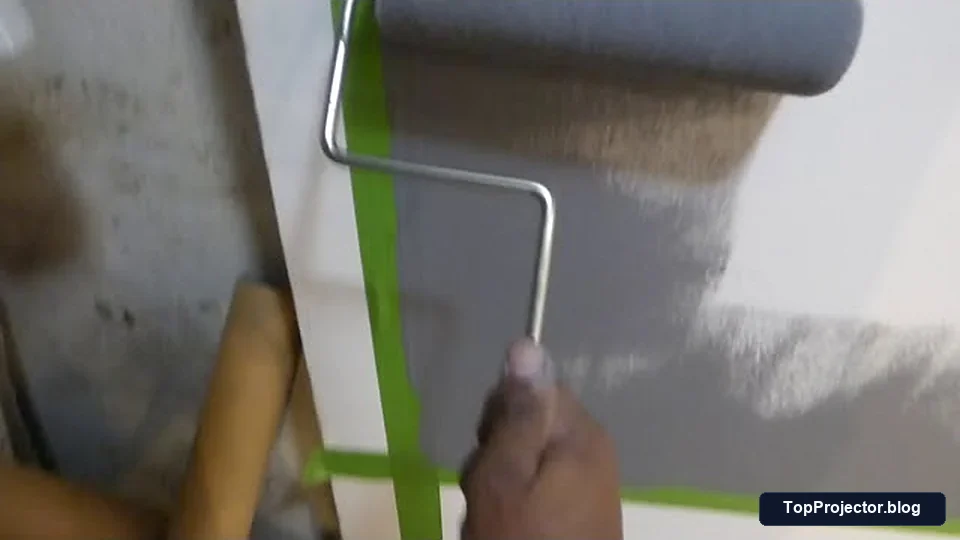
Specialized ambient light rejection coatings utilize microscopic reflective flakes designed to bounce overhead illumination away, echoing the outdoor performance found in our outdoor movie screen picks for portable backyard theater setups.
However, achieving an immaculate roller application without stippling or roller marks requires professional spray equipment and extensive surface preparation work.
Factory-engineered optical materials use precise microscopic lenticular structures that drastically outperform any hand-rolled chemical mixture under high ambient light conditions.
Testing ambient light rejection paint requires evaluating angular reflection properties against overhead fixtures. DIY mixtures often scatter light uniformly, dropping contrast ratios below 10:1 under moderate daytime living room illumination.
- Microscopic reflective flakes manage room illumination
- Factory lenticular structures deliver superior directional rejection
- Spray application required for optimal paint finishes
- Always measure ambient foot-lamberts before choosing your optical surface.
Living Room Daylight Versus Basement Darkness
Bright living spaces demand aggressive ambient light rejection to prevent washed-out highlights and muddy shadow details during daytime viewing sessions.
A professionally tensioned material with a 0.8 gain rating preserves black levels much better than standard white walls or DIY coatings.
- Daylight viewing requires high rejection coefficients
- Basement environments tolerate lower gain surfaces
Evaluating Ceiling Light Rejection
Specialized optical projector screens use microscopic sawtooth structures to reject overhead illumination. This mechanical design preserves ANSI contrast levels by deflecting ambient rays away from the primary seated viewer zone.
- Overhead light rejection is critical for bright living rooms.
Black Floor Depth and Contrast Dynamics
Achieving deep, inky black levels demands a surface capable of absorbing stray light without crushing critical shadow details in dark movie scenes.
Optical surface coatings absorb ambient room light effectively, yet their black floor often suffers when matching high-lumen laser projectors without precise calibration.
Factory-tensioned vinyl surfaces maintain uniform tension across the entire viewing area, preventing warping that destroys perceived contrast ratios.
Your projector's native contrast ultimately dictates black levels, while testing high-resolution sources becomes simple when you review our guide on how to mirror a Chromebook for portable source testing.
Achieving deep black floors demands precise optical coatings that absorb off-axis ambient light. Standard silver-infused paints frequently elevate black levels, turning dark cinematic shadow details into a washed-out gray haze.
- Surface coatings absorb ambient room light efficiently
- Vinyl tensioning prevents optical distortion and warping
- Native contrast relies on low light scatter
- Black floor retention dictates overall cinematic depth.
Shadow Detail Retention in Dark Scenes
Dark cinematic sequences expose the limitations of cheap DIY formulas by hiding subtle shadow details inside overly dark gray patches.
A high-end optical surface preserves grayscale linearity while maintaining an exceptional dynamic contrast ratio throughout late-night movie screenings.
- Grayscale linearity prevents crushed shadow details
- Late-night viewing highlights optical surface superiority
Dynamic Range Implications
True tensioned vinyl screens incorporate carbon-infused layers to absorb stray photons. This engineering marvel yields a much lower black floor and drastically improves perceived dynamic range during dark movie scenes.
- Carbon layers significantly enhance shadow detail extraction.
Peak Brightness, Gain, and HDR Delivery
High dynamic range content requires substantial peak brightness to render specular highlights like explosions and sunlight with realistic visual intensity.
Chemical coatings typically offer neutral or slightly negative gain profiles, reducing overall image luminance to compensate for bright room reflections.
Conversely, specialized optical surfaces feature engineered gain figures reaching 1.1 to 1.3 to boost perceived punch without introducing hot-spotting.
Projector enthusiasts must balance desired peak luminance against viewing cone restrictions when selecting between these two distinct projection mediums.
Maintaining accurate white luminance requires matching projector output with optical gain. High-gain paint mixtures often create aggressive hot-spotting, forcing viewers to sit directly on-axis to enjoy balanced HDR highlights.
- HDR content demands high peak brightness delivery
- Engineered gain boosts punch without hot-spotting
- Chemical formulas often feature neutral or negative gain
- Watch out for severe hot-spotting on high-gain DIY walls.
Specular Highlights and Laser Projector Matching
Modern ultra-short throw laser projectors emit massive lumen output that overwhelms standard matte walls. Before mounting, always verify screen placement using our throw distance calculator to secure proper geometry.
Pairing these high-output lasers with a high-gain optical surface ensures vivid, punchy highlights that rival traditional flat-panel televisions.
- Laser projectors require robust optical management
- Afternoon sports demand high lumen retention
HDR Tone Mapping Challenges
Modern laser projectors push massive lumens that challenge standard DIY surfaces. Premium engineered screens distribute peak brightness evenly across a 1.0 gain rating, preventing harsh clipping in bright outdoor scenes.
- Uniform luminance prevents unnatural specular highlight clipping.
Surface Texture, Viewing Angles, and Uniformity
Image uniformity heavily depends on the microscopic consistency of your chosen projection surface across the entire viewing plane.
Rolled chemical mixtures risk uneven thickness, introducing visible hot spots and texture artifacts that ruin bright, sweeping cinematic pans.
Factory-produced vinyl materials guarantee flawless micro-texture uniformity, ensuring zero grain interference even with sharp 4K content.
Wide seating arrangements benefit greatly from diffuse matte surfaces that prevent color shifting when viewing from extreme off-axis angles.
Roller application marks on DIY walls introduce micro-textures that scatter high-frequency light, a flaw easily noticed when testing precision optics like those examined in our Epson EH-LS12000B review.
- Microscopic consistency dictates overall image uniformity
- Rolled mixtures risk visible texture artifacts
- Vinyl materials guarantee flawless micro-texture
- Smooth surfaces are vital for crisp 4K pixel fidelity.
Off-Axis Viewing and Seating Arrangements
Wide living room seating configurations require broad viewing cones to prevent picture degradation for viewers sitting on the extreme left or right.
While directional optical materials narrow viewing angles, standard matte coatings maintain consistent color accuracy across a wider 160-degree dispersion arc.
- Wide seating needs broad viewing cones
- Matte coatings preserve color accuracy off-axis
Off-Axis Color Shifting
Directional material properties can induce severe color shifting for side-seated viewers. High-end multi-layer screens maintain a wide 160-degree viewing angle with strict luminance uniformity across the entire projection boundary.
- Wide seating arrangements require certified off-axis stability.
Screen Size Flexibility and Custom Room Geometries
Unique architectural layouts often feature curved walls, oversized dimensions, or custom built-ins that reject standard rectangular factory frames.
Coating a customized drywall surface provides ultimate sizing freedom, letting you paint massive cinematic canvases up to 150 inches and beyond.
Factory frames restrict you to predetermined aspect ratios and fixed sizes, making unconventional room designs difficult to accommodate properly.
DIY enthusiasts relish the complete control over borderless projection mapping that specialized optical liquid coatings provide for dedicated spaces.
Custom architectural room layouts frequently demand unconventional image dimensions that standard manufactured frames cannot accommodate. Painting a custom boundary allows exact sizing to match awkward ceiling soffits or built-in shelving.
- Custom architecture favors flexible sizing solutions
- Liquid coatings permit massive custom dimensions
- Factory frames impose strict aspect ratio limits
- Measure twice to ensure your painted border remains square.
Borderless Projection and Custom Framing
Seamlessly blending a projection surface into modern interior decor is easier when using custom-painted walls without thick aluminum bezels.
Applying velvet trim directly around your dried chemical coating delivers a clean, custom-tailored aesthetic that matches high-end custom architecture.
- Borderless integration enhances modern interior aesthetics
- Velvet trim creates a custom-tailored finish
Aspect Ratio Adaptability
Fixed-frame boundaries restrict you to standard 16:9 or 2.40:1 formats. DIY wall applications provide ultimate freedom for custom masking configurations, though optical rejection performance inevitably suffers without specialized factory coatings.
- Custom framing suits mixed multimedia entertainment spaces.
Gaming Motion, Input Lag, and Fast-Paced Action
Competitive console and PC gaming demand pristine motion handling and zero added input lag from your optical display pipeline.
Neither passive optical coatings nor tensioned vinyl materials introduce any electronic processing lag, ensuring your controller inputs remain instantaneous.
However, texture artifacts on poorly applied DIY surfaces can create distracting motion blur during rapid horizontal camera pans in FPS titles.
Smooth factory surfaces maintain absolute clarity during high-speed gaming sessions, keeping fast-moving objects sharply focused without visual distortion.
Fast-paced competitive gaming requires ultra-low input lag and pristine motion handling. While display surfaces do not process latency directly, poor reflective uniformity can exacerbate motion blur during rapid camera pans.
- Passive optical surfaces introduce zero electronic lag
- Poor DIY texture can cause distracting motion blur
- Factory surfaces maintain absolute clarity during motion
- Pair low-latency projectors with smooth, artifact-free surfaces.
High Refresh Rate Performance and Blur Reduction
Modern gaming projectors operating at high refresh rates require immaculate surfaces to resolve intricate detail during fast action sequences.
A premium factory-tensioned material prevents micro-distortions, ensuring crisp text and clear textures during high-octane 120Hz competitive matches.
- High refresh rates demand flawless surface clarity
- Tensioned materials prevent micro-distortions during motion
High Refresh Rate Compatibility
Modern consoles output demanding 4K at 120Hz signals that require flawless surface reflectivity. Smooth factory vinyl prevents optical artifacts, ensuring your rapid inputs sync perfectly with high frame rate gaming sessions.
- High frame rate signals demand pristine optical paths.
Installation Complexity, Maintenance, and Longevity
Physical installation complexity varies wildly between meticulous multi-step chemical painting and straightforward wall-mounted tensioned frame assembly.
Painting requires flawless drywall skimming, primer coats, professional spray application, and strict curing times to avoid permanent surface flaws.
Assembled screens offer predictable installation via wall brackets, but replacing damaged vinyl material requires purchasing entirely new replacement membranes.
Durability favors hard-wearing painted walls in households with children or pets, whereas tensioned vinyl demands careful handling to prevent punctures.
Constructing a rigid projection screen involves careful frame assembly and precise spring tensioning. Conversely, rolling specialized optical paint requires immaculate wall preparation, multiple coats, and professional spray equipment to avoid imperfections.
- Painting demands professional drywall prep and spraying
- Tensioned screens offer straightforward bracket mounting
- Wall coatings resist accidental physical punctures better
- Professional spray guns are mandatory for smooth paint application.
Long-Term Durability and Environmental Wear
Over years of exposure to heat and humidity, chemical wall mixtures resist sagging much better than improperly tensioned entry-level vinyl frames.
Maintaining your investment involves gentle dusting for painted surfaces, whereas vinyl requires specialized non-abrasive cleaners to preserve optical coatings.
- Wall mixtures resist long-term sagging issues
- Surface maintenance requires careful, non-abrasive cleaning
Long-Term Durability Factors
Painted surfaces attract dust and are notoriously difficult to clean without damaging the delicate optical layer. Factory screens feature protective coatings that withstand routine dusting and maintain peak optical performance for decades.
- Factory screens offer superior long-term cleanability.
Frequently Asked Questions
Does optical projection paint perform as well as a factory screen?
High-end optical paint matches budget screens in dark rooms, but factory-engineered lenticular screens offer superior ambient light rejection for bright living spaces. Professional spray techniques are mandatory to prevent stippling artifacts.
What is the primary installation challenge when applying projection paint?
Achieving an immaculate surface requires flawless drywall preparation, specialized primer coats, and professional HVLP spray equipment. Any roller texture will permanently degrade your 4K image sharpness and introduce hotspots.
Can I use an ALR paint with an ultra-short throw projector?
Specialized ultra-short throw paints exist, but achieving the precise downward light-rejecting angle needed for UST lasers is extremely difficult by hand. A dedicated UST screen remains the safer performance choice.
How does viewing angle compare between paint and screens?
Standard matte projection paint offers wide, uninhibited viewing angles similar to plain drywall. Conversely, high-performance ambient light rejection screens often narrow the viewing cone to maximize peak gain brightness.
Which option offers better long-term durability for family rooms?
Hard-wearing painted walls resist physical punctures and accidental impacts from children or pets much better than delicate tensioned vinyl surfaces. However, painted walls cannot be easily moved during a home relocation.