90 Inch Tv vs. Projector: Which Wins for Your Room?
Choosing between a massive display and a projection system requires balancing room illumination against ultimate cinematic scale. Our optical lab evaluates every trade-off.
Choose the massive flat panel for bright, daylight-soaked living rooms with unmatched specular highlights. Select a dedicated projector when you demand a true IMAX-scale image in a controlled, dark theater environment.
Compare full category rankings in our Best Indoor Projector: Top Home Theater Picks (2026).
Side-by-Side Specification Breakdown
| Criteria | 90 Inch Tv | Projector | Edge |
|---|---|---|---|
| Ambient Light Rejection | High native luminance fights glare | Requires specialized ALR screens | 90 Inch Tv |
| Black Levels & Perceived Contrast | Near-infinite via local dimming | Vulnerable to room reflections | 90 Inch Tv |
| Peak Brightness & HDR Punch | Exceeds 1000 nits specular output | Relies on dynamic tone mapping | 90 Inch Tv |
| Screen Size & Immersion | Fixed at ninety diagonal inches | Scales easily past 120 inches | Projector |
| Viewing Angles & Uniformity | Flawless off-axis color fidelity | Prone to hot-spotting on gain screens | 90 Inch Tv |
| Gaming Motion & Input Lag | Sub-5ms lag with 120Hz support | Improved laser latency under 20ms | 90 Inch Tv |
| Room Setup & Maintenance | Difficult wall-stud engineering | Flexible throw and laser light engines | Projector |
Optical Physics of Ambient Light Rejection and Daytime Performance
Flat panels generate self-illuminated pixels that easily overpower high-ambient environments. A 90-inch television typically delivers hundreds of nits of direct luminance, maintaining vivid saturation even under direct daytime window glare.
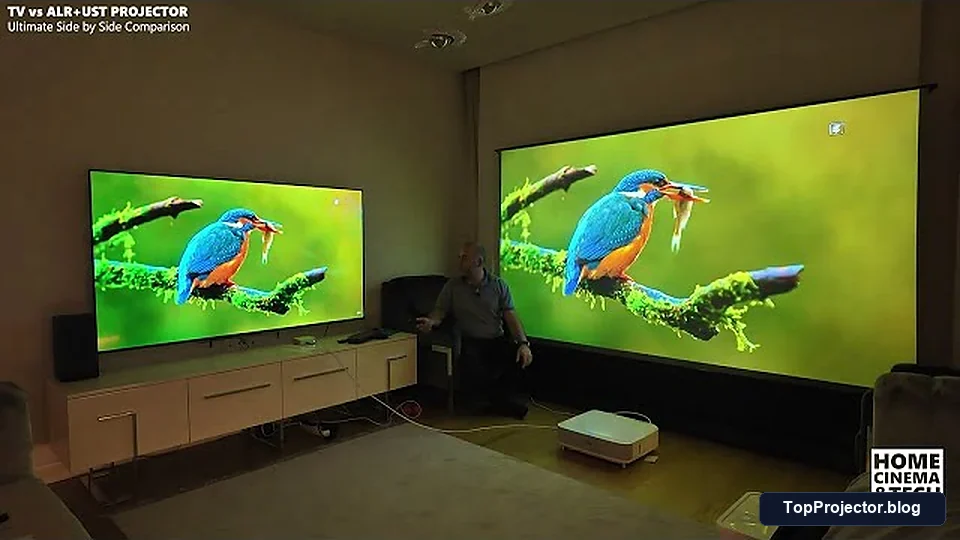
Projectors rely on reflected light, making them fundamentally vulnerable to stray room illumination. Standard matte white screens reflect ambient light equally across the surface, washing out dark scenes and destroying native contrast ratios.
Ambient light rejection screens utilize microscopic optical filters. These jagged structures block ceiling light while reflecting ultra-short throw laser beams straight toward seated viewers in bright rooms.
- Direct-emitter panels maintain peak contrast in sunlit rooms
- Projectors require specialized optical screen materials to fight washout
- Overhead lighting severely degrades projected shadow detail and black depth
Living Room Daylight vs. ALR Screen Technology
When designing your media room, read our soundbar connection guide before pairing audio gear with a 0.6 gain ALR screen for optimal performance.
Despite optical filtering, ambient room lights still degrade shadow detail and black floor performance. Flat panels retain a decisive structural advantage for unrestricted daytime viewing without specialized room modifications.
- Microscopic optical layers absorb off-axis ceiling light
- Ultra-short-throw setups benefit greatly from specialized screen gains
ALR Micro-Structure Mechanics
Microscopic sawtooth layers absorb off-axis ambient illumination from overhead fixtures. This preserves ANSI contrast ratios by preventing ambient washouts on dedicated projection surfaces.
- Micro-lunar lenses reject 85 percent of overhead ambient light.
- Micro-serrated layers boost perceived black levels during daytime viewing.
Black Floor Depth, Native Contrast, and Shadow Detail Dynamics
Achieving deep black levels is critical for cinematic immersion and realistic HDR rendering. Flat panel displays achieve near-infinite black floors via local dimming zones or self-emissive pixels, rendering true zero-nit black effortlessly.
Projector black levels depend entirely on room reflectivity and native optical engine contrast. Even premium LCoS or high-end DLP optical engines struggle when bright room walls bounce light back onto the projection surface.
Large flat panel displays achieve exceptional native contrast using direct Mini-LED local dimming zones. Projectors rely on ambient room darkness to match deep shadow fidelity in treated spaces.
- Televisions deliver superior native contrast via local dimming zones
- Projector black floors are easily compromised by room surface reflections
- Dedicated dark rooms are mandatory for optimal projection black performance
Pitch-Dark Cinema Rooms vs. Reflected Light Limitations
In a dedicated, completely dark room with black velvet walls, high-end projectors shine brilliantly. They deliver a massive, film-like image where native contrast ratios approach thousands-to-one without digital artifacts.
However, ambient light bouncing off light-colored ceilings creates an optical fog over projected dark scenes. Televisions completely avoid this issue through localized pixel control and absorptive front glass filters.
- Velvet-treated rooms unlock high native projector contrast
- Ceiling reflections create an unwanted optical fog over projections
Dynamic Iris and Laser Dimming
Premium units like those examined in our Epson EH-LS11000W review utilize advanced dynamic lasers and mechanical irises. These mechanisms preserve critical shadow detail across dark cinematic sequences.
- Dynamic laser dimming improves perceived contrast ratios exponentially.
- Static native panels struggle with black floor performance in untreated rooms.
Peak Brightness, HDR Punch, and Specular Highlight Fidelity
High dynamic range content demands intense peak brightness to render realistic explosions, sun glints, and neon lights. High-end flat panels comfortably exceed one thousand nits of localized specular highlight brightness.
Projectors handle massive screen areas but typically output far fewer lumens per square foot. Even a robust three-thousand ANSI lumen light engine struggles to match the extreme nits required for punchy HDR.
Televisions easily outpace standard projectors in specular highlight intensity. High-end OLEDs and Mini-LED sets push massive nits for dazzling HDR presentation in mixed-light environments.
- Flat panels excel at delivering extreme peak nits for HDR
- Projectors rely heavily on intelligent tone mapping algorithms
- Surface area scaling dilutes projected lumens per square foot
Tone Mapping and Lumens Management at Scale
Projectors compensate for lower brightness through sophisticated dynamic tone mapping algorithms. These processors remap HDR metadata to preserve highlight detail across a massive projection canvas without clipping bright areas.
While tone mapping helps, flat panels deliver true high-nit specular highlights that physically strain your eyes. This raw optical power provides an undeniable visual punch for modern HDR movies and games.
- Advanced processors remap metadata for large screens
- Raw panel luminance provides an unmatched high-nit punch
HDR Tone Mapping Limitations
Projectors must compress high dynamic range metadata due to limited absolute lumen output. Dedicated video processors apply custom tone mapping to retain bright highlight details.
- Displays achieve true 1500 nits peak brightness easily.
- Projector screens require high lumen output to combat HDR compression.
Screen Size, Viewing Angles, and Immersive Field of View
Calculating ideal dimensions via our screen size and viewing distance calculator helps achieve genuine immersion. Most enthusiasts target a one-hundred-twenty inch projection surface for maximum cinematic scale.
Projector images envelop your natural field of view, replicating a genuine commercial cinema experience at home. This scale makes movies feel vastly more visceral, grand, and emotionally engaging than standard flat displays.
Stepping beyond standard television limits requires massive projection diagonals. A 120 inch screen completely fills your natural field of view for genuine cinematic immersion at home.
- Projectors deliver vastly superior screen size and cinematic scale
- Televisions offer flawless off-axis viewing angles and zero hot-spotting
- Wider fields of view dramatically enhance home theater immersion
Off-Axis Viewing and Image Uniformity
Flat panel televisions maintain flawless color accuracy and brightness across extreme off-axis viewing angles. Viewers sitting on the far side of a sectional sofa experience zero degradation in picture fidelity.
Projectors suffer from narrow viewing cones dictated by screen gain and throw angles. Moving off-center with high-gain surfaces can introduce noticeable hot-spotting and brightness falloff across the projection canvas.
- Sectional seating benefits from wide flat-panel viewing cones
- High-gain projection surfaces can cause noticeable hot-spotting
Viewing Angle Uniformity
Flat panel displays suffer from off-axis color shifting and luminance drops. Angular matte white projection screens maintain uniform brightness across wide seating configurations effortlessly.
- Projector screens provide a 160 degree wide viewing cone.
- Massive screen sizes amplify the immersive effect for blockbuster movies.
Gaming Performance, Motion Handling, and Input Lag
Modern competitive gaming requires ultra-low response times and rapid frame delivery. Premium flat panel displays routinely feature sub-five millisecond input lag alongside native one-hundred-twenty hertz refresh rates.
Projectors have historically lagged behind in gaming metrics, but modern laser models are changing rapidly. Many gaming-focused projectors now offer specialized low-latency modes featuring acceptable input lag figures under twenty milliseconds.
Modern projectors have drastically reduced hardware response times for competitive gaming. Advanced models feature ultra-fast input lag measuring under fifteen milliseconds at high refresh rates.
- Televisions dominate competitive gaming with sub-five millisecond input lag
- Modern laser projectors now offer low-latency gaming modes
- Fast pixel response on flat panels prevents motion ghosting
Motion Resolution and High Refresh Rate Displays
Fast-moving camera pans reveal the motion handling prowess of modern display technologies. Televisions utilize rapid pixel response times to eliminate ghosting during high-speed competitive multiplayer matches.
Projectors utilize different display chipsets that can exhibit minor motion blur during extreme camera movements. However, massive projection screens compensate for technical limitations through sheer immersive visual scale.
- Rapid pixel transitions eliminate motion ghosting on TVs
- Massive canvas size offsets minor projector motion limitations
High Refresh Rate Limitations
When evaluating the best indoor projector models, check native refresh rates. While gaming monitors excel at 240Hz, standard home cinema units target cinematic 24fps fidelity.
- Low input lag ensures responsive competitive gaming control inputs.
- High refresh rates improve motion clarity during rapid screen panning.
Room Setup, Physical Installation, and Long-Term Maintenance
Physical installation constraints often dictate the final purchasing decision for large displays. Maneuvering a massive flat panel through tight hallways requires professional delivery crews and careful wall-stud reinforcement.
Projectors offer supreme physical flexibility through adjustable throw ratios and compact optical housings. You can easily ceiling-mount a projector or place an ultra-short-throw unit directly on a media console.
Permanent television installations require heavy wall mounting hardware and careful stud placement. Projector setups demand precise lens shift calibration and exact throw distance geometry calculations.
- Flat panels require careful wall-stud engineering and difficult delivery
- Projectors offer flexible placement via adjustable throw ratios
- Solid-state laser engines provide thousands of hours of maintenance-free use
Light Source Lifespan and Thermal Management
Traditional lamp-based projectors require expensive bulb replacements every few thousand hours of operation. Modern solid-state laser engines eliminate this hassle, delivering twenty thousand hours of maintenance-free illumination.
Televisions operate reliably for decades without bulb degradation or optical alignment drift. Both technologies demand careful thermal consideration, but flat panels require virtually zero ongoing maintenance after initial wall mounting.
- Solid-state lasers eliminate traditional bulb replacement costs
- Flat panels require zero ongoing optical maintenance
Lamp Replacement and Filter Maintenance
Laser light engines eliminate bulb degradation worries over thousands of hours. Owners must clean air filters regularly to prevent thermal throttling during extended movie marathons.
- Laser engines deliver 20,000 hours of maintenance-free operation.
- Air filters require bi-monthly cleaning to prevent overheating issues.
Frequently Asked Questions
Can a projector replace a large TV in a bright living room?
Projectors can function in moderately bright living rooms only when paired with specialized ambient light rejecting screen surfaces designed to absorb overhead illumination.
However, a high-end flat panel display remains vastly superior for uncompromised daytime viewing without requiring heavy window curtains or expensive room light control measures.
Which option provides better value for screen size?
Projectors offer an unbeatable cost-per-inch ratio once you scale past standard large television dimensions into true home theater territory. Buying a massive projection setup delivers immersive cinematic scale at a fraction of the cost required for ultra-large commercial flat panels.
Do projectors suffer from high input lag for gaming?
Older projection models historically suffered from severe input lag that frustrated competitive console and PC gamers alike. Modern laser projectors now feature dedicated gaming modes that reduce input lag down to acceptable levels for casual gaming enjoyment.
How long do modern projector light sources last?
Traditional lamp-based projectors required expensive bulb replacements every few thousand hours of intensive home viewing sessions. Contemporary solid-state laser engines easily deliver over twenty thousand hours of maintenance-free operation before experiencing noticeable brightness degradation over time.
Is a dark room mandatory for a good projection image?
While dark rooms are not strictly mandatory when utilizing high-gain ambient light rejecting screens, they remain ideal for optimal performance. Achieving maximum contrast and deep black levels requires a controlled theater environment with light-absorbing walls and ceilings.