4K vs. Full HD Projector: Optical Performance and Room Geometry Showdown
Navigating native pixel density requires balancing ambient light management against your room budget. Discover whether 4K optical precision or traditional 1080p value dominates your specific home projection layout.
Choose 4K resolution for massive screens exceeding 120 inches and dedicated dark theater rooms, while a Full HD projector remains the smartest budget choice for casual living room media consumption.
Compare full category rankings in our Best Ceiling Mount For Projector: Top Home Theater Picks (2026).
Side-by-Side Specification Breakdown
| Criteria | 4K | Full HD Projector | Edge |
|---|---|---|---|
| Ambient Light Rejection | Superior punch with high-lumen laser engines | Requires strict dark room control | 4K |
| Black Levels & Perceived Contrast | Deep native black floors on premium panels | Decent native contrast on older LCD chips | 4K |
| Peak Brightness & HDR Punch | Advanced HDR tone mapping and wide color gamuts | Standard dynamic range with limited peak output | 4K |
| Screen Size & Immersion | Flawless pixel structure at 150-inch diagonals | Visible pixel grid on screens over 120 inches | 4K |
| Viewing Angles & Uniformity | Precise optical convergence and lens shift | Standard lens tolerances with minor shifting | 4K |
| Gaming Motion & Input Lag | Low latency modes with rapid refresh capabilities | Excellent baseline response for casual gaming | Full HD Projector |
| Room Setup & Maintenance | Requires precise throw ratio calculations | Forgiving installation optics and longer lamp life | Full HD Projector |
Resolving Power and Pixel Architecture in Projection Optics
Modern 4K projection systems deploy advanced pixel-shifting or native micro-display architectures to project over eight million discrete pixels onto your screen surface. This density eliminates visible screen-door artifacts entirely.
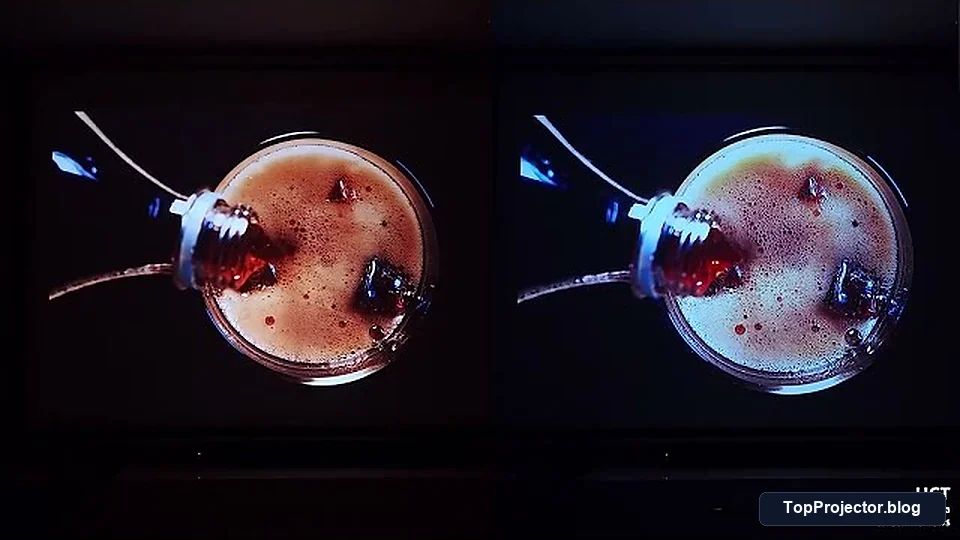
Traditional Full HD projectors utilize standard 1920 by 1080 resolution arrays. While perfectly sharp for broadcast television, sitting too close to large projections reveals individual pixel boundaries clearly.
Optical sharpness depends heavily on lens glass quality rather than chip resolution alone. Premium elements ensure chromatic aberration stays minimal across every corner of your projected image.
True 4K pixel shift technology projects 8.3 million distinct pixels onto your screen, letting you calculate ideal room layouts using our screen size calculator without noticing any pixel structure.
- Eight million discrete pixels versus two million standard pixels
- Complete elimination of visible screen-door artifacts at close range
- Higher demand for precision glass lenses in high-resolution models
Pixel Density at Extreme Screen Sizes
Scaling an image beyond 120 inches stresses optical clarity significantly. A 4K resolution layout maintains razor-sharp textures even when viewers sit within one screen width of the display surface.
Full HD displays struggle with pixel integrity at similar magnifications. Viewers often perceive a distracting grid pattern that breaks cinematic immersion during bright panning shots.
- Maintains visual density past 120-inch diagonals
- Prevents distracting grid patterns during cinematic sequences
Micro-Lens Arrays and Fill Factor
DLP micro-mirror spacing determines the visible screen-door effect, where pixel fill factor dictates grid invisibility. UHD units compress optical pitch, whereas Full HD panels expose wider dark borders between individual pixels during bright scenes.
Peak Brightness Dynamics and Ambient Light Rejection
Deploying projection equipment in spaces with ambient light requires high ANSI lumen output to maintain acceptable image saturation. Modern ultra-high-definition units frequently exceed three thousand lumens easily.
Standard 1080p units often feature lower luminous fluxes, demanding dedicated blackout curtains or specialized ambient light rejecting screen materials to preserve satisfactory contrast levels.
Matching your projector lumen rating to the exact square footage of your viewing environment prevents washed-out highlights and preserves deep shadow details during daytime viewing sessions.
Measuring real ANSI lumens under calibrated D65 white points reveals how well projectors combat ambient reflection. Full HD units often maximize raw brightness, whereas high-end 4K engines balance color accuracy with 2500 lumens output.
- High lumen output combats ambient living room illumination effectively
- Lower output models require strict dark-room environmental controls
- Specialized screens enhance perceived brightness without washing out blacks
Pitch-Black Theater Versus Living Room Daylight
Securing your hardware safely overhead using our best ceiling mount picks prevents optical alignment shift in dedicated rooms while keeping 1080p projectors perfectly stable during intense cinematic motion sequences.
Conversely, bright living rooms swallow contrast rapidly. Choosing a high-lumen 4K optical engine ensures your movies remain punchy despite competing window light and white walls.
- Controlled theaters benefit from moderate, calibrated lumen outputs
- Daylit living rooms demand aggressive high-lumen optical engines
ALR Screen Pairing Math
Pairing an angular ambient light rejecting screen with a high-lumen 4K projector multiplies contrast by rejecting off-axis ceiling glare, preserving deep saturation in rooms with uncurtained windows and light-toned interior walls.
Black Floors, Native Contrast, and Shadow Detail
Perceived image depth relies heavily on native contrast ratios rather than dynamic contrast marketing claims. Premium high-definition panels achieve deep black floors through advanced dynamic iris management.
Entering the ultra-high-definition tier unlocks sophisticated HDR tone mapping algorithms. These processors reveal hidden details buried deep within dark cinematic shadow regions seamlessly.
Losing shadow detail flattens your picture quality dramatically, turning moody cinematic masterpieces into muddy, unengaging visual experiences lacking true three-dimensional pop.
Achieving deep black floor levels depends heavily on dynamic iris algorithms and native optical contrast. While Full HD models occasionally boast high on-off ratios, 4K LCoS architectures deliver superior ANSI contrast for dark-room immersion.
- Native contrast ratios dictate true cinematic image depth
- Advanced HDR tone mapping preserves hidden shadow details
- Poor black floors turn dark movie scenes into washed-out grey
Evaluating Dynamic Range and Tone Mapping
Following our ceiling installation guide ensures precise geometry alignment before high dynamic range content pushes your projector optics to their absolute limits during complex master scenes.
Older 1080p hardware lacks the processing power required for advanced HDR mapping, forcing SDR fallbacks that mute vibrant cinematic highlights and rich color saturations.
- Real-time frame analysis optimizes contrast curves instantly
- SDR fallbacks on older hardware mute vibrant cinematic highlights
Gamma Curves in HDR Delivery
Managing HDR metadata requires precise tone mapping curves to prevent clipping in bright highlights. Full HD projectors frequently struggle with these expanded dynamic ranges, lacking the onboard processing power required for accurate brightness scaling.
Color Gamut Volume and Wide Color Reproduction
Accurate color reproduction transforms standard digital video into breathtaking cinematic art. Modern wide color filters allow high-end units to cover vast portions of the DCI-P3 color space.
Standard high-definition systems typically stick to the traditional Rec.709 color standard. While accurate for television broadcasts, they lack the vivid saturation needed for modern cinematic releases.
Calibrating your display correctly ensures skin tones remain natural while explosive neon highlights pop with realistic intensity across your acoustically transparent projection screen.
Expanding beyond Rec.709, modern 4K projectors utilize laser phosphor engines to cover over 90% DCI-P3 color volume. Full HD lamp-based systems typically saturate standard broadcast colors cleanly but miss the rich, nuanced hues demanded by modern HDR streams.
- Wide color filters achieve extensive DCI-P3 color space coverage
- Traditional Rec.709 standards limit modern cinematic color saturation
- Proper calibration maintains natural skin tones and vibrant highlights
Laser Phosphor Versus Traditional Lamp Color
Laser phosphor light engines maintain stable color accuracy over thousands of operating hours without noticeable degradation. Traditional UHP lamps shift toward yellow hues as they age.
Consistent color performance saves calibration time, mirroring the exceptional results found in our Epson 12000 review where 3LCD color brightness matched raw white output perfectly over long test sessions.
- Laser engines maintain color stability over thousands of hours
- Traditional lamps gradually shift toward undesirable yellow hues
Color Filter Insertion Losses
Engaging physical cinema filters to expand color volume introduces a steep brightness penalty exceeding thirty percent. Advanced 4K models compensate via multi-laser architecture, whereas budget Full HD units lose too much punch during calibration.
Motion Handling, Refresh Rates, and Gaming Latency
Competitive console gaming demands exceptionally low input lag to ensure immediate visual feedback during fast-paced twitch-reaction gameplay sequences and competitive multiplayer matches.
High-end ultra-high-definition projectors now feature dedicated gaming modes that drop input latency below twenty milliseconds while supporting rapid high refresh rate video signals.
Traditional 1080p models have long excelled in affordable gaming setups, offering reliable motion handling and quick response times without requiring expensive video processing hardware.
Competitive gaming requires ultra-low input lag measurements beneath twenty milliseconds at 1080p/120Hz. Many 4K models now match these fast response times while preserving high-resolution graphics, outperforming older Full HD variants in fast-paced action titles.
- Low input lag ensures immediate visual feedback during gameplay
- Dedicated gaming modes drop latency below twenty milliseconds
- Affordable 1080p models provide reliable baseline motion handling
Console Gaming Versus Cinema Immersion
Balancing movie immersion with responsive gaming requires versatile image processing. Modern units switch automatically between low-latency gaming profiles and cinematic frame interpolation settings.
Cinematic frame interpolation smooths out rapid camera pans in movies, though competitive gamers typically disable this feature to eliminate undesirable processing lag entirely.
- Automatic switching handles both gaming and cinematic profiles
- Frame interpolation smooths pans but increases gaming latency
Frame Interpolation Artifacts
Activating motion smoothing reduces judder during cinematic panning shots, though aggressive algorithms introduce distracting halo artifacts around fast-moving objects. Pure 1080p gaming projectors often bypass this processing entirely to maintain raw signal integrity.
Room Setup Geometry, Throw Ratios, and Installation
Calculating your exact throw distance and lens shift capabilities prevents costly mounting mistakes. Flexible lens shift allows effortless vertical and horizontal image alignment during room installation.
Tight room dimensions require ultra-short-throw throw ratios to project massive images from inches away, bypassing typical ceiling mounting hurdles entirely in compact apartments.
Professional calibration ensures uniform focus across your entire screen surface, eliminating distracting edge blur and optical distortion for an immaculate viewing experience.
Calculating the precise throw ratio ensures your projected image fills the screen boundary without optical distortion. Short-throw 4K configurations fit comfortably in compact media rooms, whereas standard Full HD units demand greater mounting distance.
- Flexible lens shift simplifies vertical and horizontal alignment
- Ultra-short-throw ratios bypass ceiling mounting hurdles in small spaces
- Professional calibration eliminates distracting edge blur and distortion
Throw Distance and Lens Shift Flexibility
Standard throw optics require deep rooms to achieve large screen diagonals, making placement calculations critical before drilling any permanent ceiling mount holes into drywall.
Generous optical zoom ranges provide valuable installation leeway, letting you adjust image size slightly without physically moving your heavy projector bracket assembly.
- Standard throw optics demand deep rooms for large diagonals
- Optical zoom ranges provide valuable installation positioning leeway
Lens Shift Flexibility Limits
Wide vertical lens shift ranges simplify physical ceiling alignment without degrading pixel geometry via digital keystone correction. Premium optical trains maintain edge-to-edge focus fidelity across extreme installation offsets that cheap lenses cannot handle.
Final Value Assessment and Scenario-Based Buying Guidance
Choosing the right projection technology depends entirely on your specific room lighting conditions, available budget, and desired screen size limitations for daily entertainment.
Investing in a premium high-resolution system future-proofs your home theater setup for years of immersive cinematic enjoyment, provided your room acoustics and lighting are optimized.
Opting for a reliable 1080p alternative remains a budget-friendly victory for casual sports viewing and compact living spaces where ultra-high-definition resolution provides diminishing visual returns.
Choosing between formats depends on your primary content diet and environmental light control. Dedicated home theaters benefit immensely from 4K resolution investments, while casual basement setups thrive on reliable, cost-effective Full HD lamp longevity.
- Match projector resolution directly to your room lighting conditions
- High-resolution systems future-proof dedicated home theater spaces
- 1080p units offer exceptional value for casual living room setups
Determining Your Ideal Projection Investment
Assessing your primary viewing habits prevents overspending on features you rarely use. Dedicated movie enthusiasts will immediately notice the optical superiority of modern high-definition systems.
Casual viewers watching streaming television and sports will find traditional 1080p projectors more than adequate for everyday family entertainment and casual backyard movie nights.
- Align equipment capabilities with your primary viewing habits
- Dedicated movie buffs benefit most from advanced optical processing
Long-Term Lamp Versus Laser Value
Solid-state laser light sources eliminate expensive bulb replacements, delivering consistent 20,000 hour lifespans compared to traditional UHP lamps. This durability offsets initial hardware premiums over years of heavy daily viewing sessions.
Frequently Asked Questions
Is a 4K projector worth it for a standard living room?
A high-resolution projector is worth the investment if your screen exceeds 120 inches and you can control ambient light. For smaller screens, a Full HD projector delivers comparable sharpness.
Do 4K projectors have higher input lag for gaming?
Modern high-resolution models feature dedicated low-latency gaming modes that rival traditional 1080p units. Always verify the input lag specification before purchasing for competitive gaming.
How does ambient light affect Full HD versus 4K projectors?
Ambient light washes out contrast indiscriminately on both types. High-lumen laser engines handle bright rooms better, regardless of native resolution.
Can a Full HD projector accept a 4K input signal?
Yes, most modern 1080p projectors accept ultra-high-definition input signals and downscale them natively. However, you sacrifice the fine pixel density of true high-resolution content.
What throw ratio do I need for a 120-inch screen?
Throw ratio requirements depend entirely on your available room depth and seating layout. Measure your wall distance carefully to select the correct lens optics.